
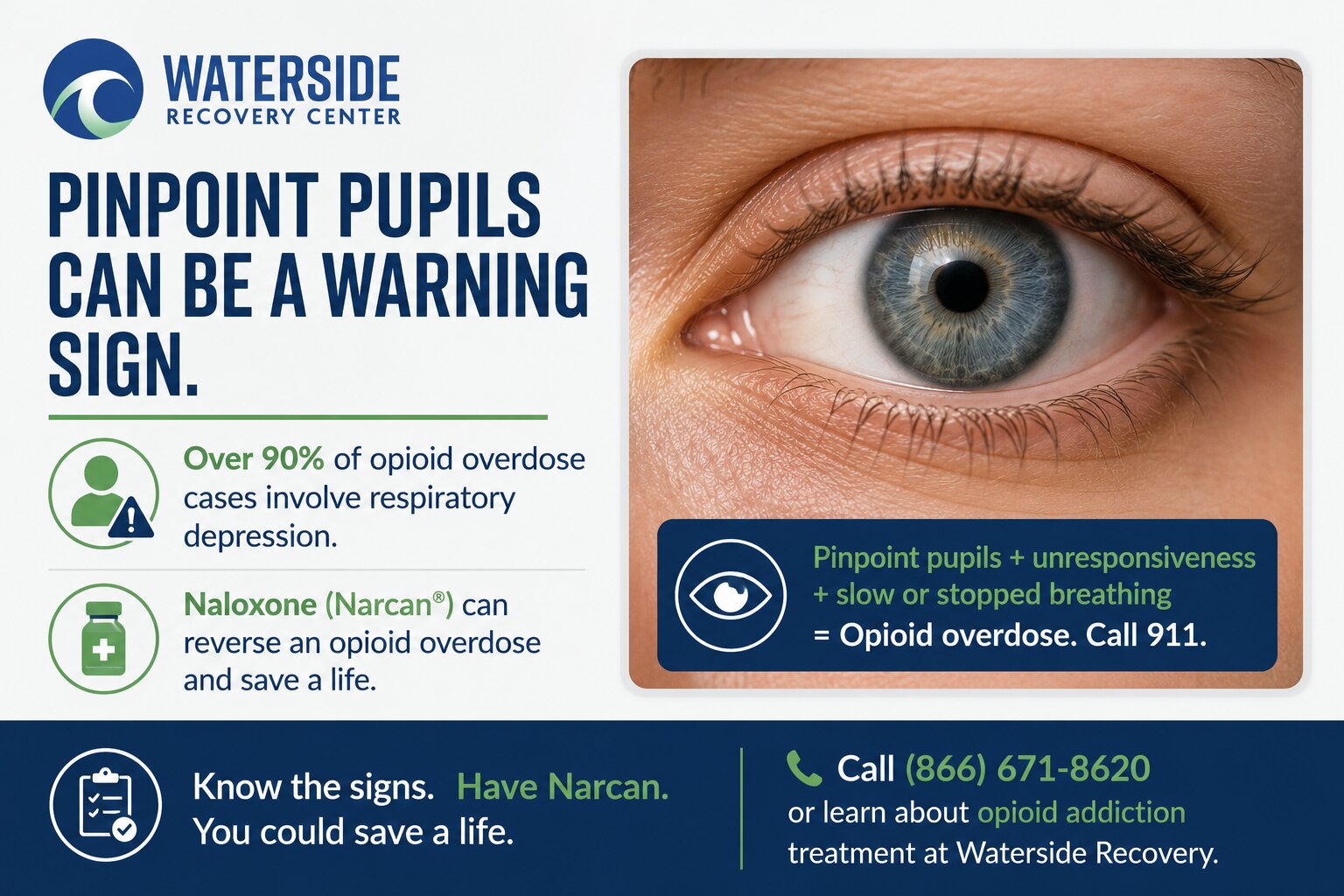
Pinpoint pupils on their own are a sign that opioids are in someone’s system. Pinpoint pupils together with slow or stopped breathing and no response when you try to wake the person can mean an opioid overdose: call 911 and give Narcan.
If you’ve noticed tiny pupils in someone you love and you’re worried, this guide covers when pinpoint pupils are an emergency, what to do in the moment, and what to watch for if the person seems okay.
What Pinpoint Pupils Mean
Pinpoint pupils (miosis) are pupils that stay very small, often 2 millimeters or less, even in dim light. Opioids are by far the most common cause outside a hospital, because they act directly on the part of the brainstem that controls pupil size.
A few medications and medical conditions can also shrink the pupils. If you’re trying to figure out the cause rather than whether it’s an emergency, our guide to which drugs cause pinpoint pupils covers them in detail.
When Pinpoint Pupils Mean an Opioid Overdose
This is the most important section for families to understand.
Pinpoint pupils alone do not necessarily mean someone is overdosing.
The danger comes when they occur together with other signs.
Healthcare providers often look for the classic opioid overdose triad:
- Pinpoint pupils
- Unconsciousness or inability to wake the person
- Slow, shallow, or absent breathing
When these three signs appear together, assume an opioid overdose is occurring.
Other warning signs may include:
- Blue or gray lips or fingernails
- Gurgling, choking, or snoring-like sounds
- Limp body
- Cold or clammy skin
- Weak or absent pulse
Today, fentanyl has made opioid overdoses even more dangerous because extremely small amounts can severely suppress breathing.
Waiting to see whether someone “sleeps it off” can be life-threatening.
Pinpoint Pupils but They Seem Okay?
If someone has pinpoint pupils but is awake, talking, and breathing normally, it usually isn’t an overdose right now. It does mean opioids are active in their body, and the situation can change.
- Stay with them, especially if they’ve just used
- Watch for drowsiness that deepens, or nodding off that gets harder to interrupt
- Keep checking that their breathing stays steady
- Keep Narcan within reach
If they become hard to wake or their breathing slows, treat it as an overdose.
What to Do During a Suspected Opioid Overdose
If someone has pinpoint pupils and is difficult or impossible to wake, treat the situation as an emergency.
Call 911 Immediately
Emergency medical services should be contacted as soon as possible.
Even if someone wakes after receiving naloxone, they still need medical evaluation because the effects of opioids may outlast the medication.
Administer Narcan (Naloxone)
Naloxone rapidly reverses opioid overdose by blocking opioid receptors.
If available:
- Administer Narcan immediately.
- If there is no response after 2 to 3 minutes, administer another dose if available.
- Continue following dispatcher instructions until emergency responders arrive.
Narcan is available without a prescription at pharmacies throughout Massachusetts, and many statewide harm reduction organizations distribute it free of charge.
Place the Person in the Recovery Position
If the person begins breathing but remains unconscious:
- Roll them onto their side.
- Keep the airway clear.
- Continue monitoring breathing until emergency personnel arrive.
Stay With Them
Never leave someone alone after administering Narcan.
The medication can wear off before the opioid leaves the body, allowing overdose symptoms to return.
Why Every Household Affected by Opioid Use Should Have Narcan
Families often hope they will never need naloxone.
Unfortunately, overdose can occur unexpectedly—even among people who have used opioids for years.
The risk is especially high because:
- Fentanyl is increasingly found in illicit drugs.
- Drug potency varies from one use to the next.
- Tolerance changes after periods of reduced use or treatment.
Keeping Narcan available provides an opportunity to save a life while waiting for emergency medical care.
It is one of the most important harm reduction tools available today.
When Pinpoint Pupils May Signal a Bigger Problem
Repeated episodes of opioid intoxication often indicate more than occasional use. They may suggest:
- Increasing opioid tolerance
- Physical dependence
- Opioid use disorder
- Escalating opioid use despite negative consequences
Small pupils are only one physical clue. Our guide to the signs of opioid addiction covers the behavioral and emotional changes that often show up alongside them.
Treatment Can Help Prevent Future Overdoses
Overdose prevention is essential, but it addresses only the immediate emergency. Long-term recovery involves treating the underlying opioid use disorder through evidence-based care. Treatment may include:
- Medication-assisted treatment (MAT) with Suboxone or Vivitrol
- Individual therapy
- Group counseling
- Family education
- Relapse prevention planning
- Continuing recovery support
Seeking treatment after repeated opioid intoxication can significantly reduce the risk of future overdose.
Frequently Asked Questions
Can you have pinpoint pupils without overdosing?
Yes. Pinpoint pupils show up whenever opioids are active in the body, including in people taking prescribed opioids as directed. They signal an overdose only when combined with unresponsiveness and slow, shallow, or absent breathing.
Are pinpoint pupils always an overdose sign?
No. Pinpoint pupils alone do not always mean someone is overdosing. They become a medical emergency when combined with unresponsiveness and slow, shallow, or absent breathing.
What are the signs of an opioid overdose?
Common signs include pinpoint pupils, inability to wake the person, slow or stopped breathing, blue lips or fingernails, gurgling or choking sounds, limpness, and loss of consciousness. If these signs are present, call 911 immediately and administer Narcan if available.
How Waterside Recovery Can Help
If you’ve seen pinpoint pupils more than once, or you’re living with the fear of another overdose, you don’t have to wait for an emergency to get help. Waterside Recovery offers outpatient care across Plymouth County, the South Shore, and MetroWest, with medication support, therapy, and family involvement.
Learn more about opioid addiction treatment at Waterside, call (866) 671-8620, or verify your insurance to see what’s covered.