
Watching someone repeatedly drift in and out of consciousness after using opioids can be frightening. Many parents, partners, and friends don’t know whether they’re witnessing a common effect of opioid use or a life-threatening emergency.
If you’re searching about nodding off opioids, you’re likely trying to understand where that line is. While not every episode of nodding is an overdose, it is a warning sign that the central nervous system is being significantly suppressed. If opioid use has become difficult to control, learning about opioid addiction treatment may be an important step toward recovery.
Knowing how to recognize the difference between opioid nodding and an overdose could save someone’s life.
What Is Nodding Off on Opioids?
“Nodding off” refers to the characteristic semi-conscious, deeply drowsy state that often occurs during opioid intoxication.
Someone who is nodding may:
- Drift off in the middle of a conversation
- Suddenly drop their head before briefly waking again
- Seem unable to keep their eyes open
- Speak slowly or slur their words
- Alternate between being awake and nearly asleep
- Appear relaxed but unusually difficult to engage
This behavior has long been associated with heroin use, leading many people to describe it as nodding on heroin. However, it can occur with nearly any opioid, including:
- Prescription oxycodone
- Hydrocodone
- Morphine
- Fentanyl
- Methadone
- Heroin
The severity of opioid nodding depends on several factors, including:
- The amount used
- Individual tolerance
- Whether other substances—especially alcohol or benzodiazepines—were also taken
- The potency of the opioid involved
While nodding itself does not always mean an overdose is occurring, it indicates that opioids are significantly depressing the central nervous system.
Why Do Opioids Cause Nodding?
Opioids work by attaching to mu-opioid receptors throughout the brain and body.
Most people know these receptors help reduce pain.
What many don’t realize is that they are also located in areas responsible for:
- Alertness
- Wakefulness
- Breathing
- Heart rate
- Consciousness
As opioid activity increases, brain function slows.
The result is opioid central nervous system (CNS) depression.
This slowing produces effects such as:
- Relaxation
- Drowsiness
- Reduced awareness
- Slowed breathing
- Slower reaction times
When opioid levels become high enough, a person may repeatedly drift toward sleep while still being able to wake briefly.
This is the “nodding” state.
Clinically, it reflects profound sedation—but one that has not yet completely shut down the brain’s ability to respond.
However, this state exists very close to the point where breathing can become dangerously impaired.
Why the Risk Is Higher Today
Years ago, heroin was the opioid most commonly associated with nodding.
Today, fentanyl has dramatically changed the landscape.
Because fentanyl is many times more potent than heroin or morphine, the difference between:
- Heavy sedation
- Respiratory depression
- Complete overdose
can occur within a much narrower margin.
A dose that causes someone to nod may quickly progress to respiratory arrest if additional opioids are taken or if fentanyl is unexpectedly present.
This is one reason healthcare professionals encourage families to take every episode of severe opioid sedation seriously.
When Nodding Becomes an Overdose
The most important distinction is this:
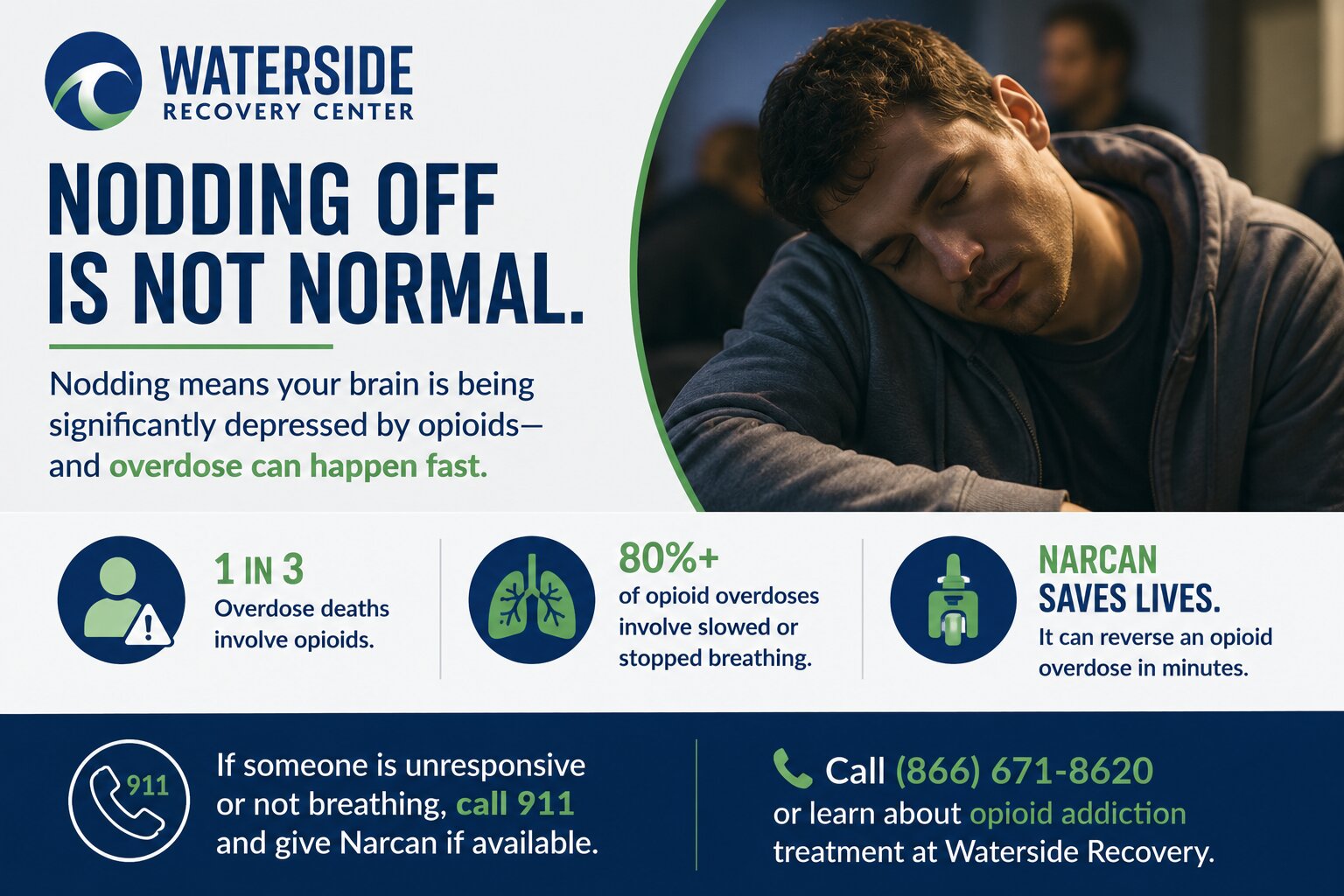
Someone who is nodding can usually still be awakened.
Someone experiencing an opioid overdose often cannot.
Understanding the difference between overdose vs. nodding off is critical.
Signs of Opioid Nodding
A person who is nodding may:
- Open their eyes when spoken to
- Respond to gentle shaking
- Answer questions, even slowly
- Continue breathing independently
- Fall asleep again shortly afterward
Although breathing may be slower than normal, it remains present.
Signs of an Opioid Overdose
An overdose is a medical emergency.
Warning signs include:
- Cannot be awakened by voice or touch
- Does not respond to vigorous stimulation
- Very slow, shallow, or absent breathing
- Blue or gray lips or fingernails (cyanosis)
- Pinpoint pupils
- Gurgling, choking, or snoring-like sounds (sometimes called the “death rattle”)
- Limp body
- Cold or clammy skin
If these symptoms are present, assume an overdose is occurring.
Waiting to “see if they wake up” can waste precious time.
What to Do If You’re Not Sure
Many loved ones hesitate because they worry about overreacting.
The safer approach is to assume the situation is serious until proven otherwise.
If the Person Is Unresponsive
If someone:
- Cannot be awakened
- Is barely breathing
- Stops breathing
- Has blue lips
- Makes choking or gurgling sounds
Take immediate action.
- Call 911.
- Administer Narcan (naloxone) if available.
- Follow emergency dispatcher instructions.
- Stay with the person until emergency responders arrive.
Narcan is safe to administer even if you’re unsure whether an opioid overdose is occurring.
If the Person Can Be Awakened but Is Extremely Sedated
If someone responds but quickly slips back into a deep nod:
- Stay with them.
- Continue monitoring their breathing.
- Do not let them remain alone.
- Keep Narcan nearby.
- Seek emergency medical care if responsiveness decreases or breathing worsens.
Never assume they are “just sleeping.”
Because opioids continue affecting the brain after use, someone who appears stable can deteriorate quickly.
Why You Should Never Let Someone “Sleep It Off”
One of the most dangerous misconceptions is that opioid intoxication improves with rest.
Unlike ordinary sleep, opioid CNS depression affects the brain’s control of breathing.
Someone who appears to be sleeping may gradually stop breathing altogether.
This risk becomes even greater when opioids are combined with:
- Alcohol
- Xanax (alprazolam)
- Ativan (lorazepam)
- Klonopin (clonazepam)
- Sleeping medications
- Other sedatives
These combinations significantly increase overdose risk.
If you’re uncertain whether someone is simply nodding or entering an overdose, continuous observation is essential.
Narcan Can Save a Life
Naloxone (Narcan) rapidly reverses opioid overdose by temporarily blocking opioid receptors.
It can restore breathing long enough for emergency medical care to take over.
Today, Narcan is available without a prescription at pharmacies throughout Massachusetts, and many community harm reduction organizations distribute it free of charge.
Having Narcan available does not encourage opioid use.
It prepares families for emergencies that can happen unexpectedly—especially in an era when fentanyl contamination is widespread.
When Nodding Reflects a Larger Problem
Repeated opioid nodding often indicates more than occasional opioid use.
It may suggest:
- Increasing opioid tolerance
- Escalating doses
- Frequent intoxication
- Opioid dependence
- Opioid use disorder
While some people begin using opioids after surgery or an injury, regular intoxication can gradually change how the brain functions.
Over time, stopping opioids may trigger withdrawal symptoms, cravings, and continued use despite harmful consequences.
Recognizing these patterns early gives individuals and families an opportunity to seek help before another overdose occurs.
Waterside Recovery proudly serves individuals and families throughout Bristol County, MetroWest, and Plymouth County with compassionate, evidence-based addiction treatment.
Professional Treatment Can Help
Living with the fear of another overdose can be exhausting for both individuals and their loved ones.
Comprehensive treatment addresses more than the physical effects of opioid use. It also helps people understand the factors contributing to addiction while building skills for long-term recovery.
Treatment may include:
- Medical detoxification
- Medication-assisted treatment (MAT)
- Individual therapy
- Group counseling
- Relapse prevention planning
- Family support services
- Continuing recovery care
Seeking help after repeated episodes of opioid nodding can reduce the risk of future overdoses and improve overall health.
Frequently Asked Questions
What does nodding off on opioids look like?
Nodding off on opioids is a state of profound drowsiness in which a person repeatedly drifts in and out of sleep. They may drop their head, briefly wake when spoken to, respond slowly, and then fall asleep again.
Is nodding off the same as an overdose?
No. Someone who is nodding can usually still be awakened and continues breathing, although breathing may be slower than normal. During an overdose, the person cannot be awakened, breathing becomes dangerously slow or stops altogether, and emergency medical care is needed immediately.
What’s the difference between an opioid overdose and nodding?
The biggest difference is responsiveness and breathing. A person who is nodding responds to voice or touch and continues breathing. A person experiencing an overdose cannot be awakened, may have blue lips or fingernails, and may breathe very slowly or not at all. If you’re unsure, call 911 and administer Narcan if available.
Final Thoughts
Seeing someone repeatedly nodding off after using opioids is never something to ignore. While nodding does not always mean an overdose is happening, it signals significant opioid CNS depression and can quickly progress to a life-threatening emergency—especially when fentanyl is involved.
If you notice someone becoming difficult to wake, breathing slowly, or showing other signs of overdose, call 911 immediately and administer Narcan if it’s available.
If opioid use has become an ongoing concern, help is available. Call (866) 671-8620 or learn more about opioid addiction treatment at Waterside Recovery.