

If you’ve experienced blackout drinking, it’s natural to wonder what actually happened. Many people assume they “passed out,” but an alcohol blackout is something very different. During a blackout, you may remain awake, talking, walking, or even carrying on conversations—yet your brain isn’t forming new memories. If alcohol has become difficult to control or blackouts are happening repeatedly, learning about alcohol addiction treatment can help you understand what recovery may look like and when it may be time to seek support.
A blackout isn’t simply forgetting details from a night out. It’s a temporary failure of memory formation caused by alcohol’s effects on the brain, and when it becomes a recurring pattern, it can be an important warning sign.
What Is a Blackout When Drinking?
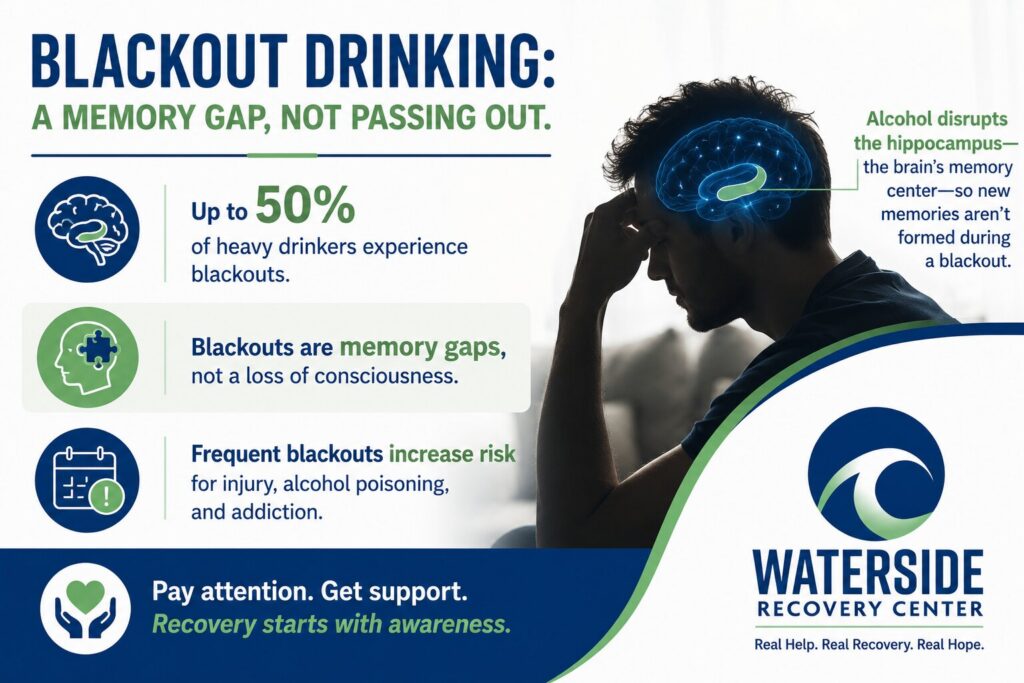
An alcohol blackout is a period of amnesia caused by drinking, not a period of unconsciousness.
During a blackout:
- You are awake.
- You may appear to function normally.
- You can carry on conversations.
- You may make decisions or complete activities.
- Your brain simply isn’t creating lasting memories of those events.
This happens because alcohol interferes with the hippocampus, the part of the brain responsible for converting short-term experiences into long-term memories.
As blood alcohol concentration (BAC) rises, the hippocampus becomes less able to store new information.
The result is that events occurring during the blackout are never properly recorded in memory.
Blackout Drinking vs. Passing Out
These terms are often confused, but they are not the same.
Blackout drinking means:
- You remain conscious.
- You continue interacting with people.
- You later have little or no memory of what happened.
Passing out means:
- You lose consciousness.
- You cannot respond normally.
- You are physically asleep or unconscious because of alcohol.
Someone experiencing a blackout may seem completely awake to everyone around them, making the memory loss especially surprising the next day.
The Two Types of Blackouts
Not every blackout looks the same.
Researchers generally describe two types of alcohol blackouts.
En Bloc Blackouts
An en bloc blackout involves complete memory loss for a specific period.
No matter how much someone tries to remember—or how many friends describe what happened—the memories cannot be recovered because they were never stored in the first place.
En bloc blackouts are often associated with:
- Very high blood alcohol concentrations
- Rapid alcohol consumption
- Heavy binge drinking episodes
Someone may lose hours of memory despite appearing awake throughout the evening.
Fragmentary Blackouts (Brownouts)
A fragmentary blackout, sometimes called a brownout, is much more common.
Instead of losing all memories, a person remembers only parts of the event.
They might recall:
- Arriving at a restaurant
- Portions of conversations
- Getting home
But have no memory of what happened in between.
Sometimes hearing details from friends or seeing photos can trigger partial recollection.
Unlike en bloc blackouts, some memories may still be recoverable with prompting.
Although fragmentary blackouts are generally less severe, they still indicate that alcohol interfered with normal memory formation.
Why Blackouts Happen
Many people ask, “Why do I black out when I drink?”
The answer involves both brain chemistry and how quickly alcohol reaches the brain.
Alcohol Disrupts Memory Formation
The hippocampus depends on a process called long-term potentiation, which strengthens connections between neurons so memories can be stored.
At high blood alcohol concentrations, alcohol disrupts this process.
Experiences continue happening in real time, but the brain struggles to transfer those experiences into long-term memory.
That’s why someone may seem completely engaged in the moment yet remember none of it the following day.
Drinking Quickly Raises the Risk
One of the strongest predictors of blackouts isn’t simply how much alcohol is consumed—it’s how quickly it’s consumed.
Rapid drinking causes blood alcohol concentration to rise sharply before the body has time to metabolize the alcohol.
The faster BAC rises, the greater the likelihood of disrupting memory formation.
Drinking on an Empty Stomach
Food slows alcohol absorption.
When someone drinks without eating first, alcohol enters the bloodstream more rapidly, increasing peak BAC and raising blackout risk.
Body Size and Biological Sex
Body composition also influences how alcohol affects memory.
In general:
- Smaller body size may result in higher BAC after the same amount of alcohol.
- Women often reach higher BACs than men after consuming equivalent amounts because of differences in body composition and alcohol metabolism.
These factors may increase susceptibility to blackouts.
Mixing Alcohol With Other Drugs
Combining alcohol with sedatives, opioids, benzodiazepines, or other substances can further impair brain function and dramatically increase the risk of memory loss, overdose, and other medical emergencies.
Genetics May Play a Role
Interestingly, not everyone who drinks heavily experiences blackouts.
Research suggests that genetic differences may influence how susceptible someone is to alcohol-related memory impairment.
Even so, blackouts remain closely associated with episodes of rapid, heavy drinking.
When Blackouts Signal a Problem
An isolated blackout after an unusually heavy night of drinking is concerning, but by itself it does not necessarily mean someone has alcohol use disorder.
However, repeated blackout drinking deserves serious attention.
Frequent blackouts are associated with:
- Binge drinking
- Escalating alcohol use
- Increased risk-taking
- Injuries and accidents
- Alcohol poisoning
- Alcohol use disorder
Another warning sign is when blackouts begin occurring after amounts of alcohol that previously didn’t cause them.
This may suggest developing tolerance, meaning the brain and body have adapted to repeated alcohol exposure.
Tolerance often allows someone to feel less intoxicated while their blood alcohol concentration remains dangerously high.
Unfortunately, this can increase the likelihood of consuming even more alcohol, leading to repeated blackouts and greater health risks.
If blackout drinking has become a regular pattern—or if loved ones are expressing concern about your drinking—it may be time to take a closer look at your relationship with alcohol.
Professional treatment can help identify the factors contributing to alcohol use while providing medical, therapeutic, and behavioral support for long-term recovery. If you’re seeking addiction treatment in Bristol County, MetroWest, or Plymouth County, Waterside Recovery offers personalized care to support lasting recovery.
Learn more about alcohol addiction treatment at Waterside Recovery, or call (866) 671-8620 to speak with someone about your options.
Frequently Asked Questions
What causes blackouts when drinking?
Alcohol blackouts occur when high blood alcohol concentrations interfere with the hippocampus, preventing the brain from transferring short-term experiences into long-term memories. Drinking quickly, consuming alcohol on an empty stomach, and binge drinking all increase the risk.
Are blackouts from alcohol dangerous?
Yes. Although a blackout itself is a memory problem rather than a loss of consciousness, it often occurs during episodes of heavy drinking that increase the risk of injuries, alcohol poisoning, unsafe decisions, and other serious consequences.
Are blackouts a sign of alcoholism?
Not necessarily. A single blackout after unusually heavy drinking does not automatically mean someone has alcohol use disorder. However, frequent or recurring blackouts are a significant warning sign and are commonly associated with binge drinking, increasing tolerance, and alcohol addiction.