
I didn’t expect this part to be harder.
Opiate addiction treatment stripped me down to the studs. Detox wrecked me. Early recovery made me question everything I thought I knew about myself. And yet—what really blindsided me came after all that.
It was the silence. The stillness. The days that felt hollow. I was clean. I was technically “doing well.” But deep inside, I felt like I was floating—disconnected from my own life.
If that’s where you are right now, you’re not broken. You’re not ungrateful. You’re not doing sobriety wrong.
You’ve just hit a layer of healing no one really talks about.
Let’s change that.
Waterside’s opiate addiction treatment program sets the foundation—but long-term recovery? That’s the climb no one cheers for.
Detox Was Loud. This Part Is Quiet—and That’s What Hurts
Early recovery was noisy. There were phone calls, check-ins, meetings, milestones. There was urgency and focus. You knew exactly what the battle was, and you were in it.
But now? Now you wake up and make coffee. Go to work. Hit a meeting. Maybe not. Either way, no one’s worried. You’re fine. Right?
Except you feel like you’re watching your own life from behind a pane of glass.
This isn’t relapse. It’s not depression—though it can look and feel similar. It’s something unique to long-term recovery: the unexpected grief of being stable, but not fulfilled.
The Loneliness of “Doing Well”
It’s a weird kind of isolation. You’re past the chaos. People assume you’re okay. You might even feel guilty for not feeling more grateful.
But here’s the truth:
Loneliness hits different when you’re sober enough to feel all of it.
You’re no longer drowning—but the quiet surface of the water shows you just how much is still unresolved underneath.
Your friends don’t check in as much. You’re the success story. And success stories don’t get to say, “Actually, I’m really struggling right now.”
But you can say that here. You’re allowed.
There’s No Chip for “I Didn’t Use but I Felt Dead Inside Today”
You show up. You go through the motions. You do “the work.”
And still—there are days when nothing clicks. The joy feels out of reach. The relationships feel flat. The meetings feel like reruns.
That doesn’t make you a fraud.
It makes you someone whose nervous system is still recalibrating.
It makes you someone brave enough to feel the uncomfortable middle of healing.
Recovery isn’t just about abstinence. It’s about reclaiming aliveness. And some days, that feels impossible.
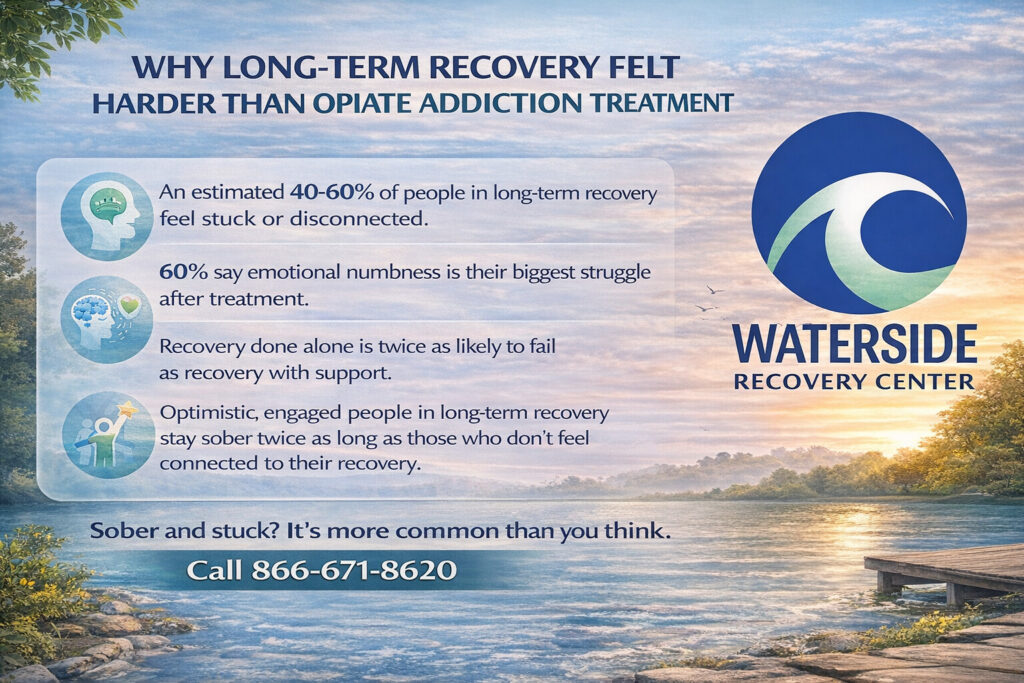
Advanced Recovery Requires Advanced Tools
When we started, the tools were simple:
Get through the hour. Call your sponsor. Don’t use.
Now the problems are deeper.
You’re wondering about purpose. About meaning. About why you still feel disconnected even though you’re doing all the right things.
That’s not a failure. That’s progress.
The tools that helped you survive may not be enough to help you grow.
Maybe you need therapy that addresses trauma, not just triggers.
Maybe your relationships need more honesty. Maybe your spirituality needs a reset.
At Waterside, we help clients in early recovery—but we also support those who’ve been sober for years and feel stuck. If you need help in areas we serve, there’s no expiration date on asking for more support.
You Deserve More Than Just “Not Using”
This is what it comes down to:
You didn’t go through everything just to wake up feeling numb and call it a win.
You got clean to feel, to connect, to live.
So if you’re sober and still feel lost—don’t minimize that.
Don’t tell yourself it’s selfish or dramatic.
It’s real. And it matters.
At a certain point in recovery, survival isn’t enough. You need something deeper: joy, purpose, alignment. And that’s allowed.
Long-Term Recovery Isn’t Linear—and You’re Not Alone
Here’s what helped me:
Talking to people who’d been there.
Admitting that the tools I had weren’t working anymore.
Reaching out not because I was at risk of relapse—but because I wanted more from my life.
Waterside understands that recovery evolves. We’re here whether you’re one day sober or five years deep and spiritually exhausted.
There’s support available—not just to help you stay clean, but to help you feel alive in your sobriety.
If you’re in Massachusetts, we offer dedicated options for long-term alumni seeking reconnection and clarity. Reach out to explore care in areas we serve that meet you where you’re at now—not just where you started.
FAQ: Long-Term Recovery & Opiate Addiction Treatment
Why does long-term recovery feel harder than opiate addiction treatment?
Because treatment is structured, urgent, and full of support. Long-term recovery is quieter. You’re rebuilding a life—and that includes facing unresolved emotions, relationship patterns, and spiritual flatness. It’s not about willpower—it’s about depth.
Is it normal to feel emotionally numb even after a year or more sober?
Yes. Many people in long-term recovery report emotional flatness, especially if they haven’t addressed the underlying emotional or trauma-based drivers of their addiction. This doesn’t mean you’re failing—it means your healing is still in progress.
Should I go back to treatment if I haven’t relapsed?
Not necessarily. But additional support—like therapy, alumni programming, or spiritual coaching—can be powerful. Waterside offers recovery support services that go beyond detox and early sobriety to help you reconnect with purpose and joy.
I’m not in crisis—but I feel disconnected. Can I still ask for help?
Absolutely. You don’t need to be on the verge of relapse to get support. If you’re sober but spiritually or emotionally lost, that’s a valid reason to reach out.
Does Waterside help people who’ve been sober for a long time?
Yes. We work with long-term alumni and those in stable recovery who need a new level of support. Whether it’s trauma therapy, emotional reconnection, or just feeling stuck—we’re here.
You’re Allowed to Want More
If you’re reading this and quietly thinking, “This is me,”—you’re not alone.
And you’re not selfish for wanting more out of recovery than just “not using.”
Call (866) 671-8620 or visit Waterside’s opiate addiction treatment services to learn more about how we support people in every phase of recovery—including yours.
You didn’t get sober just to survive. You got sober to come back to life. Let’s help you do that.