
You watched your child work hard.
They got through treatment. They said the right things. They even looked more like themselves again.
And then it happened.
The missed call. The off behavior. The money that doesn’t add up.
Now you’re staring at something you’ve prayed wouldn’t return: the signs of a relapse.
You might feel angry, scared, numb—or all three in the same hour.
Here’s what we need you to know right away:
This moment matters, but it doesn’t define your child. Or you.
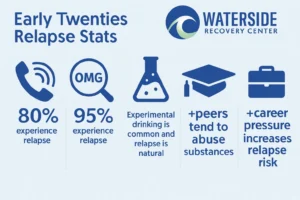
Relapse in the early twenties is not rare. In fact, it’s incredibly common.
Not because your son or daughter isn’t trying—but because early adulthood is one of the most volatile recovery windows there is.
At Waterside Recovery Center, we walk families through this moment every week. And we know what it takes to turn a setback into a second start—one that’s more stable, more strategic, and more supported than before.
Why Early Twenties Relapse Happens More Than You Think
Here’s a truth many parents don’t hear in treatment the first time around:
The brain isn’t fully developed until around age 25—especially the parts responsible for impulse control, decision-making, and long-term thinking.
Add alcohol into the mix and that delay intensifies.
So even if your child “knows better,” their brain is still catching up with their best intentions. That’s not an excuse—it’s context. And context gives you power.
Now consider:
- College drinking culture that normalizes blackouts
- Emotional immaturity in processing stress and rejection
- Social pressure from peers and dating situations
- Academic or early-career pressure with little emotional support
- A deep desire to appear fine—even when they’re falling apart
It’s not surprising they’ve slipped.
It’s surprising more people don’t talk about how often it happens.
That First Treatment Experience? It Wasn’t a Waste
You may feel defeated.
You invested time, energy, maybe thousands of dollars—and here you are again.
But what your child learned in that first round matters.
They gained:
- Language for what they’re feeling
- A blueprint for what support can look like
- A felt memory of being sober (even briefly)
- Awareness of their triggers
- A foundation of recovery knowledge—even if it wasn’t fully used
Think of it like learning to ride a bike.
They didn’t make it all the way down the road. But they know they can balance. That’s something to build on—not erase.
And if they’re willing to try again, they’re doing it with more self-awareness and experience than last time.
How Parents Can Respond: What Helps (and What Doesn’t)
You can’t control the outcome. But your response matters.
What helps:
- Calm, clear conversations
“I see what’s happening, and I want to talk—not to shame, but to understand.” - Boundaries with love
“We’ll support your recovery—but not your drinking.” - Collaboration, not control
“What kind of help do you think would actually work this time?” - Connecting to real treatment options
“Let’s look at alcohol addiction treatment near us. What feels possible?” - Taking care of yourself
You can’t support anyone if you’re emotionally drowning. Al-Anon, therapy, and support groups are vital.
What doesn’t help:
- Threats or ultimatums made out of fear
- Calling them a failure
- Ignoring the problem and hoping it passes
- Comparing them to others or “themselves before”
- Trying to fix it alone
This isn’t about getting it perfect. It’s about showing up with love, structure, and a willingness to try something new.
What to Look for in Second-Round Alcohol Addiction Treatment
The best second-round treatment isn’t a repeat—it’s a refinement.
At Waterside Recovery, we design alcohol addiction treatment programs around what returning clients actually need. That includes:
- More individualized treatment plans based on what didn’t work last time
- Focused relapse prevention training with real-world practice
- Deeper emotional processing around shame, trauma, or social anxiety
- Flexible outpatient care, so your child can stay in school or work while still receiving support
- Family support options, including structured parent coaching and group education
This round of treatment should feel different—not just more of the same. We don’t punish relapse. We treat it.
And if your child is near Bristol County, MA or lives here in Plymouth County, there’s no need to travel far to access that next step.
Outpatient Treatment Often Works Better the Second Time
When a young adult returns to treatment, it doesn’t always require full-time residential care.
In fact, outpatient treatment is often a more sustainable and empowering choice—especially for relapse cases.
Why?
- It allows your child to stay connected to their responsibilities
- It gives them the chance to practice sobriety in the real world
- It emphasizes accountability and connection without full disconnection
- It helps build routines, not just remove triggers
At Waterside, our outpatient track includes therapy, skills-building groups, peer support, and customized planning. Your child doesn’t disappear for 30 days—they build a recovery lifestyle in real time.
This Isn’t Their Rock Bottom. It’s Their Reset.
It’s easy to believe this relapse is the end of the road.
But what if it’s the beginning of a different road—one they chose with more clarity?
Some of the strongest recoveries we’ve ever seen started after a second or third attempt at treatment. Not because the person was broken, but because they were finally ready to go deeper.
Relapse doesn’t make your child a lost cause. It makes them human.
And you’re not failing as a parent by being here. You’re showing up in the storm, again—and that means everything.
FAQs: Supporting a Young Adult Through Relapse and Treatment
Is relapse common after alcohol addiction treatment?
Yes. Especially in early adulthood, where emotional regulation and brain development are still evolving. It doesn’t mean treatment failed—it means more support is needed.
How do I know if this time will be different?
You don’t. But if your child is willing to try again, especially with a different treatment structure, there’s hope. Relapse often deepens readiness—if it’s responded to strategically.
What if they don’t want to go back to treatment?
That’s common. Focus on planting seeds: invite conversation, express concern without panic, and offer real options. Stay calm, connected, and consistent. They’re more likely to come around if you’re steady—not reactive.
Can we do outpatient instead of inpatient?
Absolutely. Outpatient treatment is often a smart, sustainable approach—especially for those who’ve already done some initial work and need more integration, not isolation.
What if they relapse again?
Then you respond again—with boundaries, with support, with honesty, and with hope. Recovery is rarely a straight line. But it is a possible one.
You’re Not Alone—And This Isn’t the End
You’re walking through something heavy.
And you’re doing it out of love.
Let that love be informed, supported, and sustainable.
Call (866)671-8620 to learn more about our Alcohol Addiction Treatment services in Plymouth County, MA.
We’re here when you’re ready. And we’ll help you help them—one real step at a time.