
You don’t have to hit a breaking point to start wondering if you need more support.
For a lot of people, the question shows up quietly—almost like a whisper you try to ignore.
Why does this keep happening?
Why can’t I just get a handle on it?
If you’ve been sitting with that feeling, you’re not behind. You’re paying attention.
And if you’ve already found yourself exploring something like a day treatment program, that’s not overreacting—it’s awareness starting to turn into action.
Notice If “Managing It” Is Taking More Energy Than Living
There’s a difference between living your life and managing your life.
From the outside, things might look fine. You’re functioning. You’re showing up. Maybe even doing well.
But internally, it feels like you’re constantly adjusting:
- Thinking about when you’ll drink—or not drink
- Trying to stay ahead of anxiety before it spikes
- Recovering from nights that didn’t go the way you planned
That kind of mental load adds up.
It’s not always dramatic. Sometimes it’s just this low, steady exhaustion.
And if most of your energy is going toward “holding it together,” it might be time to consider support that helps you do more than just manage.
Pay Attention to Patterns You Can’t Quite Break
Most people try to change things on their own first.
You set rules.
You take breaks.
You promise yourself this time will be different.
And sometimes it is—for a little while.
But if you keep looping back to the same patterns, that’s not a lack of discipline. It’s a sign that something deeper needs attention.
That’s where structured daytime care can make a difference.
It creates consistency where willpower alone tends to fall apart.
Not because you’re weak—but because you’re human.
Ask Yourself What Kind of Support Would Actually Help
This question matters more than people realize.
Not: What should I do?
But: What would actually help me right now?
For some people, once-a-week therapy doesn’t feel like enough.
But the idea of live-in treatment feels overwhelming or unnecessary.
There’s a space in between.
A place where you can:
- Have structure during the day
- Go home at night
- Stay connected to your real life while still getting consistent support
It’s not about going to extremes.
It’s about finding the level of care that meets you where you are.
Consider How Mental Health and Drinking Interact
A lot of people come in thinking their challenge is just about alcohol.
But when you slow down and look closer, there’s usually more underneath.
Stress that never really turns off.
Anxiety that spikes at night.
A sense of overwhelm that builds quietly throughout the day.
For many, drinking becomes a way to cope with that.
If that sounds familiar, you’re not alone.
And if you’ve been searching for something like partial hospitalization Plymouth MA, there’s a good chance you’re already recognizing that this isn’t just about stopping a behavior—it’s about understanding what’s driving it.
Support that looks at both sides—mental health and substance use—can make everything feel more connected and less confusing.
Think About Your Environment—Because It Matters More Than You Think
Change doesn’t happen in a vacuum.
If you’re in the same environment every day—with the same stress, the same triggers, the same routines—it’s hard to create something different.
That doesn’t mean you need to step away from your entire life.
But it might mean creating intentional space within it.
Structured daytime care offers that balance.
You get time each day to step out of the noise.
To focus. To reset. To build something new.
And then you return to your life with more support behind you.
You Don’t Need to Be “Sure” to Take a Step
A lot of people wait for certainty before they reach out.
They want to feel completely ready. Completely sure.
But that kind of clarity doesn’t always come first.
Sometimes it comes after you’ve already started exploring.
You don’t need to commit to everything right now.
You just need to be open enough to ask:
Could this help me feel different?
That’s enough.
There’s a Middle Ground That Doesn’t Feel Extreme
One of the biggest misconceptions is that getting help has to be all-or-nothing.
It doesn’t.
There are treatment options in areas we serve designed specifically for people who are in that in-between space:
Not in crisis—but not feeling okay either.
These options are structured without being overwhelming.
Supportive without taking over your life.
That balance is what makes it approachable—and sustainable.
What Progress Actually Looks Like Here
Progress isn’t always dramatic.
It often looks like small shifts:
- Having a day where you don’t think about drinking as much
- Feeling less overwhelmed by your thoughts
- Noticing your triggers before they take over
- Ending the day without that familiar sense of regret
These changes might seem small—but they build.
And over time, they start to feel like something bigger:
Stability. Clarity. Relief.
A Simple Check-In You Can Do Right Now
If you’re still unsure, pause for a second and ask yourself:
- Am I tired of trying to figure this out on my own?
- Do I want things to feel different—even if I don’t know exactly how?
- Would more structure help me feel less overwhelmed?
You don’t need all the answers.
If even one of those questions lands, it might be worth taking the next step.
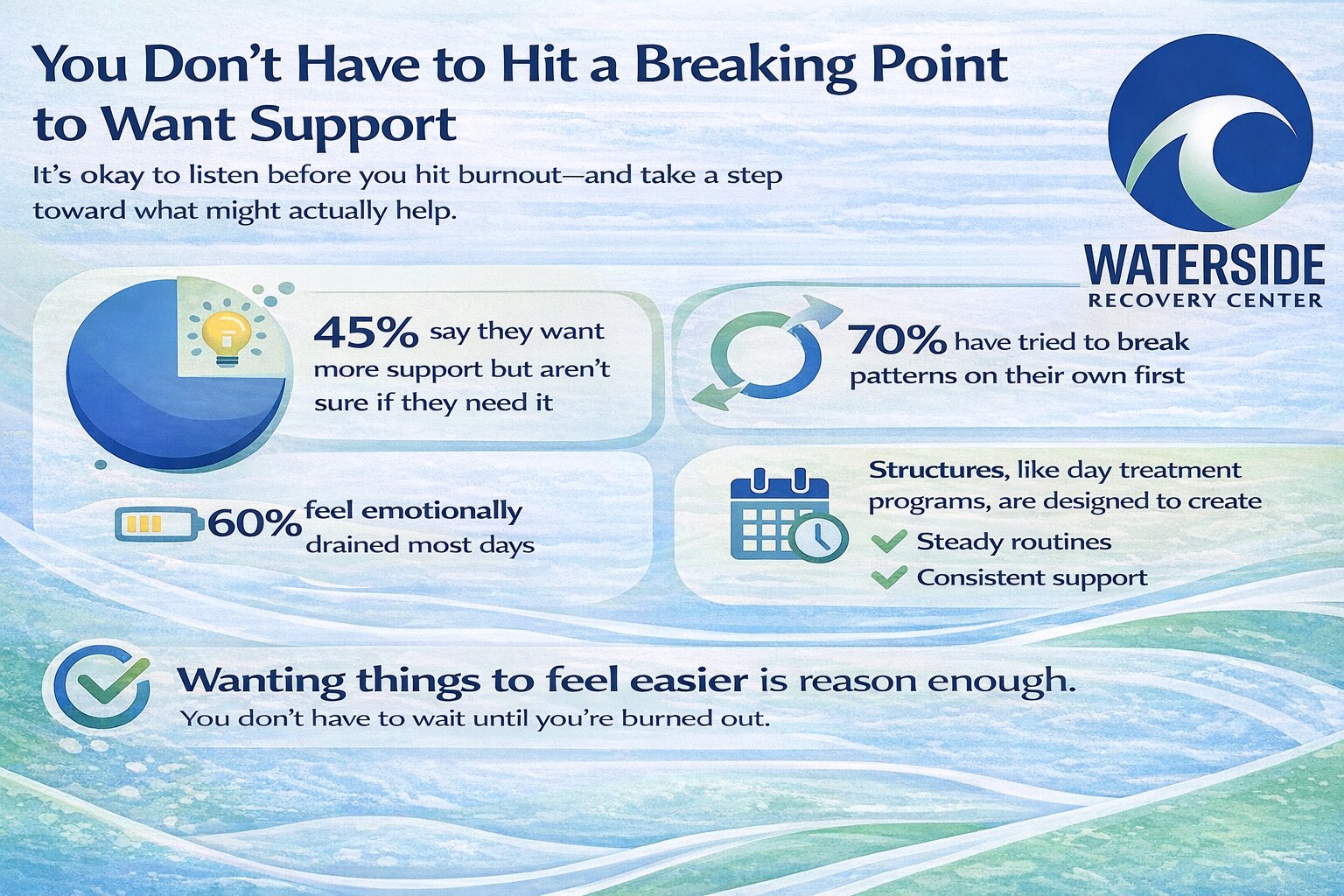
You’re Allowed to Want Support Without Hitting a Breaking Point
This is important.
You don’t have to wait until things get worse.
You don’t have to prove that you’re struggling “enough.”
Wanting things to feel easier is reason enough.
Wanting clarity is reason enough.
Wanting to feel more like yourself again—that’s more than enough.
Frequently Asked Questions
How do I know if I need more than weekly therapy?
If you find that weekly sessions aren’t giving you enough support between visits, or if you’re struggling to apply what you talk about in real time, it might be worth exploring something more structured. You don’t have to replace therapy—you can build on it.
Will this take over my entire life?
No. Structured daytime care is designed to support your life—not remove you from it.
You’ll still have time for home, responsibilities, and personal space. The goal is to create consistency during the parts of the day where support can make the biggest difference.
What if I’m not sure I have a serious problem?
That’s okay. You don’t need a label to explore support. Many people start because something just doesn’t feel right—or because they’re tired of repeating the same patterns. That’s a valid place to begin.
Can I still work or take care of responsibilities?
In many cases, yes—depending on your schedule and needs. Programs are often designed to provide structured support while still allowing you to maintain important parts of your daily life.
What happens if I start and it doesn’t feel right?
You’re not locked in.
The goal is to find what works for you. If something doesn’t feel like the right fit, adjustments can be made.
Support should feel helpful—not restrictive.
You don’t have to figure everything out before you reach out.
You just have to decide you’re open to something different.
Call (866)671-8620 or visit our day treatment program services in Plymouth County, MA to learn more about our program, day treatment program services in Plymouth County, MA.