
You already know.
You’ve known for a while.
That quiet realization—the one you push away in the middle of the night, the one that creeps back every time you swear you’ll do better tomorrow—it’s still there.
You’re not pretending anymore. You’re just trying to hang on.
If you’ve found this blog, it probably means you’re somewhere in the space between “I can’t do this” and “I don’t know what to do next.” That space is uncomfortable. It’s full of fear, self-blame, and maybe even a little hope.
This isn’t a lecture. It’s a reflection of what starts to shift—inside and outside—when you stop trying to manage opiate use alone and accept real support.
And if that sounds too big right now, let’s break it down. Because you don’t need a life plan today. You just need a crack of willingness.
At Waterside Recovery, we’ve seen what happens when that willingness turns into something real. This blog is about what that really looks like—and why trying to go it alone isn’t noble, it’s just exhausting.
You’ve Been Carrying More Than You Admit
If you’re using opiates and still functioning—still getting to work, still showing up for family, still doing enough to avoid concern—you’ve probably convinced yourself you can keep managing.
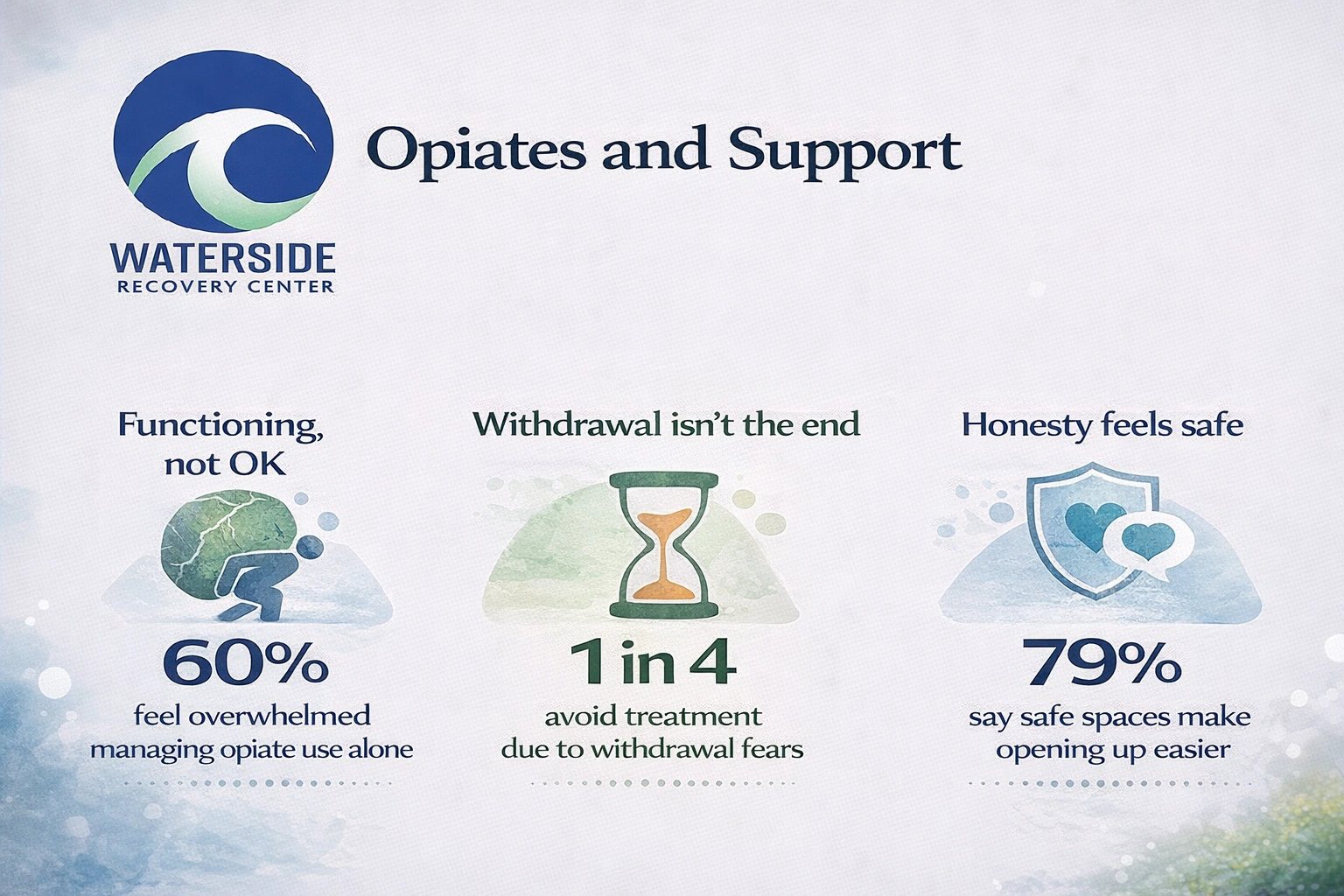
But functioning isn’t the same as being okay.
And managing isn’t the same as healing.
There’s a cost to carrying all of this alone:
- Keeping your use hidden
- Always calculating how much you have left
- Feeling sick and scrambling for excuses
- Lying to the people who care about you
- Pretending it’s not getting worse
Eventually, the weight of hiding becomes heavier than the weight of asking for help.
In Kingston, Massachusetts, we’ve worked with people who said, “I never thought I’d be the kind of person who needed treatment.” What they meant was: I didn’t think things would get this heavy.
You don’t have to wait for total collapse to let someone step in with you.
Withdrawal Isn’t the End—It’s the Beginning
Let’s talk about what most people are afraid to say out loud:
“I want to stop, but I’m terrified of withdrawal.”
Totally valid. Withdrawal is brutal. It’s physical, emotional, and layered with shame.
But here’s the thing: withdrawal is temporary. And when it’s supported, it’s manageable. You don’t have to suffer through it on a bathroom floor. You don’t have to white-knuckle it in secret. You don’t have to do it alone.
We offer care that includes medical guidance, comfort strategies, and emotional support through that first wave—because getting through withdrawal is just the first step, not the whole journey.
You Start Getting Honest—in a Way That Feels Safe
When you’re stuck in the cycle of using and hiding, even telling the truth feels dangerous. You start editing your story for everyone around you—friends, doctors, family, even yourself.
Treatment interrupts that.
The first shift isn’t just physical—it’s emotional. It’s the moment you say, “Yeah. It’s bad,” and no one flinches. No one walks away. No one throws your pain back in your face.
Instead, someone nods and says, “Okay. Let’s deal with that.”
In Marshfield, Massachusetts, we’ve seen how powerful that moment can be. Sometimes it happens in a therapist’s office. Sometimes in a group. Sometimes while filling out intake paperwork. But it happens—and when it does, you finally exhale.
The Chaos Gets Quieter
Opiates make everything feel urgent. You’re always scanning for your next dose, your next excuse, your next way to avoid being caught or collapsing.
When you enter treatment, the spinning slows down.
You’re not waking up in panic mode.
You’re not chasing or calculating or lying.
You’re just being—in a space where support is already set up.
That kind of calm can be unfamiliar at first. Even uncomfortable.
But then it starts to feel like a kind of freedom you forgot existed.
You Stop Living by Secrets
Even if no one knows what you’re going through, the weight of that secrecy shows up everywhere.
You avoid eye contact.
You isolate.
You fake confidence.
You lie by omission.
You disappear when things get hard.
Real recovery means you don’t have to keep secrets anymore.
You can say things like:
- “I was using again.”
- “I’m scared to relapse.”
- “I don’t know who I am without it.”
And instead of hearing judgment, you get support.
In Duxbury, Massachusetts, we’ve worked with people who carried years of shame in silence. When they finally let it out, the biggest surprise was that it didn’t destroy them. It relieved them.
You Start Rebuilding Trust—Including with Yourself
Opiate use erodes trust slowly.
You stop trusting yourself to follow through.
To be honest.
To keep promises.
To make it to work.
To mean it when you say you’re done.
In treatment, trust doesn’t get handed back to you all at once. It’s rebuilt moment by moment. One honest conversation. One sober morning. One decision not to run.
And eventually, you believe yourself again.
You Remember What It Feels Like to Care
For a while, you probably stopped caring.
About your body.
Your bank account.
Your relationships.
Your goals.
Your future.
That’s not because you didn’t want to care. It’s because caring while in active addiction is painful.
Treatment gives you enough distance to start caring again—without it hurting so much.
Maybe that means reaching out to your kid.
Maybe it means going for a walk.
Maybe it means saying, “I’m not okay” for the first time.
Whatever it is, it means you’re coming back to life.
You Start Figuring Out What You Want—Not Just What You’re Running From
At some point, you’ll stop obsessing over the past.
Stop thinking only about what you’ve lost or ruined.
You’ll start imagining what you could build instead.
- A routine that works
- A relationship with your family again
- A job that doesn’t make you want to disappear
- A version of yourself you don’t have to perform
This is what’s waiting on the other side of “I can’t do this alone anymore.”
And no—you don’t have to believe it today.
You just have to wonder if it could be true.
FAQs: For the Person Who Knows It’s Time
I’m scared of judgment. Will I be treated differently?
No. We’ve heard everything. You don’t have to edit your story or act put-together. This is a place where messy is welcome, and realness matters.
Do I have to quit forever?
Not right away. We focus on today, not forever. We’ll work with you to figure out what makes sense for your life—and we meet you where you are.
I’ve never told anyone about my use. What happens if I call?
You’ll talk to someone who gets it. You won’t be forced into anything. You’ll just have space to ask questions, feel things out, and hear about your options.
What if I’ve already tried before?
Then you’re even braver for coming back. Recovery isn’t a one-and-done process. Every try is part of it—and you’re not starting from zero.
Is there flexibility in how I get care?
Yes. Whether you need live-in treatment or multi-day weekly care, we’ll help you choose what works best based on your responsibilities, comfort level, and goals.
You’re Not Starting Over. You’re Starting Supported.
If you’ve been stuck in the loop of trying to quit alone, it’s okay that you’re tired. You don’t have to carry it all anymore.
You don’t need to have the answers. You don’t need to make a speech.
You just need to stop trying to fix this in the dark.
Call 866-671-8620 or visit our opiate addiction treatment in Plymouth, Massachusetts to learn more about our opiate addiction treatment services in Plymouth, MA. We’ll meet you where you are—no shame, no judgment, just real help.