
There is a moment many people experience long before they ever call a treatment center.
It usually doesn’t happen during a crisis.
It happens on an ordinary Tuesday.
You’re driving home from work. Answering emails. Paying bills. Picking up groceries. Doing everything you’re supposed to do.
And somewhere in the middle of that routine, a thought appears:
“I don’t think I can keep doing this forever.”
Not because everything has fallen apart.
Because you’re exhausted.
If you’ve been searching for answers about getting help while keeping your job, you’re not alone. In fact, some of the most common conversations we have at Waterside Recovery begin with people saying the same thing:
“I want help. I just can’t stop working.”
The good news is that recovery isn’t always an either-or decision.
Many people begin exploring opiate treatment services because they want support without abandoning the responsibilities that matter to them. If that’s where you are right now, understanding your options may help you see that change is more realistic than it feels.
The People Who Ask This Question Are Often Hiding in Plain Sight
There’s a common stereotype about opioid addiction.
People imagine someone who has lost everything.
Someone whose struggles are obvious.
Someone whose life has completely unraveled.
But many of the people searching for help don’t fit that picture at all.
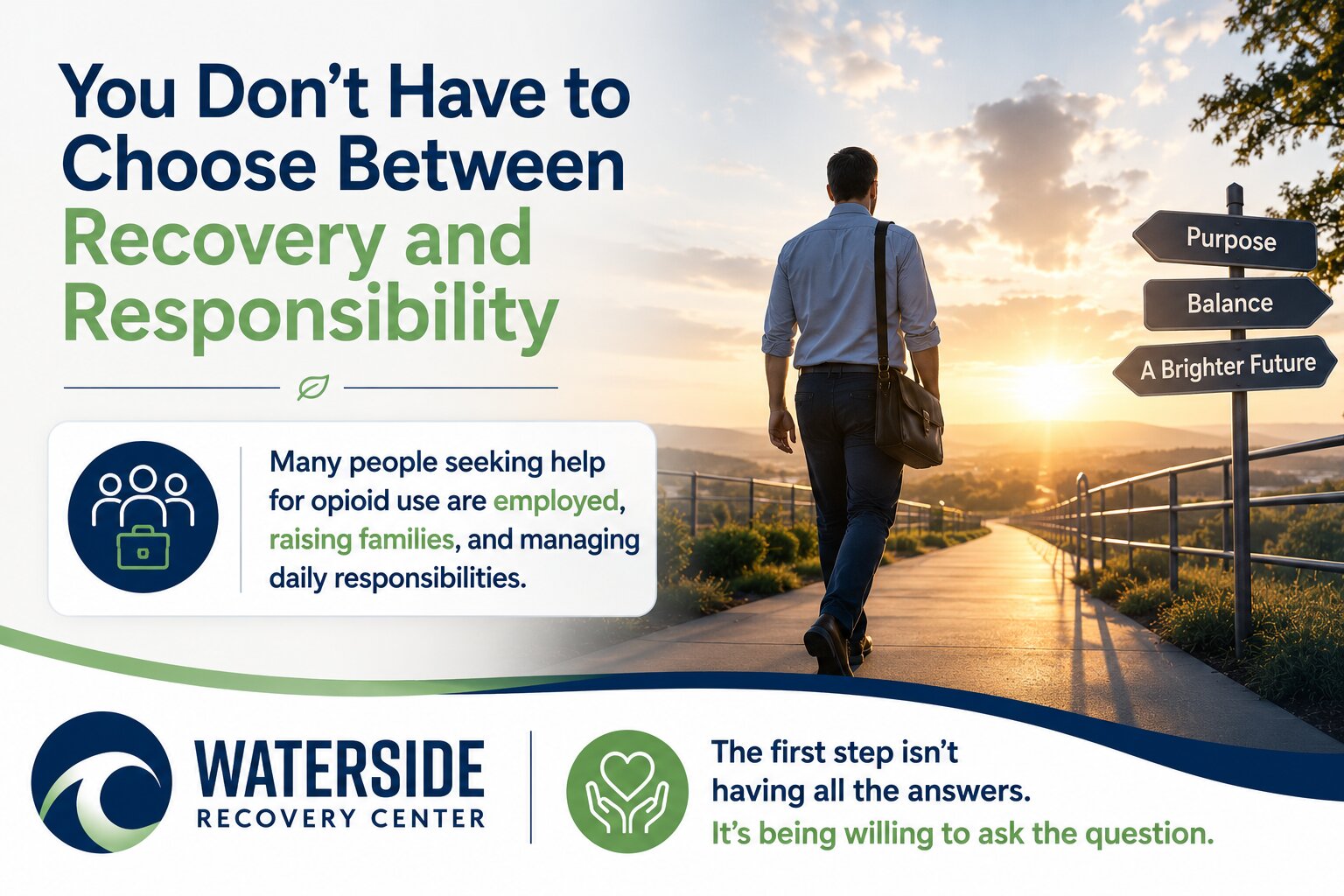
They’re employed.
They’re paying their mortgage.
They’re raising children.
They’re showing up every day.
From the outside, they look fine.
The challenge is that functioning and thriving are not the same thing.
We’ve spoken with professionals who were succeeding at work while privately battling anxiety every morning.
Parents who never missed a school event but spent every day worrying about their opioid use.
Business owners who kept companies running while feeling trapped in a cycle they couldn’t break.
When people start looking for help, it isn’t always because everything collapsed.
Sometimes it’s because they’re tired of living two separate lives.
Step 1: Stop Measuring Your Need for Help Against Someone Else’s Story
One of the biggest mistakes people make is comparing themselves to others.
They think:
“My situation isn’t that bad.”
“I still have a job.”
“I still pay my bills.”
“I haven’t lost everything.”
As a result, they convince themselves they don’t need support.
The problem is that addiction isn’t measured by how dramatic your story sounds.
It’s measured by the impact it’s having on your life.
Ask yourself:
Are you spending more time thinking about opioids than you’d like?
Do you feel trapped by a routine you can’t seem to change?
Are relationships being affected?
Do you feel emotionally exhausted?
If the answer is yes, that’s worth paying attention to.
You don’t need to wait for things to become catastrophic before seeking help.
Step 2: Understand That Recovery Doesn’t Always Mean Leaving Your Life Behind
Many people assume treatment automatically means moving away from home for weeks or months.
For some individuals, that level of support is necessary.
For others, different options may make sense.
We’ve worked with people who continued working while receiving care.
Teachers.
Nurses.
Construction workers.
Managers.
Parents.
Small business owners.
What they all had in common was a desire to get better without walking away from every responsibility they had built.
When people begin researching outpatient opioid rehab Plymouth, they often discover that treatment can be designed around real-life obligations.
That realization changes everything.
Suddenly recovery feels possible instead of disruptive.
Step 3: Be Honest About the Cost of Staying the Same
A lot of people focus on what treatment might cost them.
Time.
Energy.
Scheduling adjustments.
Conversations they don’t want to have.
What often gets overlooked is the cost of doing nothing.
Because staying stuck has a price too.
Maybe it’s the constant stress.
Maybe it’s the fear of getting caught.
Maybe it’s the growing distance between you and the people you love.
Maybe it’s waking up every morning already exhausted.
One former client described it perfectly.
He said opioid use felt like paying interest on a debt that never got smaller.
Every day demanded more.
Every day took something.
And eventually he realized that doing nothing wasn’t actually easier.
It was just more familiar.
Step 4: Build Recovery Around Your Real Life
One reason people delay treatment is because they imagine an all-or-nothing choice.
Either keep living exactly as you are.
Or completely disappear from your normal routine.
Real life is often more flexible than that.
Recovery works best when it can connect with your actual circumstances.
Your work schedule.
Your family commitments.
Your goals.
Your challenges.
That’s why learning about available care matters.
The right support isn’t about forcing your life into a predetermined box.
It’s about finding an approach that meets you where you are.
For people exploring treatment options in areas we serve, understanding what’s available often reduces much of the fear that keeps them from reaching out.
Step 5: Stop Waiting for Motivation to Arrive
Many people think they need to feel inspired before taking action.
They wait for motivation.
They wait for confidence.
They wait until they’re completely ready.
The problem is that readiness rarely shows up first.
Action usually comes first.
Think about exercise.
Most people don’t feel motivated before they start.
They start, and motivation follows.
Recovery often works the same way.
The phone call happens before confidence appears.
The appointment happens before certainty appears.
The first step happens before you’re fully convinced.
And that’s okay.
You don’t need certainty.
You need willingness.
Step 6: Learn From People Who Thought It Was Too Late
One of the most powerful parts of recovery is hearing stories from people who once felt exactly like you.
We’ve seen clients walk through our doors convinced nothing could help.
Some had tried to quit on their own repeatedly.
Some had returned to opioid use after previous attempts at recovery.
Some believed treatment was something that worked for other people but not for them.
Today, many of those same individuals are working, rebuilding relationships, reconnecting with family, and creating lives they once thought were impossible.
Not because they found a magic solution.
Because they kept moving forward.
One step.
One conversation.
One decision at a time.
Recovery rarely happens in a single dramatic moment.
It’s built through hundreds of small choices.
Step 7: Let Curiosity Be Enough
You don’t have to call yourself an addict.
You don’t have to have all the answers.
You don’t even have to be completely sure you want treatment.
You only need enough curiosity to ask:
“What if life could feel better than this?”
That question has started countless recovery journeys.
People often think change begins with certainty.
In reality, it usually begins with curiosity.
A quiet voice saying:
“There has to be another way.”
If you’ve been searching for information, reading articles, and wondering whether now is the right time, that curiosity may already be telling you something important.
Listen to it.
The Opportunity Hidden Inside Your Search
People often think they’re searching for treatment.
In reality, they’re searching for possibility.
Possibility that life could become less stressful.
Possibility that work could feel manageable again.
Possibility that relationships could improve.
Possibility that they could stop carrying this alone.
We’ve watched countless people arrive uncertain and leave with something they didn’t have before:
Hope.
Not unrealistic hope.
Not perfect hope.
Just enough hope to keep moving forward.
And sometimes that’s where everything changes.
For individuals looking for care in areas we serve, the first step isn’t committing to a lifetime of recovery.
It’s simply being willing to learn what support may be available.
Frequently Asked Questions
Can I keep working while getting help for opioid use?
Many people receive treatment while continuing to work. The appropriate level of care depends on your individual situation, responsibilities, and recovery needs.
What if I don’t think my opioid use is “bad enough” for treatment?
You do not need to reach a crisis point before seeking support. If opioid use is affecting your quality of life, relationships, health, or peace of mind, it may be worth exploring your options.
Is it normal to feel unsure about treatment?
Absolutely. Most people who reach out have questions, concerns, and doubts. Uncertainty is one of the most common emotions people experience before seeking help.
What if I’ve tried to quit before and it didn’t work?
Many successful recovery journeys include previous attempts. A setback does not mean future recovery is impossible.
Will treatment interfere with my family responsibilities?
Many individuals seek care while maintaining family obligations. Treatment planning often takes work schedules and personal responsibilities into account.
How do I know if now is the right time?
If you’re spending time wondering whether things need to change, that’s often worth paying attention to. You don’t need complete certainty to start exploring your options.
What if I’m only sober curious?
That’s okay. Many people begin by simply asking questions and learning more about recovery. Curiosity is often the first step toward meaningful change.
Call (866) 671-8620 or visit our opiate treatment services to learn more about our treatment, opiate treatment services services in Bristol County, MA.