
I didn’t relapse.
That’s the part I held onto like proof that I was fine.
No substances. No chaos. No obvious warning signs. From the outside, I looked like someone who had it together.
But inside? It felt like I was slowly disappearing.
I didn’t end up back in treatment because everything fell apart.
I went back because nothing felt real anymore—and I couldn’t ignore it.
What surprised me most is that going back didn’t look like starting over. It looked like choosing something different, like stepping into a day treatment program that actually met me where I was.
I Was Functioning—But Not Living
This is the part people don’t talk about enough.
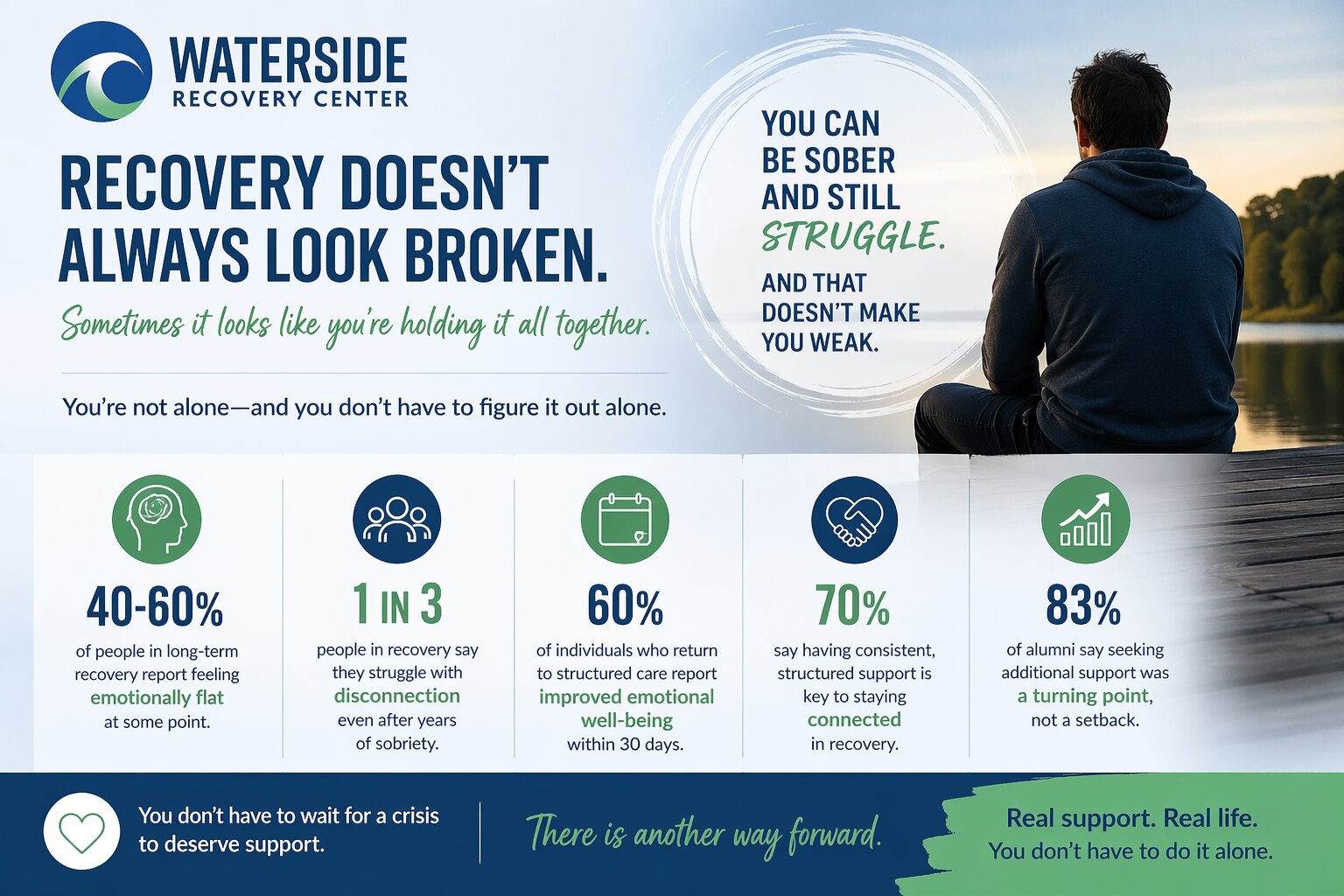
You can be sober and still feel stuck.
I was showing up to work. Answering texts. Doing the things I was “supposed” to do. If you asked me how I was, I had an automatic answer: “Good. Busy.”
But that wasn’t the truth.
The truth was:
- I felt disconnected from people I cared about
- I avoided anything that required real emotion
- I was tired all the time, but not from doing too much—just from existing
It wasn’t dramatic. It was quiet. And that made it easier to ignore.
Until it wasn’t.
The Story I Told Myself Kept Me Stuck
“I’m not that bad.”
That’s what I kept repeating.
Because I wasn’t in crisis, I convinced myself I didn’t deserve support. I told myself other people needed it more. I told myself this was just what life felt like after a while.
But here’s what I didn’t realize:
You don’t have to be falling apart to be struggling.
That belief kept me stuck longer than anything else. It made me normalize something that wasn’t sustainable.
And the longer I stayed there, the more disconnected I felt—from myself, from other people, from any sense of purpose.
Therapy Helped—But It Wasn’t Enough
I tried to handle it the “right” way.
Weekly therapy. Honest conversations. Checking in with myself.
And it wasn’t useless. It gave me language. It gave me some clarity.
But it didn’t reach the deeper layer—the part of me that felt numb, distant, and hard to access.
It felt like scratching the surface of something that needed more attention.
I started noticing a pattern:
I would feel a little better after a session… and then slide right back into the same emotional flatness.
That’s when it hit me:
I didn’t just need insight.
I needed consistency. Immersion. Repetition.
But I also couldn’t disappear into live-in treatment again. My life didn’t allow for that anymore.
So I stayed stuck in the middle for a while—knowing I needed more, but not knowing what “more” looked like.
Realizing There Was a Middle Ground
For a long time, I thought my options were limited:
Either go back to round-the-clock care…
or keep trying to manage things on my own.
That binary thinking kept me frozen.
Then I started hearing about structured daytime care—something in between.
A space where you:
- Show up consistently
- Get real support multiple days a week
- Stay connected to your life outside treatment
It didn’t require me to disappear. It didn’t ask me to start from zero.
It met me where I was.
That’s when I started seriously looking into alternatives to inpatient treatment—not as a backup plan, but as a legitimate next step.
Walking Back Into Treatment Without a Crisis
I won’t pretend it was easy.
Walking back into treatment when nothing is visibly “wrong” feels uncomfortable.
There’s no clear explanation. No dramatic story. No obvious reason to justify it to anyone else.
I remember sitting in my car before my first day thinking:
“Am I overreacting?”
“Do I really need this?”
“What if this doesn’t change anything?”
But underneath all of that was something quieter:
“What if I stay like this if I don’t?”
That was the question I couldn’t ignore.
What Actually Started to Change
The changes didn’t come all at once.
There was no big moment where everything clicked.
But slowly, I noticed:
- I was more present in conversations
- I felt things again—not just numb or detached
- I started recognizing patterns I couldn’t see before
- I stopped pretending I was okay when I wasn’t
It wasn’t about becoming a different person.
It was about reconnecting with the person I already was—but hadn’t felt in a long time.
And that kind of shift doesn’t happen in isolation.
The Part That Surprised Me Most
I thought going back to treatment would feel like failure.
It didn’t.
It felt like honesty.
Like I was finally responding to something real instead of ignoring it.
And more than anything, it felt different from the first time—because I wasn’t being forced into it.
I chose it.
That changes everything.
You Can Outgrow the Way You’ve Been Coping
This is something I wish more people understood:
Just because something worked for you before doesn’t mean it will keep working forever.
Sobriety got me here.
But staying here required something more.
If you’re feeling:
- Emotionally flat
- Disconnected from people or purpose
- Like you’re just going through the motions
That’s not something to push through indefinitely.
It’s something to pay attention to.
And there is care in areas we serve that’s built for this exact stage—not crisis, not early recovery, but the in-between space where things feel off.
You Don’t Have to Burn Your Life Down to Rebuild It
One of my biggest fears was that getting more support meant starting over.
Losing everything I had built.
That didn’t happen.
Instead, I added structure where I needed it.
Support where I had gaps.
Honesty where I had avoidance.
It wasn’t destruction.
It was adjustment.
And it made my life feel more real—not less.
FAQ: For People Who Feel “Fine”… But Know Something’s Off
Is it normal to feel disconnected even after long-term sobriety?
Yes. Many people experience periods of emotional flatness or disconnection. It doesn’t mean something is wrong with you—it may mean something needs attention.
Do I need to relapse to justify getting more help?
No. You don’t need a crisis to deserve support. Feeling stuck or disconnected is enough reason to explore options.
What if therapy alone isn’t helping anymore?
That’s more common than people think. Some stages of recovery require more structured, consistent support than weekly sessions can provide.
Will going back to treatment set me back?
Not at all. Many people find that returning to treatment at a different stage actually deepens their progress.
What if I can’t leave my responsibilities for treatment?
There are options that allow you to stay engaged in your life while still getting meaningful support.
How do I know if I actually need more support?
If something feels off and it’s not improving over time, it’s worth exploring. You don’t have to be certain—you just have to be honest.
If You’re Tired of Pretending, That Matters
There’s a specific kind of exhaustion that comes from pretending you’re okay.
Not collapsing. Not breaking down. Just… holding it together quietly.
That’s where I was.
And stepping back into support didn’t mean I failed.
It meant I stopped ignoring what I needed.
If you’re in that same space, there is help in areas we serve that doesn’t expect you to start over—just to show up honestly.
Ready to Feel Like Yourself Again—Without Starting From Scratch?
If something feels off, even if you can’t explain it, you don’t have to keep pushing through alone.
Call (866)671-8620 or visit our day treatment program services in Plymouth County, MA to learn more about what support can look like—on your terms, and at your pace.