
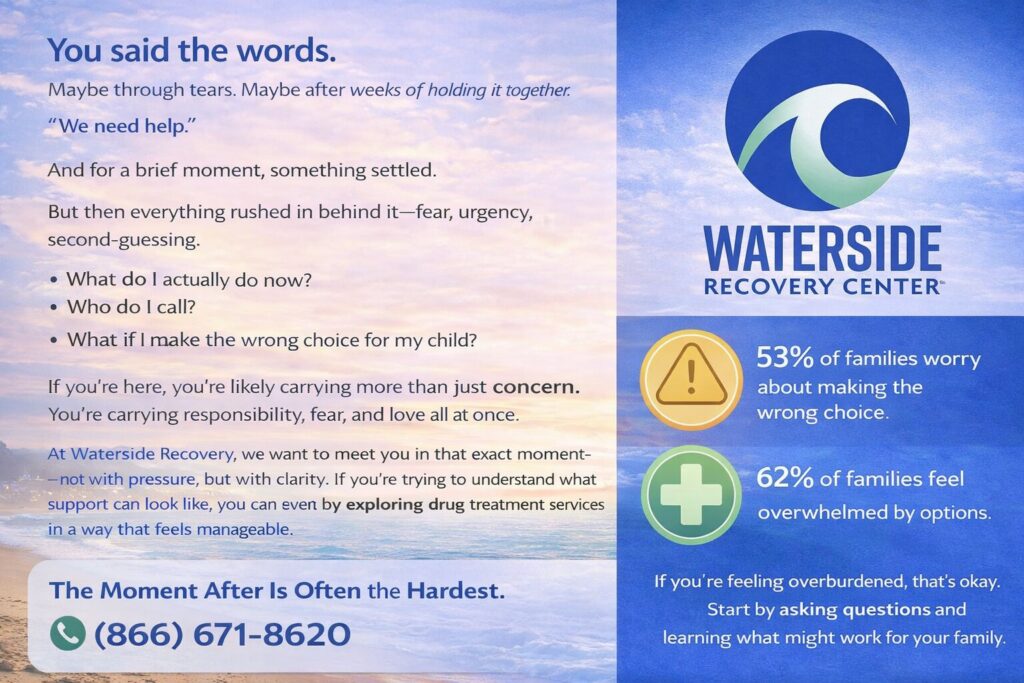
You said the words.
Maybe through tears. Maybe after weeks of holding it together.
We need help.
And for a brief moment, something settled.
But then everything rushed in behind it—fear, urgency, second-guessing.
What do I actually do now?
Who do I call?
What if I make the wrong choice for my child?
If you’re here, you’re likely carrying more than just concern. You’re carrying responsibility, fear, and love all at once.
At Waterside Recovery, we want to meet you in that exact moment—not with pressure, but with clarity. If you’re trying to understand what support can look like, you can start by exploring drug treatment services in a way that feels manageable.
The Moment After Is Often the Hardest
Saying “we need help” takes courage.
But what comes after can feel even harder.
Because now it’s real.
There’s no more pretending things might just improve on their own.
There’s no more waiting for the “right time.”
Now you’re standing in uncertainty.
And uncertainty can feel heavier than the problem itself.
You Might Feel Like Time Is Running Out
Many parents in this moment feel a quiet panic.
What if something happens before I figure this out?
What if I waited too long already?
That urgency comes from love—but it can also make everything feel more overwhelming.
Here’s what we want you to know:
You don’t have to solve everything today.
You just have to start moving in the right direction.
Even one conversation can begin to shift things.
What Actually Happens When You Reach Out
This part feels intimidating because it’s unknown.
But the first step is not as complicated as it might seem.
When you reach out, you’re not committing your child to anything.
You’re starting a conversation.
That conversation usually includes:
- You sharing what you’ve been seeing and experiencing
- Someone listening—without judgment or blame
- A discussion of what support could look like
You don’t need the right words.
You don’t need a full timeline.
You can simply say:
“Something is wrong, and I don’t know what to do.”
That’s enough.
Your Child Doesn’t Have to Agree Right Away
This is one of the most painful parts for parents.
You see what’s happening clearly.
They might not.
They may:
- Minimize what’s going on
- Push back or refuse help
- Act like everything is under control
This doesn’t mean you’re stuck.
Support can still begin—even if your child is unsure or resistant.
In many cases, willingness grows after support starts—not before.
Different Levels of Support Exist So You Don’t Have to Guess
One of the biggest fears parents have is choosing the wrong level of care.
Too much? Too little? Too soon?
But support isn’t one-size-fits-all.
It can look like:
- Structured daytime care that creates stability without removing them from home
- Multi-day weekly support that allows gradual change
- More immersive care when safety or stability is a concern
The goal is not to overwhelm your child.
It’s to meet them where they are—and build from there.
If you’re looking for options nearby, you can explore treatment options in areas we serve and find something that feels accessible and realistic.
You May Be Carrying More Guilt Than You Realize
This part is quieter—but heavy.
How did I not see this sooner?
Did I miss something important?
Is this my fault?
These thoughts are incredibly common.
And incredibly painful.
But this isn’t a reflection of your failure as a parent.
It’s a reflection of how complex this situation is.
You didn’t cause this.
You’re responding to it.
And the fact that you’re here—reading, searching, trying—means you’re showing up in one of the most important ways you can.
Progress Can Feel Messy—and That’s Still Progress
It would be easier if help created immediate change.
But real progress often looks like:
- Small moments of honesty
- Less resistance over time
- A shift in how your child responds to support
There may be setbacks.
There may be moments where it feels like nothing is working.
That doesn’t mean you chose wrong.
It means this process is human.
You Don’t Have to Do This Alone Anymore
Right now, it might feel like everything depends on you.
Every decision. Every next step.
But once you reach out, that weight begins to shift.
You gain:
- Guidance from people who understand this process
- Support in making decisions without pressure
- A team that sees both your child—and you
Because this doesn’t just affect them.
It affects your entire family.
The First Step Is Smaller Than It Feels
It doesn’t have to be a big decision.
It doesn’t have to be final.
It can be as simple as:
- Asking a question
- Learning what options exist
- Talking to someone who understands
That’s how this begins.
Not with certainty—but with movement.
Frequently Asked Questions
What if I don’t know exactly what my child is using or experiencing?
That’s okay. You don’t need all the answers before reaching out. Providers can help assess what’s going on and guide you through understanding it step by step.
What if my child refuses to go?
This is very common. Resistance doesn’t mean help isn’t possible. There are ways to approach this with support, structure, and guidance that don’t rely on immediate agreement.
How quickly should I act?
If you’re noticing serious changes or safety concerns, it’s important to reach out sooner rather than later. But that doesn’t mean rushing into the wrong decision—it means starting the conversation.
Will I be involved in the process?
Yes. Family involvement is often an important part of support. You won’t be left out—you’ll be guided on how to help in a way that supports both you and your child.
What if we try something and it doesn’t work?
That doesn’t mean failure. It means adjusting. Different approaches work for different people, and sometimes it takes time to find the right fit.
Is it too late to help my child?
No. It may feel that way—but it’s not true. People can and do find their way back, even after things feel overwhelming or out of control.
What’s the very first thing I should do right now?
Reach out. Even if you’re unsure. Even if you feel overwhelmed. Starting the conversation is the first real step forward.
If you’re standing in that moment—where everything feels uncertain but you know something has to change—you don’t have to figure it out alone.
Call (866)671-8620 or visit drug treatment services to learn more about our treatment, drug treatment services in Bristol County.