
I didn’t hit some dramatic bottom.
There wasn’t a scene. No one confronting me. No moment that screamed, “This is it.”
It was quieter than that.
Just me, sitting with the realization that I had crossed a line I promised myself I wouldn’t cross again.
And the first thing I felt wasn’t panic.
It was shame.
“You knew better.”
“You already had your shot.”
If you’re here right now—after relapse, after trying, after believing you had it—you probably know that voice.
I want to meet you there, not argue with it.
Because yeah… it feels like failure.
But that doesn’t mean it is.
At some point, I had to stop trying to undo what happened and start asking a different question: “What do I actually need now?” That’s what led me back to rethinking what alcohol addiction treatment could look like when I wasn’t trying to prove anything anymore.
It Didn’t Feel Like a Collapse—It Felt Like a Slow Drift
People imagine relapse as this sudden fall.
For me, it was gradual. Almost invisible at first.
I didn’t wake up one day and decide to drink.
I slowly stopped doing the things that were keeping me steady.
I stopped checking in.
I avoided conversations that felt too real.
I told myself I was “good” because nothing looked obviously wrong.
And underneath all of that was something I didn’t want to admit:
I was getting tired.
Tired of monitoring myself.
Tired of thinking about it all the time.
Tired of trying to do everything right.
That kind of exhaustion doesn’t always look dangerous.
But it is.
The Decision Didn’t Feel Like Self-Sabotage
This is the part that’s hard to explain to people who haven’t been there.
It didn’t feel reckless.
It felt… reasonable.
Like a quiet negotiation with myself:
“You’ve been doing well.”
“You’re not like you were before.”
“You can handle it now.”
And in that moment, I believed it.
Because what I actually wanted wasn’t alcohol.
It was relief.
Relief from the pressure of holding everything together.
Relief from the constant awareness of myself.
Relief from feeling like one wrong move could undo everything.
So I chose something that had always given me that feeling—at least at first.
I Knew the Tools—But I Wasn’t Using Them in Real Time
This is where the confusion really sets in.
Because you do know what to do.
I knew about triggers.
I knew about reaching out.
I knew how to pause, how to redirect, how to think it through.
But here’s what I didn’t understand:
Knowing the tools doesn’t mean you’ll use them when it matters.
Especially not when you’re overwhelmed, isolated, or already halfway into the decision.
Tools work best when you’re connected.
When you’re honest early.
When you let someone in before things build.
I wasn’t doing that.
So the tools stayed in my head—while my behavior went somewhere else.
The Real Damage Happened After
The relapse itself was one moment.
What came after lasted longer.
I didn’t tell anyone.
I didn’t reach out.
I didn’t want to face the look on someone’s face when I said, “I messed up.”
So I stayed quiet.
And that quiet space? That’s where things get dangerous.
Because the longer you sit in it, the more your mind starts to rewrite the story:
“Maybe it’s not that bad.”
“You don’t need help again.”
“Just fix it yourself.”
That’s how one moment turns into a pattern.
Not because you’re weak—but because you’re alone in it.
I Thought Going Back Meant I Failed
This belief kept me stuck longer than anything else.
That going back to treatment meant I didn’t get it the first time.
That I had somehow proven I wasn’t capable.
But eventually, something shifted.
I realized that avoiding help wasn’t protecting me—it was keeping me in the same cycle.
Going back wasn’t about failure.
It was about honesty.
The first time, I was trying to get it right.
The second time, I was just trying to be real.
And that difference matters more than you think.
The Second Time Was Less About Learning—and More About Applying
I didn’t need to relearn everything.
I needed to actually live it.
That meant:
- Being honest sooner—even when it was uncomfortable
- Accepting structure instead of resisting it
- Letting people see the parts of me I usually hide
- Staying connected even when I felt like pulling away
And yeah, it also meant facing the practical side again.
I remember sitting there thinking about things like whether I’d need something like alcohol detox Plymouth MA again, and what that would even look like.
It felt overwhelming.
But it didn’t have to be solved all at once.
I just had to take the next step.
You’re Not Back at the Beginning—Even If It Feels Like It
This is the part your brain won’t believe right away.
Because relapse feels like losing everything.
But you didn’t.
You still:
- Recognize what your warning signs look like
- Understand how quickly things can shift
- Know what avoidance feels like in your body
- Have language for what’s happening
That’s not starting over.
That’s starting with insight.
And insight—if you actually use it—changes how you move forward.
There Are Still Places That Will Meet You Here
If part of you is thinking, “I don’t even know where to go from here,” you’re not alone.
That’s a really common place to land after relapse.
But here’s what I’ve learned:
You don’t have to figure it out alone before you reach out.
There are people who understand this part of the process. Places where relapse isn’t treated like a failure—but like something to work through.
If you’re trying to find your way back, exploring help in areas we serve can be a simple place to start. Not a commitment. Just a way to see what support actually looks like right now.
If You’re Sitting in That Quiet Aftermath
The part where everything feels heavy.
Where you’re replaying it. Questioning yourself. Wondering if you’ve got another try in you.
I’ve been there.
And here’s what I’ll say to you, honestly:
You didn’t lose your chance.
You found the part of your recovery that still needs support.
That’s not failure.
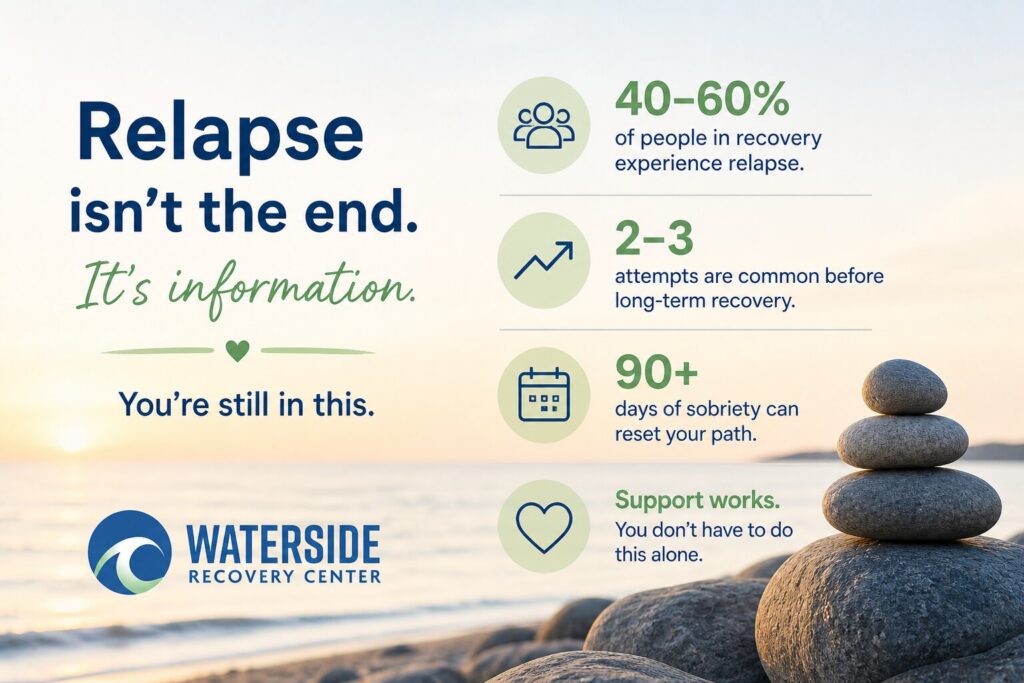
It’s information.
And if you’re willing to use that information—even slowly, even imperfectly—you can build something that actually holds this time.
Not because you’ll do it perfectly.
But because you’ll do it honestly.
FAQ: What It Really Means to Relapse After Treatment
Does relapse mean I failed treatment?
No. It means something in your support system, environment, or emotional processing wasn’t strong enough yet. That’s something you can work on—not a permanent failure.
Why does it feel worse the second time?
Because you’re more aware. You know what’s at stake. You understand the consequences. That awareness can intensify shame—but it can also deepen your recovery if you use it.
Do I have to go back to the same type of treatment?
Not necessarily. Many people benefit from adjusting their level of care—whether that’s more structure or a different kind of support that fits their life better now.
What if I don’t feel ready to go back?
You don’t have to feel ready to take a step. Readiness often comes after you start moving, not before.
How do I deal with the shame?
Start by not isolating with it. Shame grows in silence. Even one honest conversation can begin to break that cycle.
What if I’m worried about detox again?
It’s okay to have that concern. If your body has become dependent again, something like alcohol detox Plymouth MA may be part of the conversation—but you don’t have to figure that out alone. There are professionals who can guide you safely.
You’re Still in This—Even If It Doesn’t Feel Like It
Relapse has a way of making everything feel final.
Like you crossed a line you can’t come back from.
But that’s not how this works.
You’re still here.
You’re still aware.
You’re still asking questions.
That means something.
And if you’re willing to take even a small step back toward support, you’re already moving in a different direction.
If you’re ready to take that step—or even just talk it through—call (866)671-8620 or visit our alcohol addiction treatment services in Plymouth County, MA to learn more about our treatment, alcohol addiction treatment services in Bristol County, MA.