
You leave the appointment with answers—but somehow, more questions than before.
A diagnosis can bring relief, but it can also feel like something just shifted inside you.
There’s a name for what’s been happening. But now there’s also a decision.
At Waterside Recovery, we meet people in this exact moment every day—standing at the edge of “What now?” If you’re unsure about medication or what treatment might look like, you’re not doing this wrong.
You’re just beginning.
If you want to explore your options at your own pace, you can start by learning more about addiction therapy—without committing to anything before you’re ready.
The Fear Isn’t Just About Medication
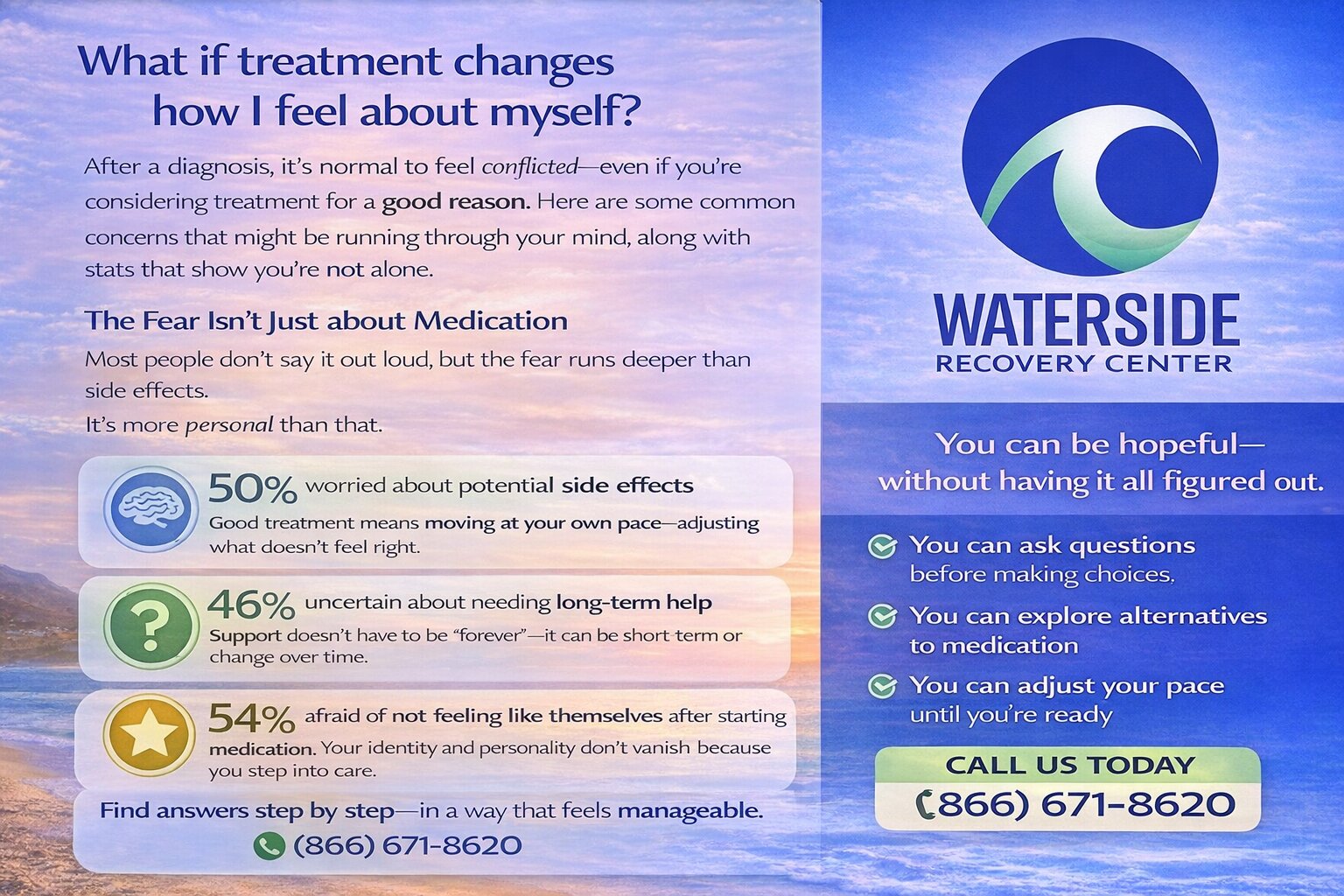
Most people don’t say it out loud, but the fear runs deeper than side effects.
It’s more personal than that.
It sounds like:
- What if I stop feeling like myself?
- What if I lose my edge, my creativity, my personality?
- What if I become dependent on something else?
These aren’t irrational fears. They’re human ones.
Especially if you’ve been managing things on your own for a long time—through willpower, routines, or just pushing through.
Medication can feel like crossing a line you can’t uncross.
But the truth is, nothing about this process has to be permanent or one-size-fits-all. You’re allowed to ask questions, take pauses, and move slowly.
You Don’t Have to Decide Everything Today
There’s often an invisible pressure after diagnosis:
Fix it. Start now. Don’t fall behind.
But healing doesn’t work on urgency alone.
Some people begin with talk-based support.
Some try medication and adjust along the way.
Some step in and out of care until something finally clicks.
There is no single “correct” path—only the one that works for you.
You’re allowed to gather information before making decisions. You’re allowed to say, “I need time to think.”
That’s not resistance. That’s self-awareness.
Therapy Is Where You Start Hearing Yourself Again
If things have felt noisy inside your mind—thoughts looping, emotions rising fast, urges pulling you in different directions—therapy creates space to slow that down.
Not by silencing you. But by helping you understand what’s happening underneath.
You might start to notice:
- Patterns you didn’t see before
- Emotional triggers that make more sense in context
- The difference between who you are and what you’re experiencing
That distinction matters.
Because you are not your diagnosis.
You are not your worst moment.
You are not beyond understanding.
Good care doesn’t rewrite you—it reconnects you.
Medication Can Support the Work, Not Replace You
One of the biggest misconceptions is that medication takes over.
In reality, for many people, it does something much quieter.
It creates a little more space.
Space between a thought and a reaction.
Space between an urge and a decision.
Space to actually use the tools you’re learning in therapy.
If your mind has been operating at full volume—racing, spiraling, overwhelming—medication can sometimes help bring that intensity down to a level that feels manageable.
Not numb. Not erased. Just steadier.
And importantly, you’re still in control.
You can:
- Ask about different options
- Start with lower doses
- Adjust based on how you feel
- Work closely with a provider who listens
Nothing about this is meant to override your voice.
It’s Okay If You Don’t Trust This Yet
Trust doesn’t appear just because someone handed you a plan.
You might still feel unsure. Maybe even skeptical.
That’s not something to push away—it’s something to bring into the conversation.
You can ask:
- What happens if I don’t take medication right away?
- What should I expect in the first few weeks?
- How will we know if this is working?
The right support team won’t rush you past those questions. They’ll sit with you in them.
Because real progress doesn’t come from pressure—it comes from understanding.
Different Levels of Support Exist for a Reason
Not everyone needs the same type of care.
And not everyone needs the same thing at the same time.
You might benefit from:
- Structured daytime care that offers consistency without full-time stay
- Multi-day weekly treatment that fits around work or responsibilities
- Individual sessions that give you space to process and rebuild
The goal isn’t to overwhelm you with options—it’s to find something that feels doable.
If you’re looking for care that fits into your life, you can explore support in areas we serve and see what might feel like a manageable starting point.
The First Step Doesn’t Have to Be Big
There’s a quiet myth in recovery that everything has to change all at once.
It doesn’t.
Sometimes the most important step is simply staying in the conversation.
Scheduling one appointment.
Asking one honest question.
Letting yourself consider help without committing to everything at once.
That’s how real change often begins—not with a dramatic decision, but with a small, steady shift.
This Is About Coming Back to Yourself
Right now, it might feel like your identity is being questioned.
Like there’s a version of you before this diagnosis—and something unknown after it.
But treatment isn’t about replacing who you were.
It’s about helping you feel more like yourself again.
More present.
More grounded.
More able to live without everything feeling so heavy.
And that process doesn’t take away who you are.
It gives you access to parts of yourself that may have felt out of reach.
Frequently Asked Questions
Do I have to take medication if it’s recommended?
No. Medication is one option—not a requirement. You have the right to ask questions, explore alternatives, and decide what feels appropriate for you. Many people start with therapy and revisit medication later.
What if medication changes my personality?
This is one of the most common fears. The goal of medication isn’t to change who you are—it’s to reduce the intensity of symptoms that may be getting in the way of your day-to-day life. If something feels “off,” adjustments can always be made.
How long does it take to know if something is working?
It depends on the type of medication and your individual response. Some people notice changes within a few weeks, while others need more time or adjustments. This process is collaborative—you’re not expected to figure it out alone.
Can I stop medication if I don’t like how it feels?
Yes—but it’s important to do so with professional guidance. Stopping suddenly can sometimes cause side effects. A provider can help you taper safely and explore other options.
What if I’ve tried treatment before and it didn’t help?
That doesn’t mean nothing will work. Treatment isn’t one-size-fits-all. Different approaches, different providers, and different timing can all make a difference. It’s okay to try again in a way that feels more aligned with you.
Is therapy enough on its own?
For some people, yes. For others, combining therapy with additional support creates better stability. There’s no universal answer—only what works best for your situation.
What’s the first step if I’m still unsure?
Start with a conversation. You don’t need to commit to a full plan. Just talking through your options with someone who understands can help you feel more grounded and less overwhelmed.
If you’re ready to explore your options in a way that feels safe, informed, and pressure-free, we’re here to meet you where you are.
Call (866)671-8620 or visit addiction therapy services to learn more about our addiction therapy services in Bristol County.