
A man once sat across from me and said something I haven’t forgotten.
“I don’t think treatment works.”
He didn’t say it angrily.
He said it the way someone talks about the weather after years of disappointment.
Matter-of-fact.
Defeated.
He had been through treatment before. More than once.
He had stopped drinking. He had stayed sober for months. He had attended meetings. He had done what people told him to do.
Then everything slowly started falling apart again.
The anxiety returned.
The depression returned.
Sleep became difficult.
His thoughts became darker.
The stress became overwhelming.
Eventually he found himself doing what he had promised he would never do again.
He used.
Like many people, he reached a conclusion that seemed logical:
“Treatment didn’t work.”
But after spending time together, a different picture emerged.
The substance use had been addressed.
The mental health struggles underneath it had not.
And that’s a very different story.
If you’ve been through treatment before and feel skeptical about trying again, you are not alone. Many people arrive at Waterside Recovery carrying the same frustration. They aren’t looking for motivation. They aren’t looking for slogans.
They want to understand why they worked so hard and still ended up back where they started.
For many individuals exploring dual diagnosis services, the answer isn’t that they failed.
It’s that only part of the problem was being treated.
The Part Nobody Could See
One of the most frustrating things about mental health challenges is that they’re often invisible.
People can see substance use.
They can see drinking.
They can see drug use.
They can see the consequences.
What they often cannot see is the anxiety that keeps someone awake at 3 a.m.
The depression that makes getting out of bed feel impossible.
The panic attacks.
The racing thoughts.
The trauma memories.
The constant feeling that something terrible is about to happen.
When those experiences stay hidden, substance use often becomes the visible symptom of a much larger struggle.
Many people spend years trying to stop the symptom while never addressing what created it.
Why Sobriety Doesn’t Automatically Create Peace
This is one of the biggest misconceptions in recovery.
People assume sobriety and healing are the same thing.
They’re not.
Sobriety removes substances.
Healing addresses what remains afterward.
Imagine turning off a television that’s been playing loudly in the background for years.
At first, the silence feels wonderful.
Then you start hearing everything else.
The creaking floor.
The traffic outside.
The conversations in the next room.
Things that were always there but impossible to hear.
For many people, early recovery feels similar.
Substances are removed.
And suddenly anxiety becomes louder.
Depression becomes clearer.
Trauma becomes harder to ignore.
That doesn’t mean recovery is failing.
It means recovery is revealing what still needs attention.
The Relief That Didn’t Last
One thing treatment skeptics often describe is a period when everything seemed to be working.
The first few weeks felt good.
Sometimes the first few months.
Relationships improved.
Energy returned.
Hope came back.
Then things changed.
Anxiety resurfaced.
Mood swings appeared.
Stress became overwhelming again.
At that point many people assume they are back at the beginning.
But they usually aren’t.
They’re standing at a different stage of the process.
The initial crisis may have improved.
Now the deeper issues are becoming visible.
That’s not failure.
It’s information.
And information creates opportunities.
Why Some People Return to Using Even When They Don’t Want To
Families often ask a question that sounds simple:
“If they knew it would hurt them, why did they use again?”
The answer is often more complicated than people expect.
Many individuals don’t return to substances because they want to get high.
They return because they want relief.
Relief from anxiety.
Relief from panic.
Relief from sadness.
Relief from loneliness.
Relief from emotional pain.
Think about it this way.
If someone has been using substances as a life jacket during emotional storms, simply taking away the life jacket doesn’t automatically teach them how to swim.
Eventually another storm arrives.
And people often reach for what helped them survive before.
Understanding that reality doesn’t excuse harmful behavior.
But it does explain why relapse can happen even when someone genuinely wants recovery.
The Loop That Keeps Pulling People Back
Many people become trapped in a cycle that looks something like this:
Mental health symptoms increase.
Substances provide temporary relief.
Substance use creates additional problems.
Stress increases.
Mental health symptoms worsen.
More substances seem necessary.
The cycle repeats.
It’s like trying to escape quicksand by pulling on your own arm.
Every effort creates more struggle.
Without addressing both sides of the equation, lasting progress becomes much harder.
This is one reason people begin researching co-occurring rehab Plymouth County options after previous recovery attempts didn’t provide the stability they hoped for.
They’re not looking for a miracle.
They’re looking for a more complete picture.
The Weight of Self-Blame
One of the saddest things we see is how much blame people carry.
They tell themselves:
“I should be stronger.”
“I should know better.”
“I ruined my chance.”
“Other people recover. Why can’t I?”
Those thoughts can become incredibly heavy.
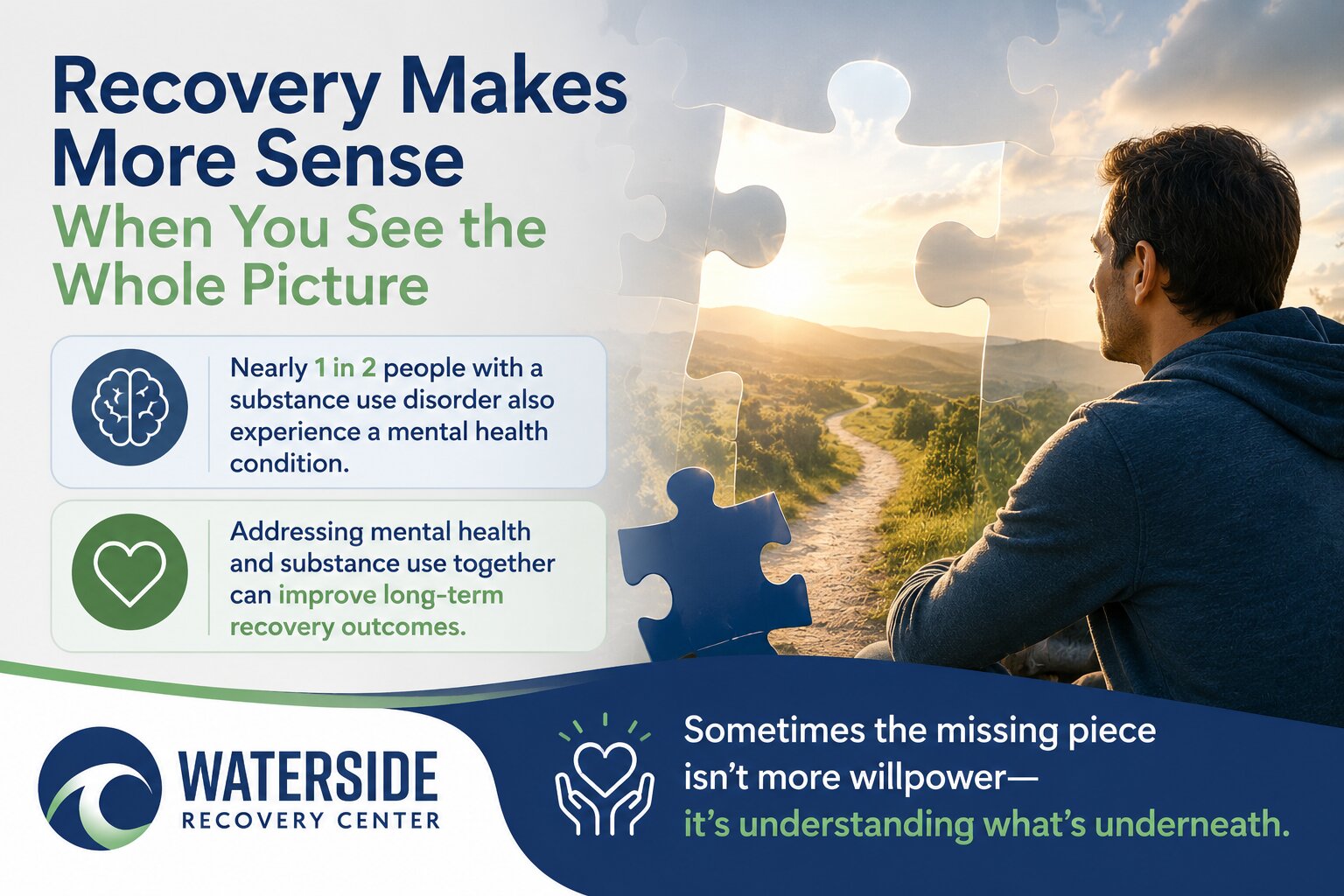
The truth is that many people have been trying to solve a complex problem using only part of the information.
Imagine trying to complete a puzzle while half the pieces remain hidden in the box.
You wouldn’t assume you’re bad at puzzles.
You’d recognize that something is missing.
Mental health challenges are often those missing pieces.
Once they’re acknowledged, recovery starts making more sense.
What Happens When the Whole Person Gets Attention
One thing we’ve noticed repeatedly is that people often experience a profound shift when they stop viewing themselves as broken.
Instead of asking:
“What’s wrong with me?”
They start asking:
“What happened to me?”
“What am I carrying?”
“What needs healing?”
Those questions create a different conversation.
A more hopeful conversation.
Because healing becomes possible when the full picture is understood.
We’ve seen individuals who spent years bouncing between periods of sobriety and relapse finally begin gaining stability once anxiety, depression, trauma, or other mental health concerns received attention too.
Not because they suddenly became stronger.
Because they finally stopped fighting with one hand tied behind their back.
Why Hope Returns When Things Start Making Sense
Hopelessness often grows in confusion.
When people don’t understand why they’re struggling, it’s easy to assume nothing will ever change.
But understanding creates possibilities.
The person who thought they lacked discipline realizes panic attacks were influencing their choices.
The person who thought they were weak discovers untreated depression was draining their ability to cope.
The person carrying unresolved trauma begins recognizing why substances felt so difficult to leave behind.
Suddenly the story changes.
Not from hopeless to perfect.
But from hopeless to understandable.
And that’s where hope often returns.
The Future Doesn’t Have to Look Like the Past
One mistake many treatment skeptics make is assuming their future will look exactly like their past.
If recovery was difficult before, they expect it to be difficult forever.
If they relapsed once, they assume they’ll relapse again.
If treatment didn’t help the way they hoped, they assume no treatment will.
But people change.
Circumstances change.
Understanding changes.
The future is not obligated to repeat the past.
Many of the people who now enjoy years of recovery once believed they were out of options.
What changed wasn’t luck.
It was discovering that their mental health and substance use were connected in ways they hadn’t fully understood.
If You’re Skeptical, You’re Not Alone
Skepticism isn’t a weakness.
It’s often the result of disappointment.
People become skeptical because they’ve been hurt.
Because they’ve tried.
Because they’ve hoped before.
If that’s where you are right now, we understand.
The goal isn’t convincing you that everything will be easy.
The goal is helping you consider a different possibility:
Maybe treatment didn’t fail.
Maybe there was more of the story that needed attention.
For people seeking help in areas we serve or looking for help in areas we serve, understanding the connection between mental health and addiction can become the first hopeful thing they’ve heard in a long time.
Frequently Asked Questions
Why do mental health challenges and addiction often occur together?
Many people use substances to cope with anxiety, depression, trauma, stress, or other emotional challenges. Over time, both issues can begin influencing one another.
Can anxiety make recovery more difficult?
Yes. Persistent anxiety can increase emotional distress, affect sleep, create cravings, and make it harder to manage daily stressors.
What if I’ve already been to treatment before?
Previous treatment experiences do not determine future success. Many people find recovery after discovering important factors that were previously overlooked.
Does relapse mean treatment failed?
Not necessarily. Relapse often indicates that additional support, coping strategies, or treatment approaches may be needed.
Why do I feel worse emotionally after I stop using substances?
Substances often mask emotional pain. Once they’re removed, underlying issues such as anxiety, depression, or trauma may become more noticeable.
Can untreated depression affect recovery?
Absolutely. Depression can reduce motivation, increase isolation, and make it harder to maintain healthy routines and coping strategies.
Is it possible to recover if I’ve struggled for years?
Yes. Many people who achieve long-term recovery spent years feeling stuck before finding an approach that addressed the full picture.
How do I know if mental health may be affecting my substance use?
If anxiety, depression, trauma, panic, mood changes, or emotional distress seem connected to your substance use, it may be worth exploring that relationship with a professional.
Call (866) 671-8620 or visit our dual diagnosis services to learn more about our treatment, dual diagnosis services in MetroWest, Massachusetts.