
I didn’t hit rock bottom.
There were no arrests. No ultimatums. No job loss. If anything, people probably envied me. I had a decent job in finance, paid my mortgage on time, cracked jokes at family dinners, and never missed my niece’s soccer games.
But every night, after the house got quiet, I poured my third—or was it fifth?—drink and stared into the dark. Just me and the silence and the uneasy truth I kept refusing to name: this isn’t normal. This isn’t freedom. And I can’t keep doing this.
I wasn’t “out of control.” I was just tired. Quietly, deeply tired of living two lives.
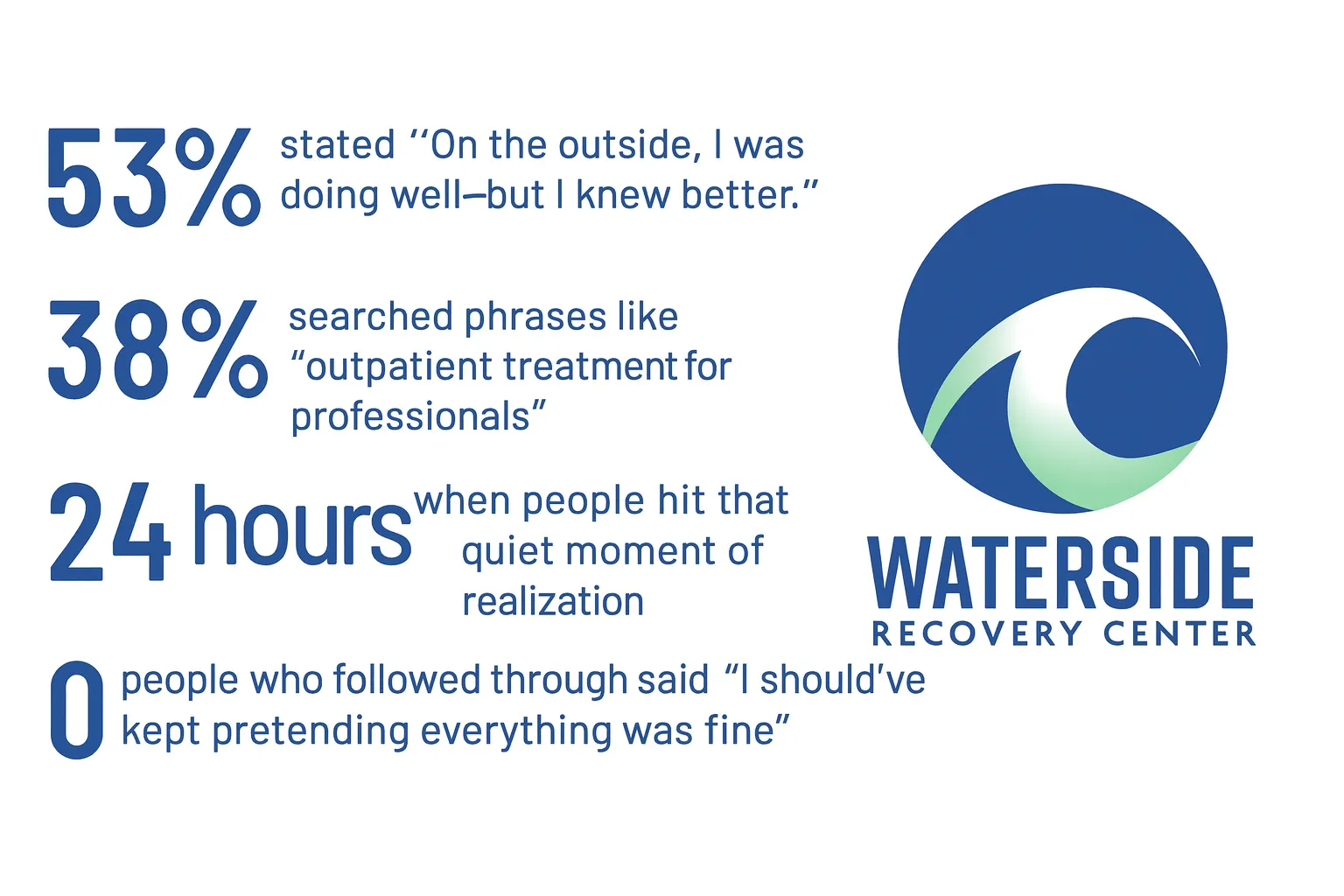
That’s how I found Waterside Recovery’s outpatient treatment program. Not in a blaze of consequences—but in a quiet moment of clarity. I didn’t want to keep pretending. I wanted one life. One honest, sustainable, peaceful life. And I didn’t know how to get there alone.
The High-Functioning Trap: “I’m Fine. I’m Just Tired.”
If you looked at my calendar, you wouldn’t think I had a drinking problem. If you looked at my browser history, you might.
Searches like:
- “Am I an alcoholic if I only drink at night?”
- “How many drinks a week is too many?”
- “Outpatient treatment for professionals”
I kept hunting for proof that I didn’t have a problem. But everything I read felt too dramatic. Too messy. I wasn’t blacking out (anymore). I didn’t drink in the morning (yet). I just… needed it to feel okay.
That’s the trick of high-functioning addiction. You don’t look like the stereotype. So you convince yourself it’s fine. Until it isn’t.
I Didn’t Want to Lose My Life—I Wanted to Keep It Without the Drinking
What finally pushed me wasn’t a disaster. It was a Tuesday.
I was at a client lunch, and someone jokingly asked if I ever took a break from wine. I laughed. They laughed. But something in me froze.
Because no—I couldn’t. I hadn’t taken a break in over a year. Not even one day.
That night, I didn’t drink. I wanted to prove I could. I lasted until 8:30pm.
That’s when I knew: this wasn’t just a habit. It was a dependency dressed up in self-control.
I needed help. But I didn’t need—or want—to disappear into rehab for 30 days. I needed something that fit the life I wanted to keep living. That’s what brought me to outpatient treatment.
Why I Chose an Outpatient Treatment Program
I’d heard of rehab, of course. I thought it was for people with DUIs or interventions or failed marriages. Not people like me, with functioning routines and decent credit scores.
But outpatient treatment offered a middle path.
At Waterside Recovery in Plymouth County, I could:
- Attend structured therapy several times a week
- Join group sessions with people who also had careers, families, and responsibilities
- Keep working while getting real support
- Stay connected to the life I was building—without needing to hit pause
This wasn’t a shortcut. It was a lifeline that respected my reality while helping me change it.
The Surprising Power of Telling the Truth—Out Loud
Walking into my first group session, I expected to feel out of place. I thought I’d be the only one still “holding it together.” I was wrong.
Everyone there was managing something—some were parents, some owned businesses, some were quietly falling apart like me.
No one judged me when I spoke. No one tried to fix me. They just nodded. Understood.
That’s when I realized: high-functioning doesn’t mean okay. It just means quiet suffering.
Group gave me something alcohol never could: honesty without consequence. Support without pretense.
The Hardest Part Was Letting Go of the Act
When I finally said the words out loud—“I don’t think I can stop on my own”—it didn’t feel like failure. It felt like relief.
Outpatient treatment didn’t just help me stop drinking. It helped me understand why I was drinking in the first place.
I learned to:
- Sit with discomfort instead of numbing it
- Set boundaries I used to drink my way around
- Face anxiety without medicating it
- Redefine connection without alcohol as the middleman
It wasn’t always easy. But it was real. And over time, real started to feel better than performance.
Now I Live One Life—And It’s Enough
Recovery didn’t turn me into someone new. It brought me back to who I was before I split myself in two.
I still work hard. I still show up for my family. But now I do it without the secret weight of shame, secrecy, and hangovers.
When someone asks how I’m doing, I tell them the truth. Because now, the truth is good enough.
If you’re tired of hiding your drinking behind your accomplishments, you’re not alone. And you don’t have to lose everything to get help. You just have to stop pretending.
Outpatient treatment gave me the space to get honest—and stay in my life while changing it. And it can do the same for you.
Looking for Outpatient Treatment in Massachusetts?
Whether you live in Plymouth County or are looking for outpatient treatment in Bristol County, MA, Waterside Recovery offers flexible, stigma-free support designed for people who don’t fit the typical mold of “addiction.”
Frequently Asked Questions About Outpatient Treatment Programs
What is an outpatient treatment program?
An outpatient treatment program offers structured support for substance use recovery without requiring an overnight stay. You attend therapy sessions, group support, and educational programming multiple times a week while continuing to live at home and maintain your daily responsibilities.
How do I know if outpatient treatment is enough for me?
If you’re functioning in daily life but struggling privately with substance use—especially alcohol—outpatient treatment may be the right fit. It’s ideal for individuals who need support and accountability without stepping away from work or family life.
Is outpatient treatment confidential?
Yes. At Waterside Recovery, your privacy is protected. Group members agree to confidentiality, and the program complies with all HIPAA regulations. You don’t have to worry about your employer or community finding out unless you choose to share.
How long does outpatient treatment last?
Programs vary by individual needs, but many last between 8–12 weeks, with options to step down into less frequent care as progress is made. Some clients continue attending support groups or therapy for ongoing recovery even after formal programming ends.
What happens after I finish outpatient treatment?
Recovery doesn’t end when treatment does. You’ll work with your care team to develop an aftercare plan that may include ongoing therapy, community support groups, alumni events, or additional recovery resources. Waterside Recovery helps you stay connected and supported for the long haul.
Do I have to stop drinking entirely?
Outpatient treatment encourages full abstinence, especially if alcohol has become a coping mechanism or source of distress. But the decision is ultimately yours. Many clients begin with ambivalence and work toward clarity as they experience support, reflection, and healing.
You Don’t Have to Crash to Change Course
Maybe no one knows how much you’re drinking. Maybe you’ve convinced yourself that because you’re functioning, it’s not a problem.
But if your drinking is something you hide, explain away, or regret quietly—it matters.
You matter. And your story doesn’t have to stay split in two.
Call (866)671-8620 to learn more about how our outpatient treatment program in Plymouth County, MA can help you reclaim your peace—without blowing up your life.