
You show up. You deliver. You stay on top of deadlines, carpools, prescriptions, elder care calendars, and tax filings. From the outside, your life looks controlled—even admirable. But inside, it’s fraying.
Not in ways most people would notice. You’re still standing. Still taking care of others. But you know something has shifted. You’re tired—deep, bone-deep tired. You’re managing your pain, your stress, or your anxiety with something that’s started to manage you.
Maybe it started with a prescription for back pain. Maybe it was a few leftover pills you kept “just in case.” Maybe it helped with the pressure. The long days. The nights when your mind wouldn’t quiet down.
You told yourself it was manageable. Because, for a while, it was.
But now, you’re not so sure.
If you’re reading this, chances are you’re holding two truths:
- You’re high-functioning—and also dependent.
- You don’t know how to stop without losing everything.
At Waterside Recovery, we’ve built opiate addiction treatment programs that respect both of those realities. And we want you to know: you don’t have to hit rock bottom to deserve help. You don’t have to lose everything to start getting it back.
When Addiction Hides in High Functioning
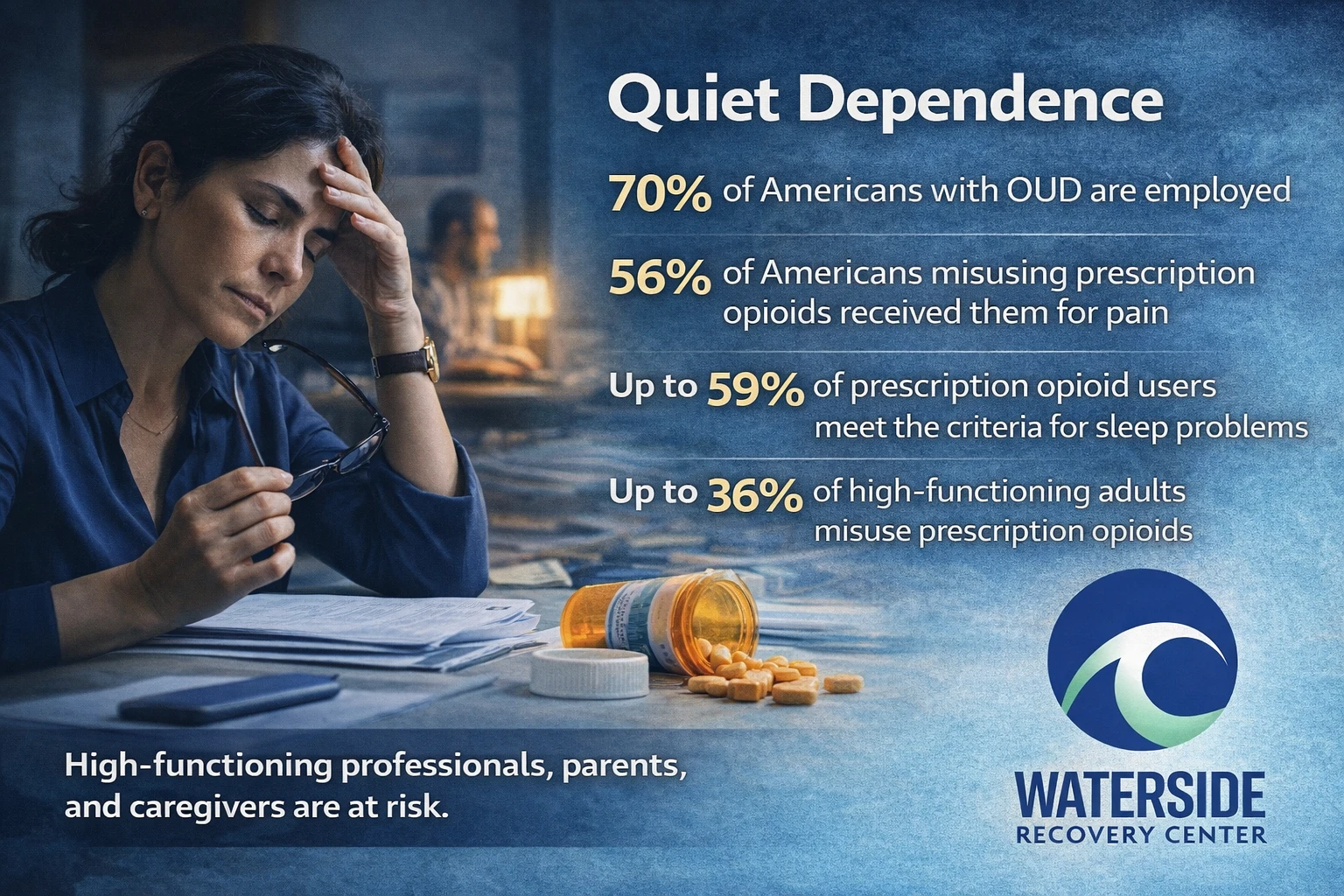
Opiate addiction doesn’t always look like a dramatic crash. Often, it looks like excellence. Perfectionism. Holding everything together on the surface, while privately slipping further away from yourself.
You might still be excelling at work. Still caring for your kids. Still showing up for others. But inside, you’re exhausted, anxious, and increasingly reliant on opiates just to get through the day—or the night.
You may be telling yourself:
- “It’s prescribed, so it’s fine.”
- “I only use it to sleep, or when the stress is unbearable.”
- “I’ll stop when things settle down.”
But things never settle down. And the quiet negotiation with yourself becomes a daily loop.
This is the invisible burnout. The kind that keeps you isolated and ashamed because it doesn’t look like addiction. But it still robs you of peace.
Opiate Addiction in Professionals, Parents, and Caregivers
Opiates appeal to high-functioning adults for a reason—they numb the discomfort without disrupting your performance. Until they do.
For professionals, opiates can feel like a way to shut off the anxiety, stay focused longer, or recover faster. For parents and caregivers, they may offer relief from chronic exhaustion, physical pain, or emotional depletion.
But over time, tolerance builds. Use increases. And what started as a solution becomes its own problem.
Some signs this may be happening:
- You plan your schedule around availability or refills.
- You feel anxious when you run low.
- You’ve increased your dose without a doctor’s recommendation.
- You’re hiding your use—or minimizing it when asked.
These aren’t signs of failure. They’re signals that your body and brain have adapted to something you didn’t intend to depend on. That’s treatable. And that’s where we come in.
You Don’t Have to Step Away From Everything
One of the biggest fears for high-functioning clients is that treatment will force them to step away from their careers, families, or caregiving duties. But effective care doesn’t have to mean inpatient rehab or disappearing for 30 days.
At Waterside Recovery, we offer flexible options that support your healing without derailing your life, including:
- Intensive Outpatient Program (IOP): Attend structured group and individual therapy 3–5 times per week—while still working or parenting.
- Partial Hospitalization Program (PHP): A more immersive, day-based program with evenings free.
- Outpatient Support and Aftercare: Ideal for maintaining stability after initial treatment or for those needing lower-intensity care.
- Discreet Medication-Assisted Treatment (MAT): When appropriate, medications like Suboxone or Vivitrol can reduce cravings and support long-term recovery.
Whether you’re a teacher, executive, caregiver, or small business owner, there’s a way to get support without abandoning your responsibilities.
Why So Many People Wait (and Why You Don’t Have To)
People like you—capable, high-achieving, deeply responsible—often wait too long to ask for help. Why?
Because you’re used to solving your own problems. Because you’re afraid of judgment. Because the idea of losing control feels worse than staying stuck.
But here’s the thing:
- Asking for help isn’t losing control.
- Treatment isn’t punishment.
- Recovery doesn’t mean giving up your roles—it means reclaiming your presence in them.
And if you live or work locally, you don’t need to travel far. Waterside Recovery provides opiate addiction treatment in Plymouth County, MA, and also supports families and professionals in nearby regions like Bristol County. You don’t have to disappear to get better. You just have to be willing to take the next step.
What Treatment Feels Like When It’s the Right Fit
It feels like breathing again.
Like no longer calculating how many pills are left.
Like sleeping deeply for the first time in months.
Like facing your workday without fear or fog.
Like being able to focus on your kids—and actually enjoy it.
Like not needing a substance to feel okay.
Our clinicians understand the nuances of high-functioning addiction. We don’t shame. We don’t stereotype. We help people reclaim a life that may look successful on the outside—but hasn’t felt right inside for a long time.
Your Private Struggle Deserves Real Support
You’ve likely helped everyone around you. At work. At home. In your community.
It’s not selfish to need support.
It’s not dramatic to seek treatment.
It’s not “bad enough” that determines when you get help—it’s being done.
If you’re ready, we’ll walk with you—quietly, clearly, and confidentially.
FAQ: Opiate Addiction Treatment for High-Functioning Adults
Will I have to stop working or parenting to start treatment?
Not necessarily. Many of our clients balance treatment with professional or family life. Our IOP and PHP programs offer structure without requiring full residential admission. We’ll help you find a level of care that fits your reality.
What if I’ve been prescribed these medications?
It’s very common to develop dependence on legally prescribed opiates. We won’t shame you for that. Our clinical team works with you to safely reduce, replace, or manage use based on your unique health history.
I’m scared my employer or family will find out.
Your privacy is our priority. We maintain strict confidentiality, and many treatment options are scheduled in ways that protect your time and discretion. You’re not alone in this concern, and we’ll help you navigate it.
Is this really addiction if I’m still functioning?
Yes—and that doesn’t diminish your strength. High-functioning people can absolutely be struggling with addiction. If opiates are causing distress, taking up mental space, or making you feel less like yourself, that’s enough to seek help.
What happens after treatment?
We offer ongoing support through outpatient therapy, alumni programming, and aftercare planning. Recovery isn’t just about stopping use—it’s about building a sustainable, satisfying life that doesn’t require opiates to get through.
This Is the Part Where You Get to Choose Peace
You’ve done hard things before. This one’s just different.
Different because it’s for you.
Different because it’s quiet.
Different because it starts not with crisis—but with courage.
Call (866)671-8620 or visit our Opiate Addiction Treatment services in Plymouth County, MA to take the next step toward clarity, health, and freedom. We’ll meet you where you are—and walk with you toward what’s next.