
I didn’t want help because I thought help would take something from me.
Not just the drinking—but the version of me that felt alive, expressive, and somehow more me.
It wasn’t dramatic. It didn’t look like rock bottom.
It looked like quiet routines no one questioned.
A drink to settle my nerves. Another to soften the edge.
A promise to myself that tomorrow I’d do better.
And then tomorrow came—with the same anxiety, just heavier.
I Thought the Anxiety Was Just Part of Who I Was
For a long time, I didn’t even question it.
I told myself I was wired this way. Sensitive. Intense. A little overwhelmed by everything—but also more aware, more creative because of it.
That’s what I held onto.
What I didn’t see—at least not clearly—was how often I was using alcohol to regulate what I didn’t know how to sit with.
It became a pattern of drinking to cope with anxiety, even though I wouldn’t have said it like that back then.
I would’ve said I was “unwinding” or “taking the edge off.”
But the edge kept coming back. Sharper each time.
And the mornings carried something new—this low, steady shame that didn’t match the life I looked like I had on the outside.
The Fear Wasn’t About Sobriety—It Was About Losing Myself
This is the part that kept me stuck.
I wasn’t afraid of quitting alcohol.
I was afraid of what would be left if I did.
Because alcohol wasn’t just something I used—it was tied into how I showed up.
Socially. Creatively. Even emotionally.
It helped me feel open. Looser. Less trapped in my own head.
So I asked myself questions I didn’t know how to answer:
- Who am I without that release?
- Will I still feel like me?
- What if everything becomes… flat?
That fear is real. And it deserves to be taken seriously.
Because it’s not really about alcohol—it’s about identity.
Living in That In-Between Space
There’s a strange place you end up in when you start questioning your habits but aren’t ready to change them.
You notice more.
You notice how quickly you reach for a drink.
How your body feels before and after.
How your thoughts race a little faster at night.
But you also notice the relief it brings—even if it’s temporary.
So you stay in this loop:
“I need this.”
“I hate that I need this.”
“I don’t know what I’d do without this.”
That loop is exhausting.
And it’s incredibly isolating, even if no one else can see it.
What I Didn’t Expect About Getting Help
I thought getting help would feel like being broken down.
Like someone would take away my coping mechanisms and leave me to figure it out alone.
That’s not what happened.
What I found instead was a space where both things could be true at once:
- I was using alcohol for a reason
- And that reason deserved attention—not judgment
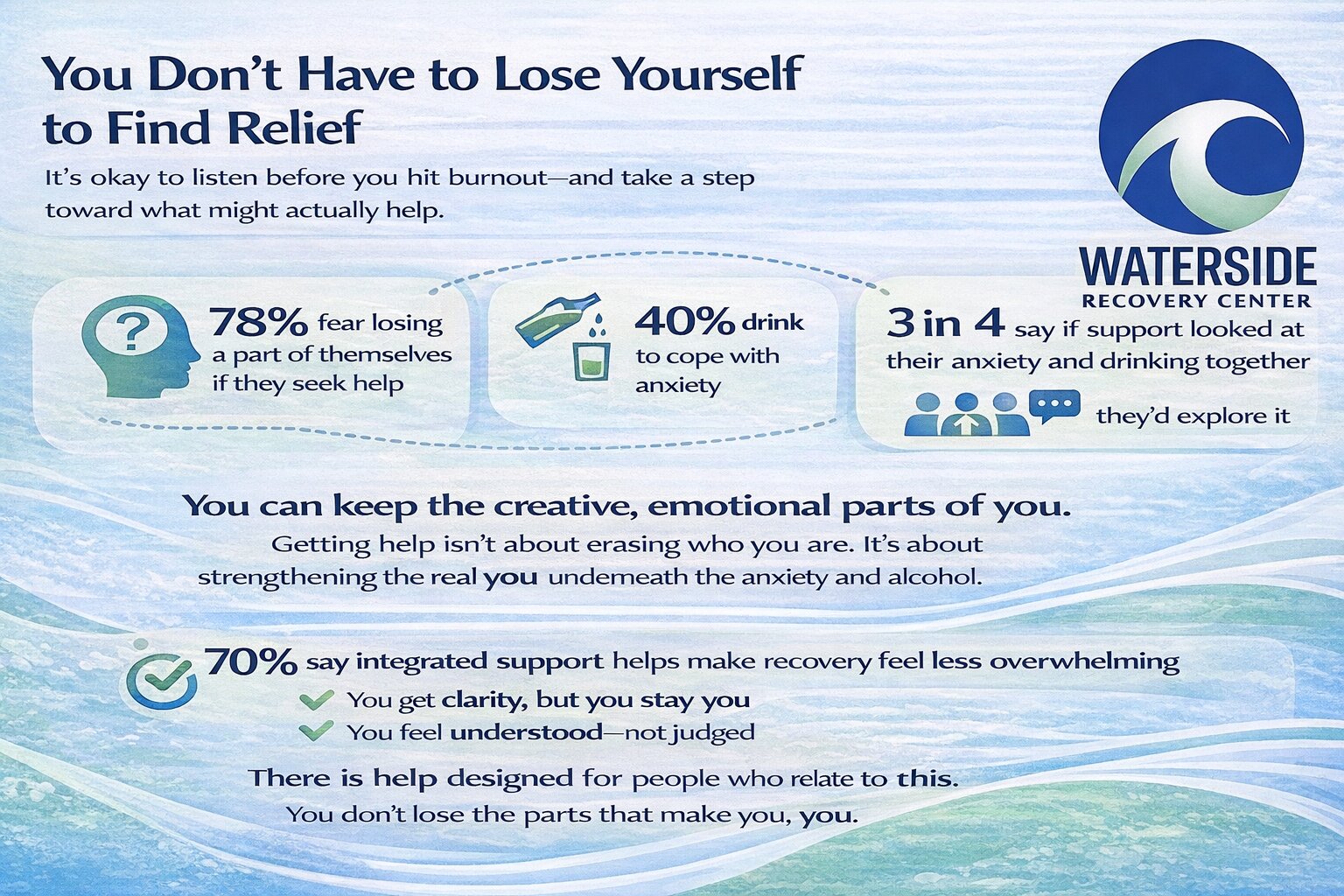
The biggest shift came when someone helped me see that my anxiety and my drinking weren’t separate problems.
They were connected.
Deeply.
Finding support that addressed both at the same time—like this kind of integrated support—was the first time I didn’t feel like I had to explain myself in pieces.
For once, everything I was experiencing made sense in one place.
It Wasn’t About Becoming Someone Else
I expected rules. Restrictions. A version of recovery that felt rigid and unfamiliar.
Instead, I found curiosity.
What triggers your anxiety?
What does it feel like in your body?
What are you trying to escape—or hold onto?
No one told me who to be.
They helped me notice who I already was—without the constant interference of anxiety and alcohol pulling in opposite directions.
And slowly, something shifted.
Not overnight. Not perfectly.
But noticeably.
The Creative Part of Me Didn’t Disappear
This was one of my biggest fears.
I thought sobriety would dull everything that made me interesting.
But what actually happened was different.
The creativity didn’t go away—it became clearer.
More intentional.
Less dependent on chaos.
I could sit with ideas longer.
Finish things I started.
Feel emotions without immediately needing to escape them.
It wasn’t that I lost something.
It’s that I gained access to it in a steadier way.
The Version of Me I Was Protecting Was Exhausted
I used to think I was protecting my identity.
But looking back, I was protecting a version of myself that was constantly overwhelmed.
Always managing. Always coping.
That version of me needed relief—not reinforcement.
Getting help didn’t erase who I was.
It gave me space to breathe inside my own life again.
You Don’t Have to Choose Between Relief and Identity
If you’re stuck in that same fear—worried that getting help will take away something essential about you—I want you to hear this clearly:
You don’t have to become a different person to feel better.
You don’t have to lose your depth, your sensitivity, your personality.
What you might lose is the constant cycle of anxiety → escape → regret.
And what you might gain is something quieter—but stronger.
Stability. Clarity. Energy that isn’t constantly being drained.
There are real treatment options in areas we serve designed for people who feel exactly like this—people who aren’t trying to become someone new, just trying to feel okay in their own mind again.
What Healing Actually Felt Like
It didn’t feel like a transformation.
It felt like small returns.
- Sleeping without overthinking everything
- Waking up without dread
- Sitting in a moment without needing to change it
And maybe the most important one:
Feeling like I could trust myself again.
That’s not something I thought treatment would give me.
But it did.
You’re Allowed to Keep the Parts of You That Matter
You’re allowed to care deeply.
You’re allowed to feel things strongly.
You’re allowed to want relief without losing yourself in the process.
Getting help doesn’t erase you.
It helps you come back—without the constant weight.
Frequently Asked Questions
Will I lose my personality if I stop drinking?
This is one of the most common fears—and one of the most understandable. Alcohol can feel like it enhances parts of your personality, especially in social or creative settings. But in reality, those parts are still yours. Treatment helps you access them without relying on something that also brings anxiety, regret, or instability. Most people don’t lose themselves—they feel more like themselves.
Why does alcohol make my anxiety worse the next day?
Alcohol can temporarily calm your nervous system, but it often disrupts brain chemistry in a way that increases anxiety afterward. That’s why the relief feels real in the moment—but the rebound can feel even heavier the next day. Over time, this cycle can make anxiety feel more constant and harder to manage.
What if I’m not “that bad”? Can I still get help?
Yes. You don’t need to hit a certain level of severity to deserve support. If you’re questioning your relationship with alcohol or noticing patterns that don’t feel good anymore, that’s enough. Early support can actually make change feel more manageable—not more overwhelming.
What does it mean to treat both anxiety and drinking together?
It means looking at the full picture. Instead of treating anxiety and alcohol use as separate issues, integrated care helps you understand how they influence each other—and gives you tools to manage both. This kind of approach can make recovery feel more realistic and more sustainable.
How do I know if this kind of support is right for me?
If any of this feels familiar—
If you’ve been stuck in the loop of anxiety and relief and regret—
If you’re afraid of losing yourself but also tired of feeling this way—
It might be worth exploring.
You don’t have to decide everything right now.
You just have to be willing to look a little closer.
Call (866)671-8620 or visit our dual diagnosis services in Plymouth County, MA to learn more about our treatment, dual diagnosis services in Plymouth County, MA.