
It’s a thought that sticks longer than people admit.
“I tried that already.”
“It didn’t work.”
And after that, something shifts.
You stop looking.
You stop asking.
You quietly decide this just might not be for you.
If you’re here, reading this anyway, there’s probably a part of you that isn’t fully convinced of that story.
And that part matters.
If you’ve found yourself revisiting options like alcohol addiction treatment, not because you’re hopeful—but because you’re tired—that’s still a step.
What “Didn’t Work” Usually Means
Most people don’t walk away from treatment feeling like it was completely useless.
It’s more layered than that.
You might have felt:
- Clear while you were there
- Supported in a way you hadn’t before
- Motivated—maybe even confident
And then something changed.
You left.
Life came back in.
Old patterns showed up faster than expected.
So now, “it didn’t work” really means:
“It didn’t last.”
That’s a very different problem.
The Gap No One Prepares You For
There’s a moment that doesn’t get talked about enough.
It’s not during treatment.
It’s after.
You go from structure to freedom overnight.
From:
- Scheduled support → open time
- Accountability → independence
- Understanding → real-life pressure
That gap can feel like stepping off solid ground without realizing it.
And if you fall back into old patterns there, it can feel like proof that nothing worked.
But most of the time, it’s not about failure.
It’s about what happens after support ends—or changes.
When Your Body Is Still Pulling You Back
There’s another layer people don’t always talk about.
The physical side.
If you’ve ever woken up feeling shaky—like your hands aren’t steady, your body feels off, and the fastest way to feel normal again is a drink—you know how strong that pull is.
Those alcohol withdrawal shakes aren’t a mindset problem.
They’re physical.
They can override everything you learned, especially early on.
If that piece wasn’t fully stabilized before—or if it came back after—it can make it feel like you never really had a chance.
Because your body was still asking for something your mind was trying to resist.
You Might Have Been Doing the “Right” Things Alone
A lot of people leave treatment with insight.
You understand your triggers.
You recognize your patterns.
You know what you should do.
But knowing and doing aren’t the same thing.
Especially when you’re back in the same environment that shaped those habits.
Without consistent support, even the right tools can feel impossible to use.
That’s not a lack of effort.
That’s what happens when you’re trying to hold everything on your own again.
Not All Support Is Built the Same
It’s easy to assume treatment is one thing.
You tried it once. It didn’t work. End of story.
But there are different layers to support.
Some are more structured.
Some are more flexible.
Some focus more on routine.
Others focus more on underlying mental health.
Some people need:
- More time in treatment
- More gradual transitions
- More support integrated into their daily life
Others need something that fits around work, family, and responsibilities.
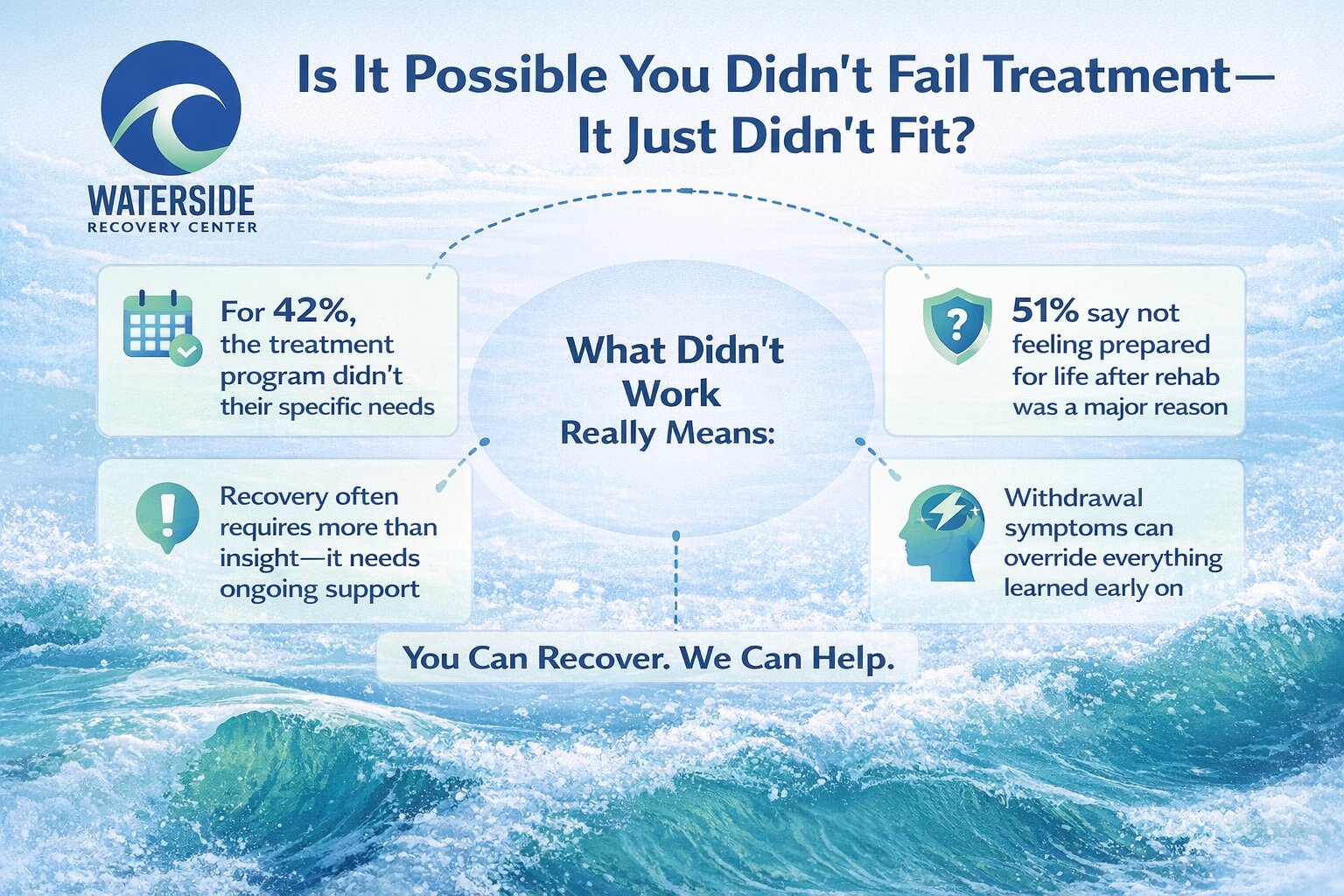
If what you tried before didn’t fit your life—or your needs at the time—it doesn’t mean treatment doesn’t work.
It means that version of it didn’t work for you then.
You’re Not the Same Person You Were Then
Even if it doesn’t feel like it.
You’ve learned things.
You’ve experienced what it feels like to step away from drinking—even if it didn’t last.
You’ve seen what support can look like.
And maybe most importantly, you’ve seen what doesn’t work for you.
That matters.
Because trying again isn’t starting from zero.
It’s starting with more awareness.
Skepticism Isn’t the Opposite of Change
A lot of people think they need to feel hopeful to try again.
You don’t.
You can feel doubtful.
You can feel guarded.
You can feel like this probably won’t work—and still be open enough to explore it.
Skepticism often comes from experience.
It means you’ve tried before.
And while that can make things feel heavier, it also means you’re not walking in blindly.
What Could Be Different This Time
Not everything has to change.
Sometimes it’s about adjusting the pieces that didn’t hold before.
More consistent support instead of short-term structure.
More flexibility so it fits your actual life.
More attention to both the mental and physical sides—not just one.
There are help in areas we serve designed for people who are in this exact place:
Not new to the idea of treatment.
Not fully convinced by it either.
But still willing to see if something could feel different.
The Part That Might Be Hard to Hear
Trying again doesn’t guarantee it will work.
But not trying guarantees things stay the same.
That’s the tension most people sit in.
Not hope. Not certainty.
Just a quiet question:
“Is there something I haven’t tried yet that might actually fit?”
That’s where change usually starts.
You Don’t Have to Believe—Just Be Willing
You don’t need to walk into this confident.
You don’t need to feel ready.
You don’t need to believe it’s going to work.
You just need a small part of you that’s willing to see if something different might feel possible.
That’s enough to begin.
Frequently Asked Questions
What if I’ve already tried treatment more than once?
That’s more common than people admit.
Different experiences can offer different insights—and sometimes it takes more than one attempt to find the right fit. Each time, you learn something that can make the next step more effective.
Why did I feel better in treatment but not after?
Because treatment provides structure and support that can be hard to replicate on your own.
When that structure changes or disappears, it can feel like everything falls apart. That doesn’t mean treatment didn’t work—it means the transition needed more support.
Are physical symptoms really that important?
Yes.
Things like alcohol withdrawal shakes are real, physical responses that can make it extremely difficult to stay on track without proper support.
Addressing the physical side is just as important as the mental and emotional side.
What if I don’t feel motivated to try again?
You don’t need motivation to start.
A lot of people begin from a place of exhaustion, not inspiration. Willingness matters more than motivation—and even a small amount is enough.
How do I know if something will be different this time?
You don’t fully know.
But you can look for differences in:
- Level of support
- Flexibility of the program
- How well it fits your real life
Those factors often make a bigger difference than people expect.
You didn’t fail.
You were trying to make something work with the tools and support you had at the time.
And it’s okay if it takes more than one attempt to find something that actually fits.
Call (866)671-8620 or visit our alcohol addiction treatment services in Plymouth County, MA to learn more about our treatment, alcohol addiction treatment services in Plymouth County, MA.