

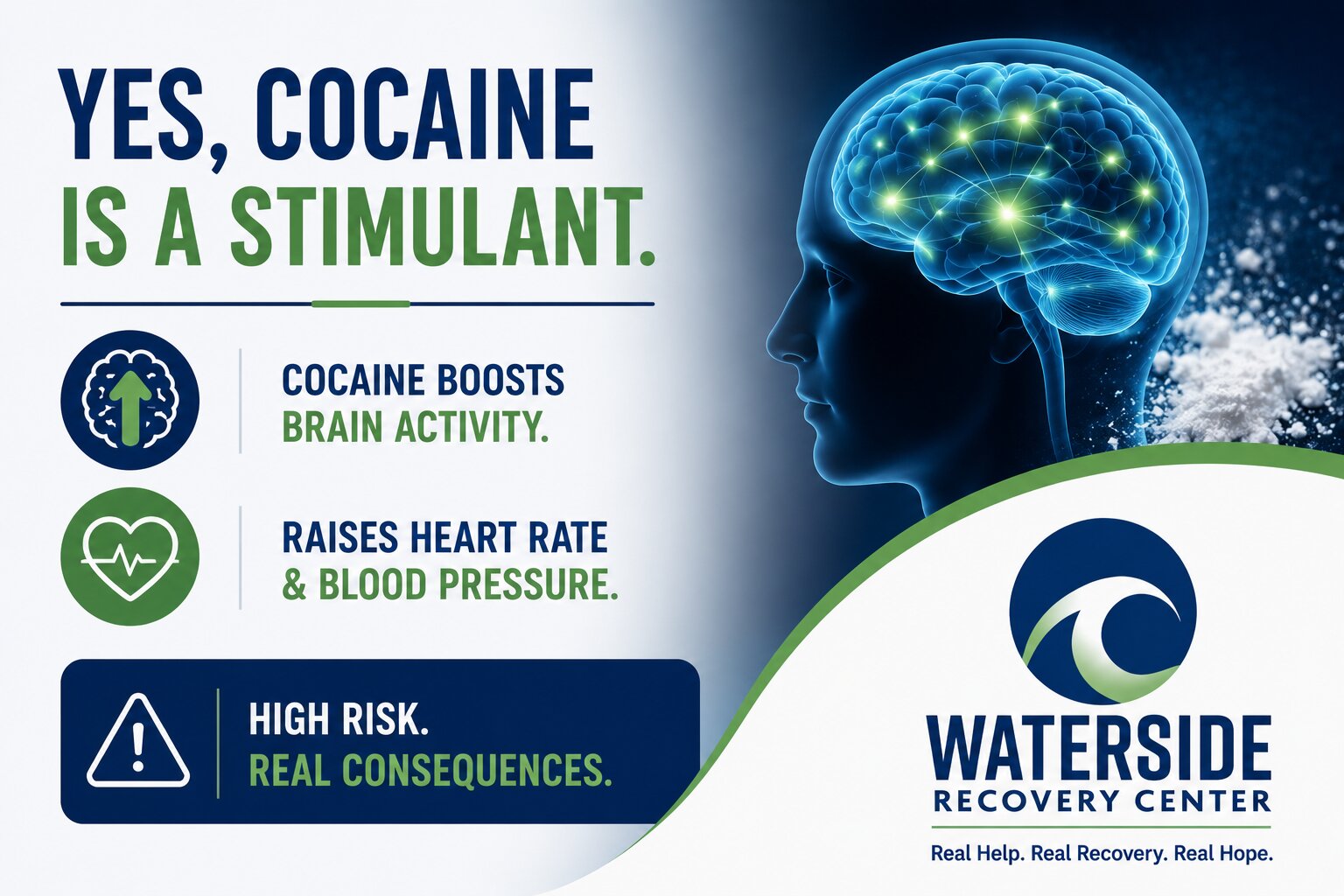
If you’ve been asking, “Is cocaine a stimulant?” the short answer is yes. Cocaine is a central nervous system (CNS) stimulant that speeds up communication between the brain and body, producing a rapid surge in energy, alertness, confidence, and euphoria. If cocaine use has become difficult to control, learning about cocaine addiction treatment can help you understand what professional support looks like and what recovery may involve.
Understanding how cocaine works isn’t just about learning the science. It also helps explain why the drug can become so difficult to stop using. The same brain changes responsible for the intense high are also responsible for the powerful crash that often leads people to use cocaine again.
Yes, Cocaine Is a Stimulant — Here’s How It Works
Cocaine belongs to a class of drugs known as central nervous system (CNS) stimulants. Unlike depressants, which slow brain activity, stimulants increase activity throughout the nervous system.
As a result, cocaine commonly causes:
- Faster heart rate
- Elevated blood pressure
- Increased alertness
- More energy
- Reduced fatigue
- Increased wakefulness
- Heightened confidence
What makes cocaine especially powerful is how it affects brain chemistry.
Normally, brain cells communicate using chemical messengers called neurotransmitters. After these chemicals deliver their message, they’re recycled through a process called reuptake.
Cocaine interrupts that process.
Instead of allowing neurotransmitters to be recycled, cocaine blocks their reuptake, causing them to build up between nerve cells. The three primary neurotransmitters affected are:
- Dopamine
- Norepinephrine
- Serotonin
Among these, dopamine plays the largest role in cocaine’s addictive potential.
Dopamine and the Brain’s Reward System
Dopamine is heavily involved in motivation, pleasure, and learning.
When cocaine blocks dopamine reuptake, dopamine accumulates in areas of the brain responsible for reward—especially the nucleus accumbens, often called the brain’s reward center.
This produces the intense feelings of:
- Euphoria
- Excitement
- Motivation
- Confidence
- Reinforcement to repeat the behavior
The brain quickly learns to associate cocaine with an unusually powerful reward, making future cravings more likely.
Cocaine Also Acts as a Local Anesthetic
Interestingly, cocaine has another medical property that many people don’t realize.
In addition to stimulating the nervous system, cocaine blocks voltage-gated sodium channels, preventing nerves from transmitting pain signals.
Because of this, purified cocaine is still occasionally used as a local anesthetic during certain ear, nose, and throat (ENT) procedures, where its anesthetic and blood vessel-constricting effects can be medically useful.
Medical use is highly controlled and entirely different from recreational cocaine use.
Effects of Cocaine on the Body
Because cocaine stimulates nearly every major organ system, its effects extend far beyond producing a temporary high.
Short-Term Effects
Common immediate effects include:
- Increased energy
- Elevated heart rate
- Higher blood pressure
- Increased alertness
- Reduced appetite
- Dilated pupils
- Increased confidence
- Talkativeness
- Restlessness
- Reduced need for sleep
These effects often begin within minutes, depending on how cocaine is used, but they also fade relatively quickly.
Higher Doses Can Become Dangerous
As the dose increases, the risks increase as well.
Higher amounts of cocaine may produce:
- Severe anxiety
- Panic
- Agitation
- Suspiciousness
- Paranoia
- Hallucinations
- Chest pain
- Irregular heartbeat (arrhythmia)
- Seizures
These complications can become medical emergencies.
Cocaine Constricts Blood Vessels
One of cocaine’s most dangerous effects is vasoconstriction, meaning it causes blood vessels to narrow.
Reduced blood flow places significant stress on the cardiovascular system and can increase the risk of:
- Heart attack
- Stroke
- Dangerous heart rhythm disturbances
- Damage to organs from reduced circulation
For people who regularly snort cocaine, repeated vasoconstriction inside the nose can also damage the nasal lining and surrounding tissue over time.
The Cocaine Crash
The stimulant high from cocaine is intense—but it’s also remarkably brief.
That’s because cocaine has a relatively short half-life, meaning the body clears it quickly.
As drug levels fall, the brain experiences a dramatic shift.
During the high, dopamine levels were artificially elevated far beyond normal. Once the cocaine wears off, those dopamine levels rapidly decline.
This sudden drop creates what is commonly called the cocaine crash.
People often experience:
- Extreme fatigue
- Depression or low mood
- Irritability
- Difficulty concentrating
- Flat emotions
- Increased sleepiness
- Powerful cravings for more cocaine
The crash isn’t simply feeling tired after staying awake.
It’s the brain responding to the sudden loss of an unusually large dopamine surge.
Because cocaine temporarily overwhelms the brain’s natural reward system, normal dopamine signaling cannot immediately return to baseline.
The result is a temporary dopamine deficit.
Many people describe feeling emotionally “empty,” unmotivated, or unable to experience pleasure during this period.
This neurological shift is one of the biggest reasons cocaine use often becomes repetitive.
Instead of seeking euphoria alone, people may begin using cocaine simply to escape the uncomfortable crash.
Why the Stimulant Mechanism Drives Addiction
Understanding how cocaine works also explains why cocaine addiction can develop surprisingly quickly.
The cycle often looks like this:
- Cocaine produces an intense dopamine surge.
- The brain adapts to that unusually high dopamine level.
- The drug wears off quickly.
- Dopamine activity falls sharply.
- Cravings emerge as the brain seeks relief.
- Cocaine is used again.
Repeated exposure changes how the brain responds to dopamine over time.
As this happens:
- The high often becomes less intense.
- Larger or more frequent doses may be used.
- Cravings become stronger.
- The crash becomes more difficult to tolerate.
This pattern is sometimes called the binge-and-crash cycle, and it’s one of the defining features of stimulant addiction.
Importantly, addiction is not simply about lacking willpower.
The brain’s reward pathways adapt to repeated cocaine exposure, making stopping much more difficult without support.
If cocaine use has begun affecting your health, work, finances, or relationships, professional treatment can help address both the physical and psychological aspects of recovery. Learning more about cocaine addiction treatment can be an important first step toward lasting recovery.
When to Seek Help
Some people begin using cocaine occasionally and find that it gradually becomes more frequent. Others notice increasing cravings, difficulty stopping once they begin, or repeated binges followed by emotional crashes.
Seeking help early may reduce the risk of more serious medical and psychological complications.
At Waterside Recovery, treatment is individualized to address both the neurological effects of stimulant addiction and the underlying factors contributing to continued use.
If you or someone you care about is struggling with cocaine use, call (866) 671-8620 or learn more about cocaine addiction treatment to explore available treatment options. If you’re seeking addiction treatment in Bristol County, MetroWest, or Plymouth County, Waterside Recovery offers personalized care to support lasting recovery.
Frequently Asked Questions
Is cocaine a stimulant or a depressant?
Cocaine is a central nervous system stimulant. It increases brain activity by blocking the reuptake of dopamine, norepinephrine, and serotonin, producing increased energy, alertness, and euphoria. It is not classified as a depressant.
What does cocaine do to the body?
Cocaine increases heart rate, raises blood pressure, constricts blood vessels, reduces appetite, increases energy, and stimulates the brain’s reward system. At higher doses, it can also cause anxiety, paranoia, chest pain, dangerous heart rhythm problems, stroke, or heart attack.
Why is cocaine so addictive?
Cocaine rapidly floods the brain with dopamine by preventing its reuptake. When the drug wears off, dopamine levels drop sharply, producing fatigue, depression, and intense cravings. This crash often drives repeated use, creating the binge-and-crash cycle that contributes to addiction.