
At first, you tell yourself there is probably a simple explanation.
Maybe he is exhausted from work.
Maybe he has not been sleeping well.
Maybe the medication simply makes him tired.
But then it happens again.
And again.
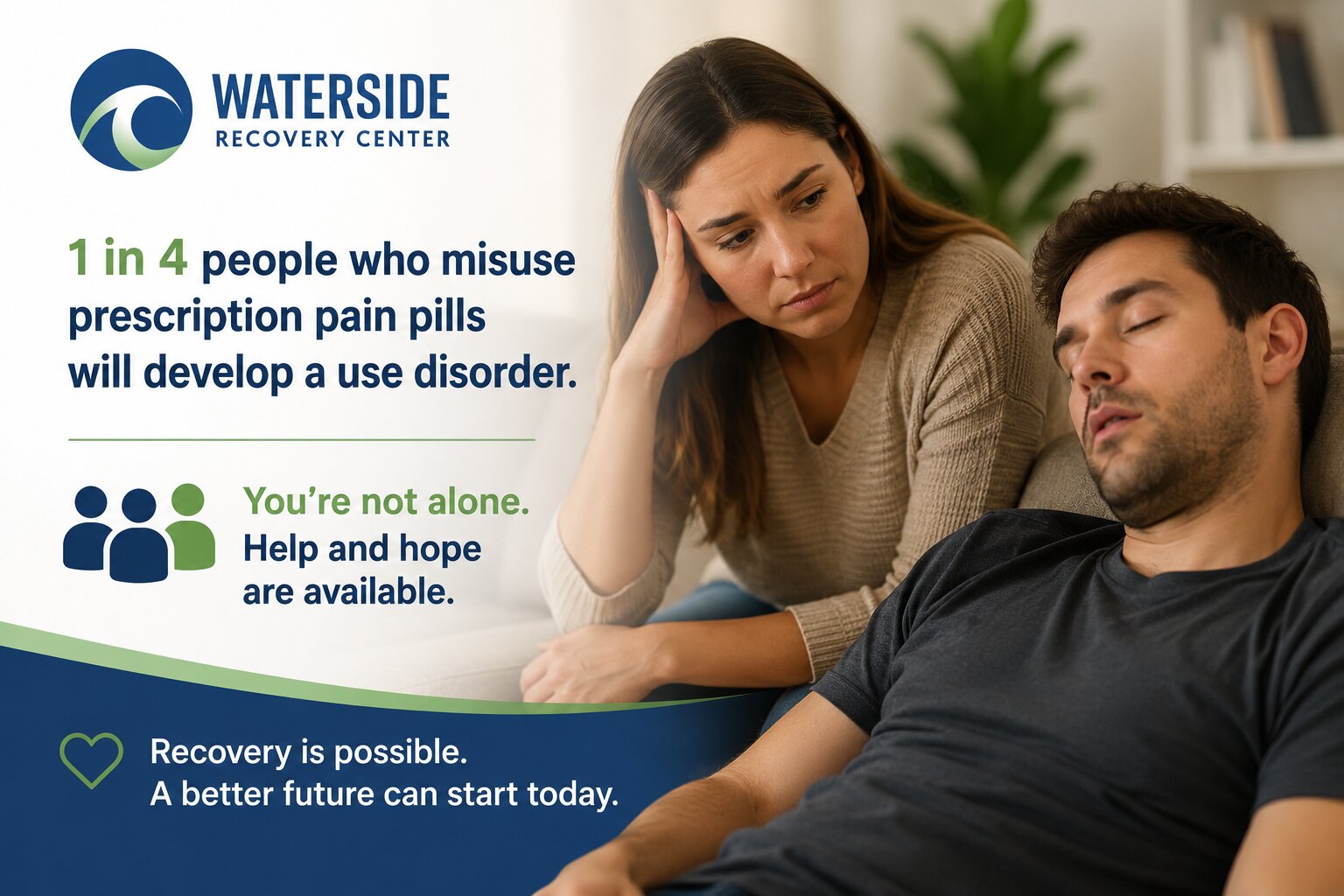
You are talking about dinner plans and suddenly his eyes close.
You are watching television together and his head drops forward.
You repeat a question three times before realizing he drifted off in the middle of the conversation.
Eventually, you stop asking yourself whether you noticed something.
You start asking yourself what it means.
If you’ve found yourself searching online because your boyfriend keeps nodding off after taking pain pills, know that you are not alone.
Many people arrive at this question after weeks or months of uncertainty. They are not trying to accuse someone they love. They are trying to understand what they are seeing.
At Waterside Recovery, we often speak with partners who feel caught between concern and confusion. Many begin exploring available opiate treatment services because they want answers before the situation becomes more serious.
And if that is where you are right now, your concern deserves attention.
Sometimes Your Instincts Notice the Problem Before Your Mind Accepts It
One of the most difficult parts of loving someone who may be struggling with opioids is that the changes often happen gradually.
There is rarely one dramatic moment.
Instead, there are dozens of small moments.
You notice he seems tired all the time.
He forgets conversations.
He loses interest in activities he once enjoyed.
His energy changes.
His mood changes.
His priorities change.
Individually, each change may seem explainable.
Together, they begin forming a picture that feels impossible to ignore.
Many partners tell us they sensed something was wrong long before they could explain exactly why.
That intuition is worth listening to.
What Does “Nodding Off” Actually Mean?
When people describe someone “nodding off,” they are usually talking about sudden episodes where a person drifts into sleep unexpectedly.
It may last only a few seconds.
Sometimes it lasts longer.
The person may appear awake one moment and asleep the next.
Their eyes close.
Their head drops.
Their speech slows.
Then they suddenly wake up and continue talking.
This type of behavior can occur when opioids affect the central nervous system.
These substances slow breathing, reduce alertness, and create sedation.
The stronger the effect, the more noticeable the drowsiness may become.
Not every episode of sleepiness means addiction is present.
However, repeated episodes—especially after taking pain pills—can be an important warning sign that deserves closer attention.
The Changes Often Go Beyond Physical Symptoms
Many people initially focus on sleepiness because it is visible.
What they often overlook are the emotional and behavioral changes happening alongside it.
You may notice that your boyfriend seems emotionally distant.
Conversations feel shorter.
Plans are canceled more often.
Responsibilities start slipping.
Small problems suddenly create large arguments.
You may feel as though you are spending more time worrying about him than actually connecting with him.
One partner described it this way:
“It felt like he was sitting right beside me, but somehow he wasn’t really there.”
That feeling is common.
When substance use becomes part of someone’s life, emotional availability often changes long before obvious consequences appear.
Why Opioid Problems Can Be Difficult to Recognize
Many people expect addiction to look dramatic.
They imagine job loss.
Financial collapse.
Legal trouble.
Complete dysfunction.
The reality is often very different.
Some people continue working.
They maintain relationships.
They pay bills.
They appear successful.
From the outside, life may seem normal.
Meanwhile, opioids quietly begin taking up more space.
More mental energy.
More emotional energy.
More physical dependence.
This is one reason partners often struggle to identify the problem.
The person they love still appears functional.
But something feels different.
And that difference matters.
Looking for Patterns Instead of Proof
One mistake many people make is searching for a single piece of evidence that confirms their fears.
Unfortunately, addiction rarely works that way.
It usually reveals itself through patterns.
Repeated behaviors.
Repeated concerns.
Repeated observations.
Instead of asking:
“Can I prove there is a problem?”
Consider asking:
“What patterns am I seeing?”
Has the nodding off become more frequent?
Are medications being used differently than prescribed?
Are there changes in mood, motivation, or relationships?
Do explanations seem inconsistent?
Patterns often provide far more information than isolated incidents.
The Emotional Toll of Constant Worry
When someone you love may be struggling, your life changes too.
You begin monitoring behavior.
Watching for warning signs.
Replaying conversations.
Questioning your own judgment.
Many partners describe feeling emotionally exhausted.
Part of them wants to trust.
Part of them feels afraid.
Part of them worries they are overreacting.
Part of them worries they are underreacting.
Living in that uncertainty can be incredibly stressful.
Many people spend months carrying the weight alone because they feel guilty discussing their concerns with anyone else.
If that sounds familiar, know that your feelings are valid.
Concern is not betrayal.
Paying attention is not judgment.
Caring enough to ask difficult questions is often an act of love.
Understanding the Bigger Picture
When people search for signs of opioid addiction, they are usually hoping for certainty.
A checklist.
A diagnosis.
A simple answer.
Unfortunately, real life is rarely that clear.
Addiction often develops gradually.
Someone may begin taking medication exactly as prescribed.
Over time, tolerance develops.
Higher amounts become necessary.
Dependence grows.
Behavior changes.
Relationships become strained.
What begins as a medical solution can slowly become something much more complicated.
That does not mean recovery is impossible.
In fact, many people who struggle with opioids eventually find lasting recovery.
The earlier concerns are recognized, the easier it often becomes to seek support before consequences grow more severe.
Hope Is More Common Than You Think
If you are worried about your boyfriend, it is easy to focus on everything that could go wrong.
Many loved ones immediately imagine worst-case scenarios.
Overdose.
Addiction.
Relationship breakdown.
Loss.
Those fears are understandable.
But they are not the entire story.
Every day, people recover from opioid addiction.
People who once nodded off during conversations become fully present again.
People who seemed emotionally distant reconnect with family and loved ones.
People who felt trapped discover that recovery is possible.
One of the biggest misconceptions about addiction is that change is rare.
The truth is that recovery happens every single day.
Often, it begins with someone recognizing that help may be needed.
At Waterside Recovery, we help individuals and families understand treatment options, navigate difficult conversations, and explore pathways toward recovery. We also provide help in areas we serve and ongoing care in areas we serve for individuals seeking support closer to home.
Sometimes the most important step is not having all the answers.
Sometimes it is simply deciding to stop carrying the questions alone.
Frequently Asked Questions
Does nodding off always mean someone is addicted to opioids?
No. Sleep deprivation, medical conditions, and other medications can also cause excessive drowsiness. However, repeated nodding off after taking pain medication deserves attention and may indicate a larger concern.
Why do opioids cause people to nod off?
Opioids slow activity in the central nervous system, which can cause sedation, drowsiness, slower breathing, and reduced alertness.
Can someone become addicted even if the medication was prescribed?
Yes. Many people who develop opioid addiction originally received medication through a legitimate prescription. Dependence and addiction can develop over time.
What other warning signs should I watch for?
Changes in mood, secrecy, financial difficulties, social withdrawal, missed responsibilities, unusual sleep patterns, and increasing focus on obtaining medication may all indicate a problem.
How do I bring up my concerns without starting an argument?
Choose a calm moment, focus on specific observations rather than accusations, and approach the conversation from a place of concern and care.
What if my boyfriend becomes defensive?
Defensiveness is common when substance use is discussed. Even if the conversation is difficult, expressing concern respectfully can still be valuable.
Can opioid addiction be treated successfully?
Yes. Many people achieve long-term recovery through professional treatment, therapy, support systems, and ongoing recovery planning.
When should professional help be considered?
If substance use appears to be affecting health, relationships, work, safety, or daily functioning, professional support may help determine the best next steps.
What should I do if I think an overdose may be happening?
If someone is difficult to wake, breathing slowly, has blue lips, or becomes unresponsive, call emergency services immediately and administer naloxone if available.
Call 866-671-8620 or visit our opiate treatment services to learn more about our treatment, opiate treatment services Plymouth, MA.