
When your son or daughter is in crisis, everything feels urgent.
The mood swings. The isolation. The drinking. The anger. The fear that you might get a phone call you’re not prepared for.
And somewhere in the middle of all that chaos, you’re trying to answer one impossible question:
Is it the alcohol… or is it their mental health?
For many families who reach out about alcohol addiction treatment, the answer is both. And that’s not a complication—it’s a clue.
Because when mental health and drinking feed each other, separating them in treatment rarely works.
Let’s walk through why.
Drinking Is Often a Symptom, Not Just the Problem
When parents see heavy drinking, it’s natural to focus on the visible behavior.
The empty bottles. The late nights. The arguments. The risky decisions.
But in many young adults, alcohol is functioning as relief.
Relief from anxiety that won’t shut off.
Relief from depression that makes the world feel gray.
Relief from trauma that resurfaces at night.
Take away the alcohol without addressing the pain underneath, and the nervous system has nowhere to go.
The distress doesn’t disappear.
It intensifies.
That’s often when relapse happens—not because your child doesn’t want to be sober, but because sobriety without mental health support feels unbearable.
Crisis Rarely Has A Single Cause
Behavioral health crises build in layers.
You may have noticed changes over months or even years:
- Increasing irritability
- Withdrawal from friends
- Academic or work decline
- Sleeping all day or not at all
- Drinking alone
- Talking about feeling hopeless
No one wakes up one morning and decides to spiral.
It’s usually anxiety, depression, trauma, stress, and alcohol gradually reinforcing each other until everything feels unstable.
When families attempt to treat “just the drinking,” the mental health crisis often continues underneath the surface.
That’s why integrated care matters.
Why Treating Them Separately Often Fails
There was a time when substance use and mental health were handled in separate systems.
A young adult would detox, stabilize from alcohol, and then—maybe—seek therapy later.
The problem?
If alcohol was being used to manage panic attacks, depression, or intrusive thoughts, removing it without building alternative coping skills leaves your child exposed.
Imagine taking away someone’s crutch before their leg is strong enough to walk.
Without integrated support, sobriety can initially feel like free-falling emotionally.
That doesn’t mean treatment isn’t working.
It means it isn’t complete.
What Integrated Care Looks Like In Practice
Integrated support addresses both realities at once.
It looks like:
- Therapy that explores anxiety, trauma, and mood disorders while addressing drinking patterns
- Structured daytime care that stabilizes routine and emotional regulation
- Psychiatric support when medication is appropriate
- Group work that helps young adults understand how mental health and substance use interact
When both sides are treated together, something shifts.
We’ve seen young adults who cycled through short sober periods begin to stabilize once their depression was properly treated.
We’ve seen anxiety decrease dramatically when alcohol was removed and replaced with evidence-based coping skills.
The goal isn’t just sobriety.
It’s sustainability.
A Pattern Many Parents Recognize
A father once told us, “Every time he stops drinking, he gets worse.”
He wasn’t wrong.
When his son attempted sobriety without mental health support, his underlying anxiety disorder surged. He became agitated, restless, and emotionally volatile.
Drinking had been masking the anxiety.
When integrated care addressed both, the volatility softened. Sleep improved. The edge came down.
Sobriety stuck—not because of fear of consequences—but because his mind felt safer.
This is why we emphasize treating both together.
The Guilt Parents Carry
You may be wondering:
“Did I miss signs of depression?”
“Did I ignore the anxiety?”
“Did I focus too much on the drinking?”
Please hear this clearly.
Behavioral health crises are complex. Even trained professionals can miss early warning signs. Symptoms overlap. Young adults hide distress. Alcohol disguises pain.
Your role is not to have diagnosed everything perfectly.
Your role now is to seek comprehensive support.
Families in Braintree, Massachusetts have sat where you are—confused, exhausted, afraid—and found steadier ground through coordinated care.
You are not alone in this.
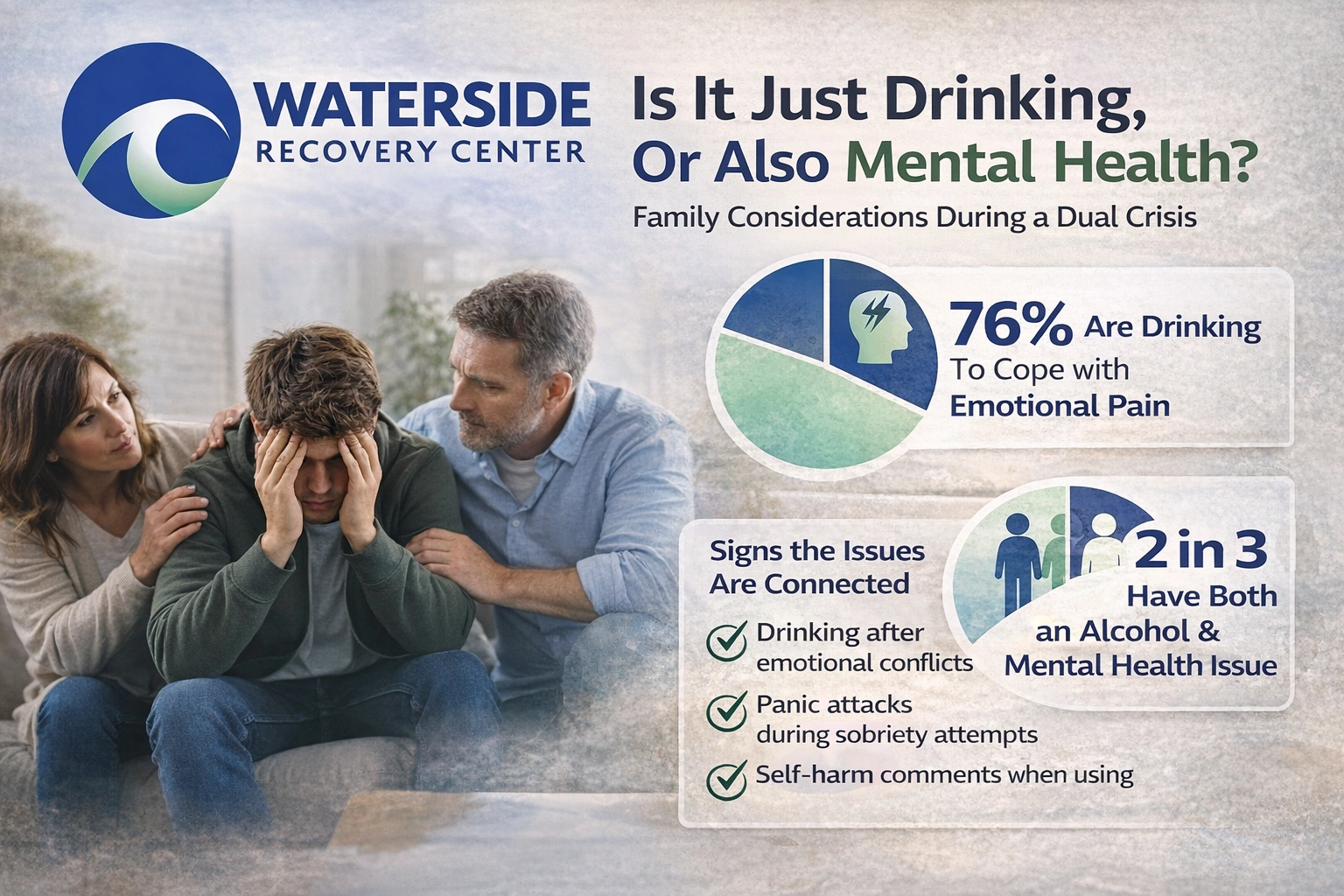
Signs Both Issues May Be Connected
You might notice patterns like:
- Drinking increases after emotional conflicts
- Panic attacks intensify during attempts at sobriety
- Self-harm statements tied to substance use
- Extreme mood swings when intoxicated
- A history of trauma combined with escalating alcohol use
When these signs appear together, they rarely resolve in isolation.
They require alignment.
Integrated support doesn’t just remove alcohol.
It stabilizes the emotional storm underneath.
Why Early Integrated Support Changes Outcomes
When both mental health and drinking are addressed early, long-term outcomes improve.
Young adults regain stability faster.
Relapse rates decrease.
Trust begins rebuilding sooner.
Families often tell us that once treatment addressed both issues simultaneously, their child seemed more present—less reactive, more grounded.
Not perfect. Not instantly transformed.
But steady.
And steady is a powerful beginning.
If you’re exploring options in surrounding communities such as Weymouth, Massachusetts, know that seeking coordinated care isn’t overreacting.
It’s preventative.
Hope Isn’t Naïve — It’s Clinical
Hope doesn’t mean pretending everything is fine.
Hope means understanding that young brains are adaptable. That emotional regulation can be taught. That trauma can be processed safely. That sobriety becomes sustainable when mental health is stabilized.
We’ve seen young adults return to school. Rebuild friendships. Repair family relationships. Laugh again.
Not because someone told them to “just stop drinking.”
But because both the drinking and the despair were treated together.
When mental health stabilizes, alcohol loses its grip.
When alcohol is removed safely, mental clarity improves.
Both must move together.
What You Can Do Right Now
If your child is in immediate danger, seek emergency care.
If they are struggling but stable, consider:
- Asking providers whether they treat mental health and substance use together.
- Looking for structured care that provides clinical depth, not just abstinence.
- Encouraging honest conversations about anxiety, depression, trauma, and suicidal thoughts.
- Seeking family involvement in treatment when appropriate.
You don’t need every answer tonight.
You need one step toward alignment.
Frequently Asked Questions
Is drinking causing the mental health crisis, or is mental health causing the drinking?
Often, it’s both. Alcohol can worsen depression and anxiety. Untreated depression and anxiety can increase alcohol use. They create a feedback loop. Breaking the loop requires treating both at the same time.
Should my child get sober before addressing mental health?
Not separately. While stabilization from alcohol may be necessary, mental health support should begin immediately—not months later. Integrated care prevents emotional destabilization during early sobriety.
What if my child refuses help?
Resistance is common. Fear, shame, and denial can block engagement. Family support, clear boundaries, and professional guidance can gradually reduce resistance. Focus on consistent messaging: help is available, and you are not the enemy.
Can treatment actually stabilize both issues long term?
Yes—with the right level of care. When therapy, psychiatric support, and sobriety skills are integrated, long-term stabilization becomes far more likely. Recovery is not instant. But it is possible.
How do I manage my own fear during this?
Parents often carry constant vigilance. Support groups for families, therapy, and education about integrated care can help you regulate your own nervous system. Your steadiness becomes part of the recovery environment.
The Bridge Between Fear And Stability
Right now, you may feel like you are losing your child to two battles at once.
You are not powerless.
When drinking and mental health are treated together, crisis becomes manageable. Patterns become visible. Skills are learned. Stability returns gradually.
It won’t be perfect overnight.
But it can become steady.
And steady is enough to begin.
If you’re ready to explore coordinated support, call (866)671-8620 or visit our Alcohol Addiction Treatment services in Plymouth County, MA to learn more about how Waterside Recovery can support your family.