
You don’t have to be in crisis to want clarity.
Maybe you’re still working. Maybe your friends don’t know. Maybe your use is “controlled,” in the way that only you understand—timed, calculated, hidden just well enough.
But if you’ve landed here, reading this, there’s probably a quiet question already echoing in your mind:
“Is this helping anymore?”
That question is where real change begins—not in chaos, but in curiosity.
At Waterside Recovery, we work with people who are high-functioning, sober-curious, and increasingly tired of walking the tightrope of daily opiate use. Not everyone who walks into our program has “hit bottom.” But many are starting to feel the emotional fog, mental fatigue, and internal disconnection that long-term opiate use brings.
And what they want—more than anything—is space.
Space to think clearly. To feel things again. To make decisions without second-guessing whether it’s them or the substance talking.
Here’s how opiate addiction treatment can give you that space—without demanding a full identity rewrite.
1. It Stops the Constant Calculating in Your Head
Opiate use doesn’t just hijack your body—it clutters your brain.
If you’re actively using (even if it’s “just” prescribed pills), your day might be filled with low-grade math:
- How long until I need another one?
- Do I have enough for the weekend?
- Can anyone tell?
- What excuse do I use if I run out?
Even if you’re managing fine on the outside, this background mental load eats up real energy. It shapes your calendar, your social life, your mood, your sleep.
One of the most noticeable benefits of entering treatment? That loop quiets down.
You’re not constantly scanning your body for withdrawal. You’re not mentally rationing. You’re not waking up wondering if you’ll have to lie to get through the day.
Suddenly, there’s room in your mind for other things—your goals, your emotions, your actual thoughts. It’s not that you become a new person. You just become available again.
2. It Helps You Reclaim Emotional Bandwidth
Opiates flatten things.
Yes, they take the edge off pain—physical or emotional. But they also take the depth out of joy, connection, and clarity.
So when people begin treatment, one of the first surprises is emotional: everything feels louder.
You might cry more easily. You might feel restless. You might experience a weird combination of boredom and anxiety.
This is actually a good sign. It means your nervous system is thawing.
And once that initial intensity levels out (and it does), what’s left is sharper. More honest. You stop responding on autopilot. You notice how things actually feel.
Thinking clearly isn’t just about cognition—it’s about emotional truth. Treatment helps you reclaim both.
3. You Learn What Your Own Voice Sounds Like Again
Long-term opiate use has a way of stealing your inner compass.
You may still be productive, even social—but decisions start to feel more reactive than intentional. You wonder: Is this how I actually feel? Or am I just trying to avoid discomfort?
One of the quiet victories we witness in treatment is this moment: when someone says, “I finally trust myself again.”
That trust comes from having a clear mind. A body that isn’t constantly cycling through chemical peaks and crashes. A space where you don’t have to manipulate, defend, or perform.
In that space, you hear yourself clearly—for the first time in a long time.
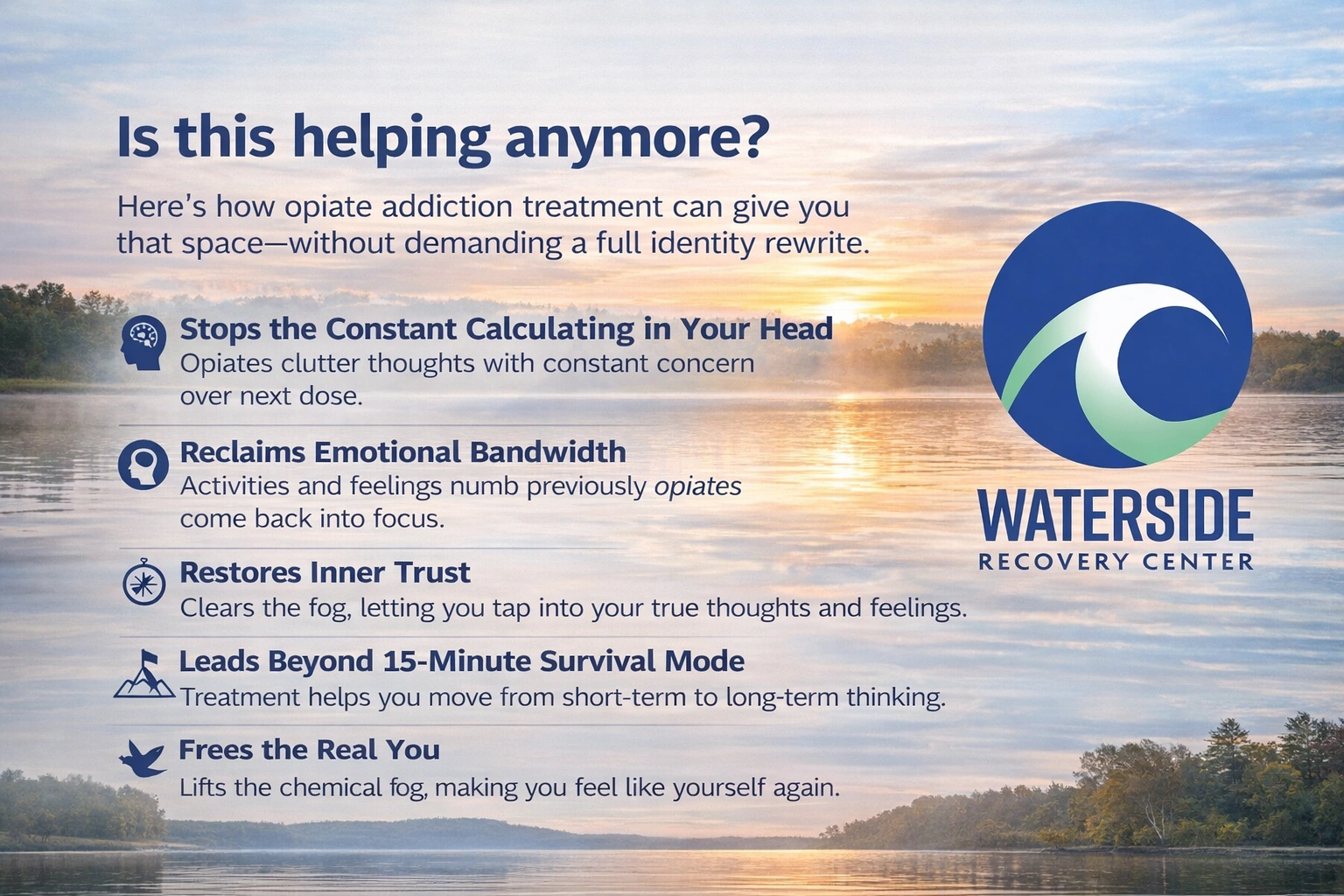
4. It Helps You Zoom Out From 15-Minute Survival Mode
Opiate dependence creates tunnel vision. You live in 15-minute increments. 4-hour blocks. Next-dose math.
This micro-survival mindset blocks long-term clarity. You might know you want change, but you don’t feel like you have access to it. There’s too much noise in the now.
Opiate addiction treatment zooms you out.
Whether you’re in an outpatient track, partial hospitalization, or just starting the conversation, treatment helps you slow the chaos long enough to look ahead again. Not with pressure, but with possibility.
Instead of asking, “How do I get through today?”
You start asking, “What do I want next year to feel like?”
And that question leads to better ones. Healthier ones. Ones with real choices attached.
5. It Doesn’t Flatten You—It Frees You
Many people delay treatment because they’re afraid it will take away something vital:
- Their energy
- Their personality
- Their edge
- Their creativity
But what we see—especially in sober-curious clients—is the opposite.
When the fog lifts, they become more themselves.
More curious. More emotionally available. More open. More honest.
They don’t lose their identity—they reclaim it. The part that isn’t shaped by doses and discomfort. The part that isn’t tethered to secrecy and shame.
You don’t need to become someone else to heal. You just need to become someone unfiltered.
6. You Stop Wondering “Is This Bad Enough?” and Start Asking “Is This the Life I Want?”
This shift is subtle—but it’s the heart of sober curiosity.
Most people don’t decide to get help because everything’s crashed. They decide because they want something better than survival.
You may not be in withdrawal. You may not have “lost everything.” But if you’re tired of feeling half-present, constantly managing, and emotionally dulled—then it’s okay to say enough.
At Waterside Recovery, we don’t ask you to prove that your situation is “bad enough” to deserve help.
We ask: Do you want something different?
If the answer is yes—even a whisper of yes—then you’re already ready.
7. Real Help Exists—Even If You’re Not Sure You Belong
This part matters.
So many sober-curious people avoid seeking support because they assume treatment is only for people who are visibly “falling apart.” They picture clinics filled with chaos and desperation—and think, That’s not me.
But good treatment—real treatment—looks different.
It looks like flexible outpatient programs that meet you where you are. It looks like clinicians who respect your autonomy, not just your symptoms. It looks like spaces built for growth, not punishment.
If you’re in Framingham, Worcester, or anywhere we offer treatment options in areas we serve, know that help exists for people like you—not just people “worse” than you.
You don’t have to crash to get clear. You just have to want your mind back.
FAQ: Opiate Addiction Treatment for the Sober Curious
Do I need to be totally sure I want to stop before starting treatment?
No. You just need to be curious. Many people begin treatment unsure of whether they’re ready to quit entirely. The process helps you explore your relationship with substances—without judgment or pressure.
Is outpatient treatment an option if I’m still working?
Absolutely. Waterside Recovery offers outpatient and partial hospitalization programs designed for people balancing work, family, or other responsibilities. You don’t need to disappear from your life to get support.
What if I’m still using occasionally—can I still start treatment?
Yes. You don’t need to be abstinent to begin. Our clinicians work with you to develop a plan that fits your situation, whether that means tapering, harm reduction, or full detox support.
Will I lose my creativity or emotional edge without opiates?
It’s a common fear—but most clients find the opposite. Once the chemical fog clears, people report more emotional range, better memory, and a deeper sense of self-trust—all of which fuel authentic expression.
What if I try and fail?
Trying isn’t failure. Trying is evidence that you want something more. And relapse—or re-evaluation—isn’t the end. It’s part of many people’s path. What matters is staying connected to support.
Ready to Clear the Fog?
Call (866)671-8620 to learn more about our opiate addiction treatment in Plymouth, Massachusetts. Clarity doesn’t come after perfection. It starts with one clear yes—to yourself.