
I used to say treatment didn’t work for me.
Not in a sad or desperate way. More like a shrug. Like I’d outgrown it. Like I was too smart, too damaged, or too complicated for it to help. I used it as proof that I was beyond saving—and sometimes, that was more comfortable than trying again and risking disappointment.
But the truth is simple and sharp: treatment didn’t fail me. I just wasn’t done drinking yet.
And that made all the difference.
I Did the Motions. Not the Work.
I went to my first alcohol addiction treatment program because my girlfriend begged me to. I stayed 28 days. I listened in groups. I filled out the worksheets. I said the things that sounded right.
But I was still lying. Not to the staff—but to myself.
I didn’t want to stop drinking. I wanted people to stop worrying about me. I wanted the consequences to pause—but I wasn’t ready to give up my “off switch.” I wasn’t ready to feel everything raw.
That’s the thing no one prepares you for: You can go to rehab and still want to drink. And that doesn’t make you a bad person. It makes you human.
I Expected a Quick Fix, Not a Deep Change
I thought alcohol addiction treatment would “fix” me. Like a mechanic patches up a flat tire. Like something would get removed, replaced, and I’d leave healed.
What I didn’t understand then—and what pissed me off, honestly—is that treatment isn’t surgery. It’s a blueprint. It’s a mirror. It’s a practice.
I didn’t want to practice anything. I wanted relief. I wanted peace without work. I wanted to feel better without having to face the reasons I drank in the first place.
So when that didn’t happen fast, I said the program failed. But I hadn’t even opened the door.
I Compared My Way Out of Getting Better
Here’s another trap I fell into: comparing.
I’d sit in group and think, I didn’t lose my job. I don’t drink in the morning. I’m not like them. And as long as I could point to someone “worse,” I could justify not changing.
But pain isn’t a contest. Rock bottom isn’t a competition.
The truth? My life was getting smaller. My world was shrinking to the next drink and the next lie. I wasn’t living—I was managing.
Once I saw that clearly, I couldn’t unsee it.
The Turning Point Wasn’t a Crisis. It Was a Quiet Moment.
People love to tell dramatic stories about waking up in jail or being left by their family. That’s not what happened to me.
I was sitting in my apartment on a Sunday afternoon. I hadn’t left in days. There were empty bottles in the trash and takeout containers stacked on the counter. It was quiet. I was tired.
And a thought dropped into my head like a rock in water: You don’t want this anymore.
Not just the alcohol—but the whole way I was living.
That was it. No police. No hospital. Just a moment of honesty I couldn’t ignore.
Treatment Worked—When I Stopped Fighting It
The next time I went to treatment, I didn’t try to perform. I didn’t argue. I didn’t pretend I had answers. I just showed up.
And slowly—through shaking hands and angry days and awkward silences—I started to want something more than numb.
That’s when the tools started to make sense. That’s when group started to feel real. That’s when recovery became mine.
Alcohol addiction treatment didn’t “fix” me. But it gave me the tools to face myself and the support to try again. That’s what I needed. That’s what worked.
If You’ve Tried Before and It Didn’t Stick—You’re Not Alone
Some of the strongest people I know didn’t get it right the first time.
They came in cynical. They left early. They relapsed. They ghosted. Then one day—weeks or years later—they came back. And this time, something clicked.
If that’s you, hear me when I say: You’re still allowed to try again.
Not because you owe anyone. But because you deserve to see what happens when you stop giving up on yourself.
Recovery Doesn’t Need You to Believe in It. Just Don’t Lie to Yourself.
You can hate treatment. You can roll your eyes in group. You can question the slogans. You can be skeptical, raw, and real.
But try not to lie to yourself.
If you’re drinking more than you want to admit…
If you feel numb more than you feel alive…
If you think about quitting but can’t seem to…
That’s enough to take another look at alcohol addiction treatment. Not because it’s magic. But because it might give you something drinking never will: clarity, connection, and a way forward.
Looking for Alcohol Addiction Treatment That Respects Where You’re At?
Waterside Recovery gets it. They’ve seen people come in hopeless, pissed off, and half-ready. And they’ve helped them build something real anyway.
If you’re looking for support in areas we serve, Waterside offers experienced, stigma-free care in the Framingham area and beyond.
Whether it’s your first time or your fifth, you’re not too far gone. You’re right on time.
Alcohol Addiction Treatment FAQ
What if I’ve already been to treatment and it didn’t work?
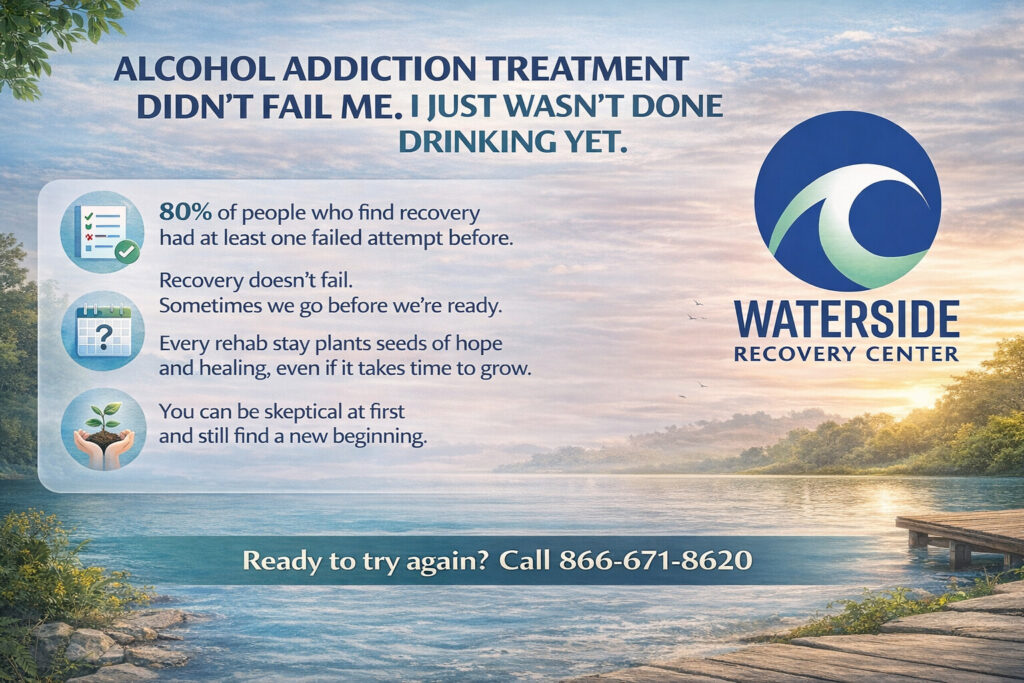
That’s more common than you think. Many people need multiple attempts before recovery “sticks.” It’s not about failure—it’s about timing, readiness, and finding the right fit.
Do I have to hit rock bottom before going to treatment?
No. You don’t have to lose everything to ask for help. If drinking is making your life harder—even in subtle ways—that’s reason enough.
How do I know if treatment is the right choice for me?
If you’ve tried cutting back and couldn’t… if drinking feels more like a need than a choice… if you feel stuck… that’s a sign it might be time to explore treatment.
What makes Waterside Recovery different?
Waterside Recovery offers personalized care that respects your starting point. Whether you’re coming in skeptical, scared, or somewhere in between—they meet you there. No judgment. Just help.
Is there support for people who’ve relapsed?
Absolutely. Relapse is part of many people’s recovery journey. At Waterside, you’ll find understanding, support, and a clear path forward—no shame, no lectures.
Ready to try again—your way?
Call (866)671-8620 or visit Waterside’s alcohol addiction treatment page to learn more about their alcohol addiction treatment services in Framingham.