
I remember the exact thought: “I know how this goes. I shouldn’t be here again.”
That was the part that hurt the most. Not just the relapse—but the awareness of it. The fact that I had sat in groups, nodded along, written things down, even helped other people understand what to do…
…and still didn’t do it myself.
If that’s where you are right now—sitting in the gap between what you know and what just happened—I want you to hear this clearly:
You didn’t waste your time in recovery.
You’re not back at zero.
And you didn’t fail in the way you think you did.
You hit something real. Something the tools alone couldn’t carry you through.
At some point, I had to stop pretending I could think my way out of it—and start looking at what kind of support actually works in real life, not just in theory. That’s where revisiting alcohol addiction treatment started to feel less like going backward—and more like finally getting honest.
I Thought Knowing Better Would Protect Me
There’s this quiet belief a lot of us carry after treatment:
“Now that I understand it, I won’t go back.”
It sounds logical. It even feels reassuring.
But addiction doesn’t operate on logic alone. It doesn’t check whether you’ve completed a workbook or memorized coping skills. It shows up in the moments where you’re tired, overwhelmed, lonely, or just done holding it together.
I knew what HALT meant. I knew to pause, to call someone, to redirect.
But knowing and doing are two very different things when your mind is already halfway out the door.
The truth is, I didn’t relapse because I forgot the tools.
I relapsed because I didn’t fully understand when I needed them—or how quickly things could shift.
It Was Building Long Before I Picked Up
I told myself it came out of nowhere.
But it didn’t.
Looking back, there was a slow drift:
- I stopped being as honest in conversations
- I skipped meetings or check-ins because I felt “fine”
- I started isolating, even if it didn’t look obvious from the outside
- I minimized stress instead of dealing with it
- I let routines slide—the ones that were actually keeping me steady
Nothing dramatic. Nothing alarming on its own.
But together? It created just enough distance for relapse to feel like an option again.
That’s the part no one really prepares you for—the quiet unraveling.
The Moment Didn’t Feel Like a Big Decision
People think relapse is this dramatic turning point.
For me, it wasn’t.
It was a series of small permissions:
“Just tonight.”
“I’ve been doing well.”
“I can handle it this time.”
And underneath all of it was something I didn’t want to admit:
I was tired of trying so hard.
That’s the part I wish I had taken more seriously. Not the craving—but the exhaustion. The emotional fatigue that made the idea of “just checking out” feel like relief.
Because relapse didn’t feel like chaos in that moment.
It felt like rest.
Shame Is What Kept Me Stuck
The drinking wasn’t what kept me out.
It was the aftermath.
That voice that said:
“You already blew it.”
“They’re not going to take you seriously.”
“You should’ve gotten it by now.”
Shame has a way of making you believe you’ve lost your place—that you’re somehow outside of help now.
And the longer I listened to that voice, the harder it became to reach back out.
If you’re there right now, hear this:
You are not disqualified from recovery because you relapsed.
You’re in one of the most common—and most treatable—parts of it.
The Second Time Forced Me to Get Honest
The first time, I wanted to do it “right.”
The second time, I just wanted it to work.
That shift changed everything.
I stopped pretending certain things didn’t affect me.
I admitted where I was still struggling.
I became more open to structure—even when I didn’t like it.
And treatment felt different.
Not because the tools changed—but because I did.
This time, it wasn’t about collecting information. It was about applying it in real situations, with real support around me.
That might look like structured daytime care to rebuild consistency. Or multi-day weekly support that keeps you connected while still living your life.
Either way, it’s not a repeat.
It’s an adjustment.
The “Practical Stuff” Almost Stopped Me From Going Back
I won’t pretend this part didn’t matter.
I sat there thinking:
“Can I afford this?”
“Is this even covered?”
“How complicated is this going to be?”
Questions about things like insurance for alcohol rehab MA felt overwhelming enough to delay me.
But here’s what I learned:
Most of those questions get answered faster than you expect—especially when you stop trying to figure it all out on your own.
You don’t need to have it all sorted before reaching out.
You just need to be willing to ask.
You’re Not Starting Over—You’re Starting Informed
This is the part I resisted the most.
I didn’t want to “start over.” I didn’t want to be back in the same place.
But I wasn’t.
Because this time:
- I knew what my warning signs looked like
- I understood what I tend to avoid
- I had real experience—not just theory
- I could see how quickly things can shift if I disconnect
That’s not starting over.
That’s starting with insight.
And insight, when you actually use it, is powerful.
You Can Come Back Without Explaining Everything
There’s this fear that you need a perfect explanation before you return.
You don’t.
You don’t need a speech.
You don’t need to justify what happened.
You just need to show up.
There are places that understand this cycle—places that don’t expect perfection, just honesty. If you’re not sure where to begin, exploring treatment options in areas we serve can be a simple first step.
Not a commitment. Just movement.
If You’re Sitting in That Quiet “Now What?” Moment
I know that space.
It’s not loud. It’s not dramatic.
It’s just… heavy.
You’re replaying everything. Questioning yourself. Wondering if you’ve got another try in you.
You do.
Not because you’re suddenly going to get everything right.
But because you’ve already learned something most people avoid:
You’ve seen what happens when you try to do it alone.
And that awareness? That’s where real change starts.
FAQ: What People Don’t Always Say Out Loud After Relapse
Why didn’t I use the tools I learned?
Because tools require timing, emotional readiness, and support—not just knowledge. In high-stress moments, your brain defaults to what feels immediate, not what you’ve learned intellectually.
Does relapse mean treatment didn’t work?
No. It usually means something important wasn’t fully addressed or supported long enough. Many people need multiple attempts to find what truly sticks.
How soon should I go back to treatment?
Sooner than you feel ready. Waiting often allows shame and patterns to deepen. Even starting a conversation early can shift your direction.
What if I feel embarrassed to come back?
That’s normal—and it’s also one of the biggest barriers to getting help again. Most providers expect relapse and are prepared to meet you without judgment.
Is it really worth trying again?
Yes. Especially now that you have experience. The second (or third) attempt is often where recovery becomes more realistic and sustainable.
What if I can’t figure out the financial side?
You don’t have to figure it out alone. Questions about coverage, including things like insurance for alcohol rehab MA, are common—and there are people who can walk you through it step by step.
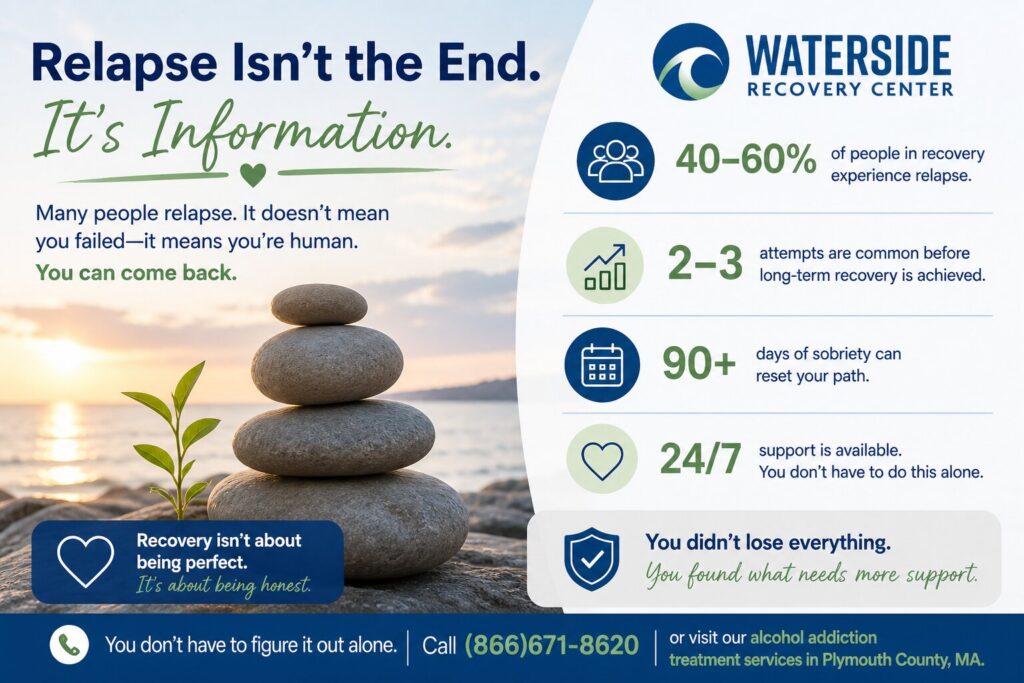
You Didn’t Lose Everything—You Found What Needs More Support
That’s the reframe I had to learn.
Relapse didn’t erase my progress.
It showed me exactly where I needed more help.
And once I stopped fighting that… things started to change.
Not all at once. Not perfectly.
But honestly.
If you’re ready to take that next step—or even just talk it through—call (866)671-8620 or visit our alcohol addiction treatment services in Plymouth County, MA to learn more about our treatment, alcohol addiction treatment services in Bristol County, MA.