
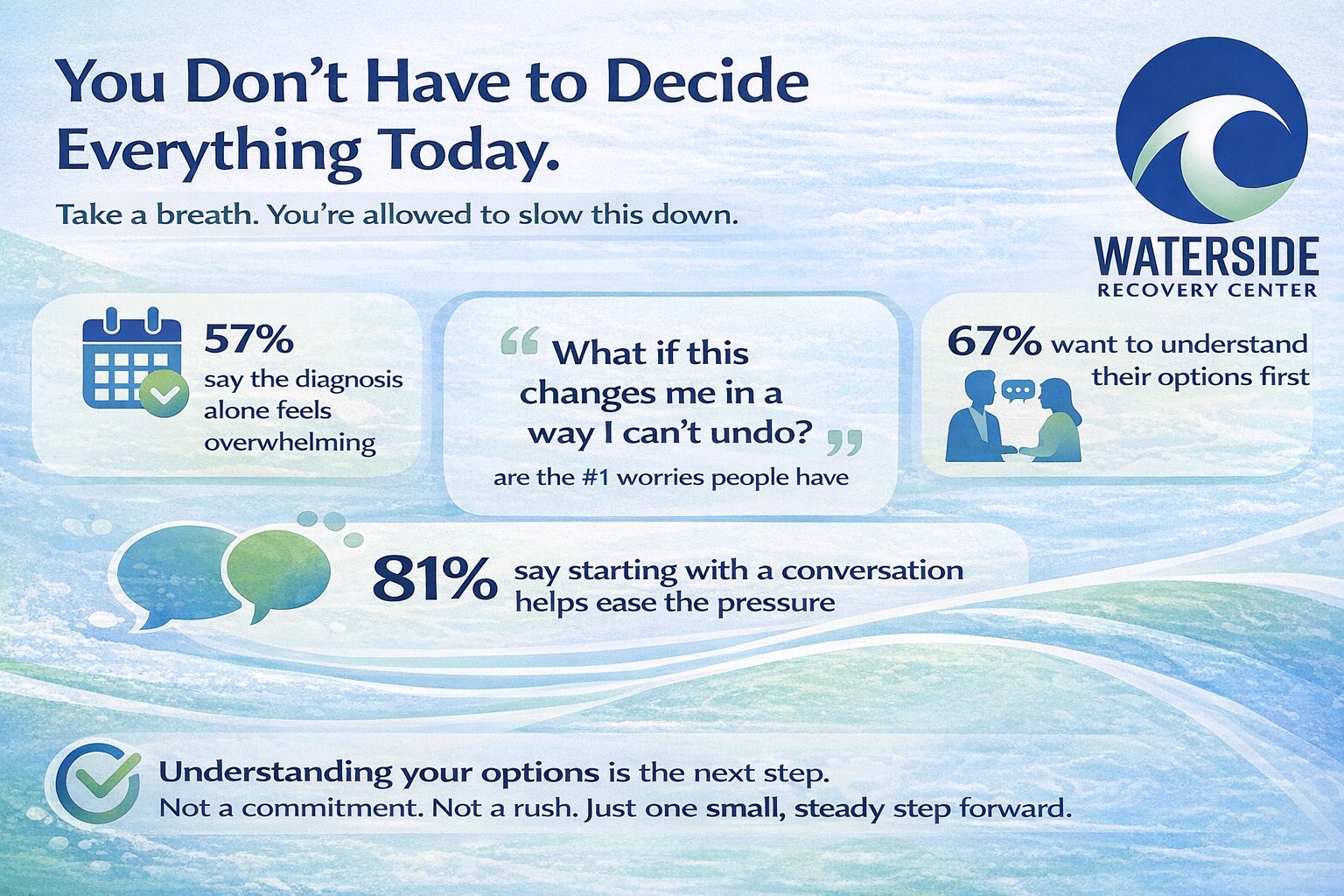
You don’t have to decide everything today.
Not about medication. Not about treatment. Not about who you’re going to become.
For a lot of people, the moment after a diagnosis doesn’t feel like clarity.
It feels like pressure.
Pressure to choose.
Pressure to act.
Pressure to “fix it” quickly.
And underneath all of that, there’s usually one quiet fear:
What if this changes me in a way I can’t undo?
If that’s where you are right now, take a breath.
You’re allowed to slow this down.
And if you’ve already started looking into something like drug treatment services, that doesn’t mean you’ve committed to anything—it just means you’re willing to understand your options.
That’s where real change begins.
The Fear Behind the Fear
People often say they’re scared of medication.
But when you sit with that fear a little longer, it’s rarely just about side effects.
It’s about identity.
- What if I feel numb?
- What if I lose my edge?
- What if I don’t recognize myself anymore?
These aren’t small questions.
They come from a place that wants to protect you.
Because whatever you’ve been using—whether it’s substances, patterns, or just pushing through—it’s been doing something for you.
Helping you cope. Helping you get by. Helping you feel something.
Letting go of that, even a little, can feel like stepping into the unknown.
And the unknown is uncomfortable.
You Don’t Have to Agree to Everything at Once
There’s a common misconception that once you enter treatment, you lose control over your choices.
That things start moving quickly and you just have to go along with it.
That’s not how good care works.
You can say:
- “I’m not ready for medication yet.”
- “I want to understand my options first.”
- “I need to move slower than this.”
And still be supported.
Treatment isn’t about taking control away from you.
It’s about giving you more of it—through clarity, support, and options.
Treatment Is More Than One Path
Medication is one option.
But it’s not the only one.
There are other ways to start building stability:
- Talking through what’s actually going on beneath the surface
- Understanding how your thoughts, emotions, and behaviors connect
- Learning ways to regulate stress and anxiety without relying on substances
- Building routines that support you instead of draining you
For many people, this is where things begin to shift.
Not because everything is suddenly fixed—but because it finally starts to make sense.
You Can Get Help Without Pressing Pause on Your Life
This matters more than people expect.
A lot of fear around treatment comes from the idea that you’ll have to step away from everything.
Your job. Your responsibilities. Your routine.
But that’s not always the case.
There are flexible options—like outpatient rehab Massachusetts—that allow you to receive consistent support while still living your life.
You don’t have to disappear to get better.
In fact, staying connected to your life while learning new ways to navigate it can make the process feel more real—and more sustainable.
The Part No One Talks About: Ambivalence
You can want help… and still feel unsure.
You can be curious about change… and still not feel ready.
You can see that something isn’t working… and still hesitate to do anything about it.
That in-between space? It’s normal.
It doesn’t mean you’re resistant.
It means you’re thinking.
And thinking is part of the process.
What Actually Changes (And What Doesn’t)
Let’s say this clearly, because it matters.
You don’t lose yourself in treatment.
You might lose:
- The constant tension of holding everything in
- The cycle of using something just to get through the day
- The exhaustion of managing everything on your own
But the parts of you you’re worried about?
Your personality. Your creativity. Your emotional depth.
Those don’t disappear.
If anything, they become easier to access—because they’re no longer competing with chaos.
You’re Allowed to Move at Your Own Pace
There is no timeline you have to follow.
No deadline for figuring it all out.
You don’t need to say yes today.
You don’t need to have a perfect plan.
You can:
- Ask questions
- Have conversations
- Explore options
- Take one small step at a time
That’s still progress.
Support Doesn’t Have to Feel Cold or Clinical
If part of your hesitation comes from how “treatment” sounds—structured, clinical, impersonal—you’re not alone.
But support doesn’t have to feel that way.
There are help in areas we serve that focus on real human connection.
Conversations that feel natural.
Support that feels personal.
Care that sees you as more than a diagnosis.
You don’t have to fit into a system.
The right support meets you where you are.
What It Might Feel Like to Start
Starting doesn’t feel like a dramatic transformation.
It often feels quieter than that.
Like:
- Saying something out loud for the first time
- Realizing you’re not the only one who feels this way
- Understanding your patterns without judging them
- Feeling a small sense of relief where there used to be pressure
These moments don’t look big.
But they matter.
Because they build something steady underneath you.
You Don’t Have to Decide Everything—Just the Next Step
If you take anything from this, let it be this:
You don’t have to figure out your entire future today.
You don’t have to commit to medication.
You don’t have to commit to a long-term plan.
You just have to decide if you’re open to the next step.
A conversation.
A question.
A little more information.
That’s enough.
Frequently Asked Questions
Do I have to take medication if I start treatment?
No. Medication is always a choice—not a requirement. Many people start by exploring therapy, support groups, or structured care without medication. You can decide what feels right for you, at your own pace.
What if I’m scared medication will change my personality?
This is one of the most common fears. The goal of treatment isn’t to change who you are—it’s to help reduce the things that are making it harder to be yourself, like anxiety, overwhelm, or emotional instability.
If medication is ever considered, it should feel collaborative and adjustable—not permanent or forced.
Can I work while getting help?
In many cases, yes. Flexible options like outpatient care are designed to fit around your life so you can continue working or managing responsibilities while still getting consistent support.
What if I’m not sure I “need” treatment?
You don’t need to reach a certain level of struggle to deserve help. If something feels off, or if you’re tired of doing things the same way, that’s enough reason to explore support.
What happens if I start and change my mind?
You’re allowed to adjust.
Treatment is not a one-size-fits-all path. If something doesn’t feel right, it can be modified. You’re part of the process—not just along for the ride.
You don’t have to rush this.
You don’t have to force clarity.
You just have to stay open long enough to see what’s possible.
Call (866)671-8620 or visit our drug treatment services in Plymouth County, MA to learn more about our treatment, drug treatment services in Plymouth County, MA.