
If alcohol has been part of how you connect, express yourself, loosen up, or even create—stepping away from it can feel like more than just a health decision. It can feel like the end of who you are.
This fear doesn’t come from nowhere. And if you’ve ever wondered, “What if I’m just not me without it?”—you’re not overreacting. You’re naming something real.
At Waterside Recovery, we’ve worked with clients who’ve made music, built businesses, headlined events, and filled rooms with charisma—but who secretly feared that sobriety would strip them of their spark.
They didn’t just fear discomfort. They feared erasure.
Here’s what we’ve learned: the most personal parts of you—your voice, your creativity, your warmth—don’t disappear when alcohol does.
They come into clearer focus.
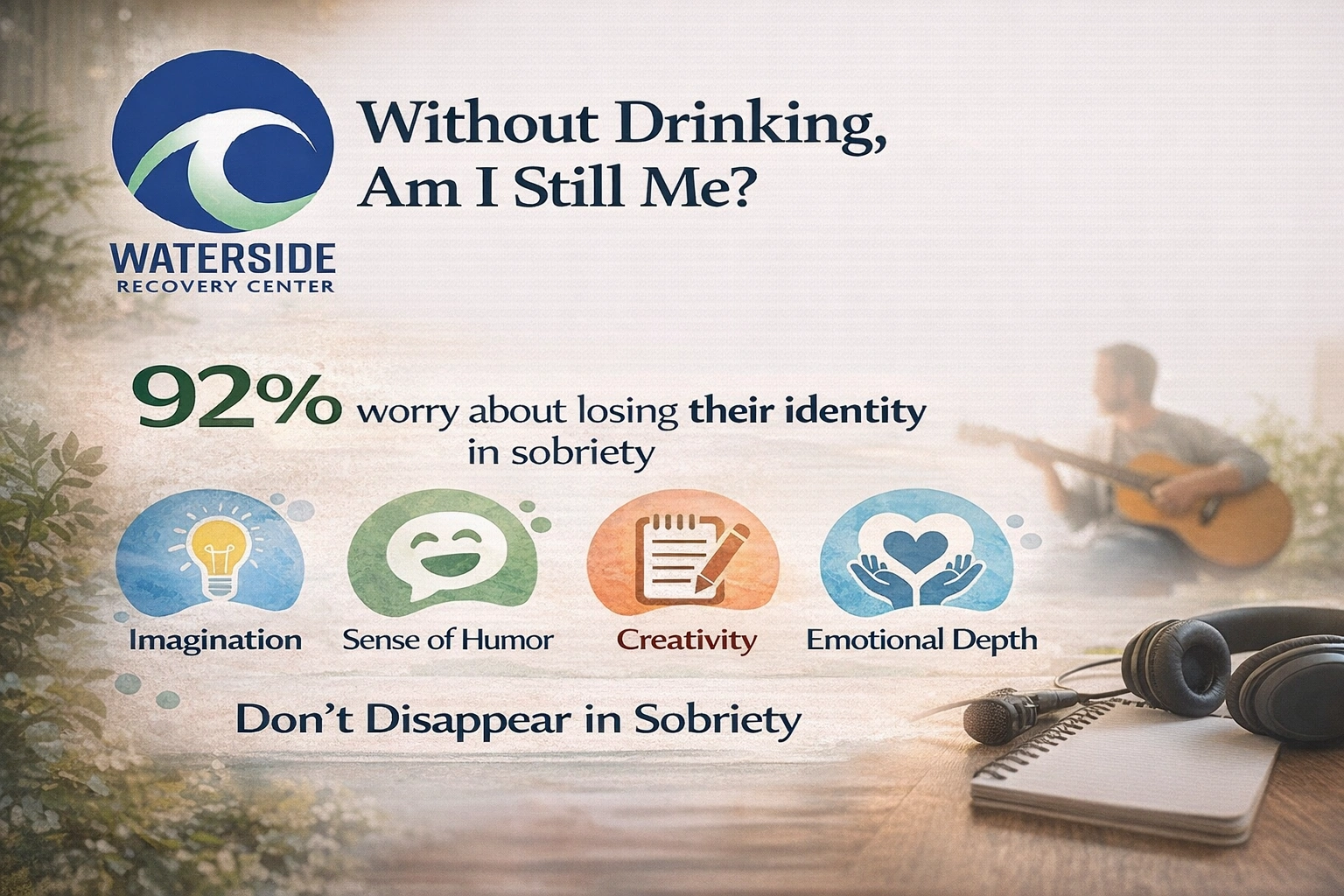
“Without Drinking, Am I Still Me?”
Alcohol doesn’t just sit on the surface of life. It gets woven into rituals, habits, identities.
For some people, drinking became part of how they felt confident at parties, how they wrote without inhibition, how they opened up emotionally, how they coped quietly when the world got loud.
And when something becomes that woven in—it can start to feel like a personality trait.
So the thought of giving it up brings on a rush of unspoken fears:
- What if I lose my edge?
- What if my work suffers?
- What if people stop finding me interesting?
- What if I feel flat and colorless without it?
These fears aren’t denial. They’re self-protection. And we honor them, not override them.
Alcohol Didn’t Make You Interesting—It Just Made You Feel Less Afraid
One of the hardest truths we help people unpack is this: alcohol didn’t invent your brilliance. Or your depth. Or your voice.
What it might have done is make it feel safer to show.
That’s a huge distinction.
We hear this often from creatives in MetroWest, Massachusetts, who have spent years believing that their spark only shows up with a drink nearby. But the spark was always there. What they were missing was the trust to let it shine unfiltered.
Sobriety doesn’t remove what makes you compelling. It removes the thing that made you think you needed something else to access it.
Early Sobriety Can Feel Awkward—But That’s Not the End of the Story
Let’s be honest about this: the beginning can be weird.
You might feel quieter. More self-aware. Less animated in conversations. Maybe you’ll even wonder if you’re becoming boring.
That’s not the truth. That’s the detox.
In those early weeks, you’re not dull—you’re recalibrating.
You’re learning how to move through the world without the volume cranked up. And like adjusting to light after leaving a dark room, that can take time.
We’ve walked through this exact stage with people in Plymouth County, Massachusetts, where alcohol had become a social default. Watching someone re-learn how to laugh, flirt, joke, or create—without needing to drink first—is one of the most powerful transformations we get to witness.
What You Keep in Recovery Might Surprise You
Here’s what doesn’t go away when you stop drinking:
- Your imagination
- Your sense of humor
- Your instincts
- Your emotional depth
- Your way with words
- Your ideas
- Your weirdness (in the best way)
- Your sensitivity
- Your strength
If anything, recovery often gives these things more room to grow.
Some of our clients from Bristol County, Massachusetts have told us, months after starting treatment, that they felt more creatively alive than they had in years—not because everything was easier, but because everything was realer.
You Can Still Be Social, Funny, Creative—Just Without the Cost
Let’s talk about what alcohol actually does over time, even when it seems like it’s helping:
- It shortens your attention span
- It messes with memory and emotional regulation
- It fragments follow-through
- It heightens anxiety the day after
- It disconnects you from authentic emotional cues
So yes, it might help you feel uninhibited in the moment. But it often leaves you feeling more disconnected from yourself in the long run.
Sobriety can feel quieter at first. But that quiet is not emptiness—it’s space.
It’s space to be intentional. Space to feel your emotions without confusion. Space to speak when you actually want to—not just because your guard is down.
There’s No “One Version” of Recovery
You don’t have to become someone who loves yoga. You don’t have to wear linen pants and drink green smoothies. You don’t have to change your entire identity to get better.
At Waterside, we offer different types of support—including live-in care, structured daytime treatment, and multi-day weekly care—so people can find a pace that matches their real life.
We never tell clients who to become. We help them protect what matters most about who they already are.
Recovery isn’t a uniform. It’s a return.
What If I Try Sobriety and Hate It?
Another honest fear. And a fair one.
Because what if you make all these changes and it doesn’t feel better?
Here’s what we say: you don’t have to love every moment of sobriety. You just have to be open to seeing what’s underneath the habit.
Not all days will feel easier. Some may feel raw. But that rawness is information. It’s clarity.
And the only way to know whether alcohol is enhancing or distorting your life—is to give yourself a chance to see the difference.
We’ll help you do that without pressure, shame, or rigid expectations.
You Don’t Have to Decide Everything Today
Top-of-funnel means this might be your first time even entertaining this conversation. So let’s make it simple:
You don’t have to want long-term sobriety. You don’t have to be sure.
You just have to be curious.
- Curious about what life might feel like without drinking.
- Curious about whether your creativity could grow, not shrink.
- Curious about whether your relationships would feel more grounded.
- Curious about whether your anxiety might actually go down.
That’s all you need to start.
FAQs: Identity, Expression, and Sobriety
Will I lose my personality?
Not at all. You may feel a little quieter at first, but your core traits remain—and often become more vivid once alcohol is no longer clouding them.
What if drinking is part of my social or creative life?
That’s real. You’ll explore new ways to connect or create that feel more sustainable and more aligned with who you really are—not just who alcohol allows you to perform as.
Does Waterside offer flexible treatment options?
Yes. We provide options that range from full-day live-in support to weekly programming that works around your job or creative practice. We’re here to adapt—not to control.
What if I don’t think I’m “that bad”?
You don’t have to hit rock bottom to get help. Many of our clients were high-functioning, successful, and outwardly fine. But inwardly, something didn’t feel right. That’s reason enough.
I’m not sure I want to give up alcohol forever. Can I still get support?
Absolutely. We meet people where they are. If you’re exploring moderation, sober curiosity, or just want to understand your relationship with alcohol more clearly, you’re welcome here.
You’re Not Giving Yourself Up—You’re Getting Yourself Back
The parts of you you’re afraid to lose? They were never alcohol’s to own.
You created. You connected. You felt things deeply. You made people laugh. You lit up rooms.
You did that.
And you’ll still do it—maybe more powerfully, more honestly, and more sustainably—when you’re not borrowing your spark from something that costs you so much to maintain.
Ready to protect the real you?
Call 866-671-8620 or visit our alcohol addiction treatment in Plymouth Massachusetts to learn more. We’ll meet you right where you are—with support that honors your identity, not rewrites it.